
As well opening a window onto the wider universe like nothing had before – it discovered supermassive black holes at the centres of galaxies, the moons of Pluto, the age of the Universe itself, and led to the publication of more than 20,000 scientific papers, the Hubble Space Telescope also played a critical role in the evolution of what was to come next: the James Webb Space Telescope. As a successor, James Webb was designed to build upon Hubble’s legacy, specifically targeting the infrared spectrum to enable it to peer through the dusty haze obscuring the deeper, older realms of the Universe. As she explains to Chris Smith, Princeton University astrophysicist Jenny Greene suspects that the “little red dots” she can see with the James Webb in some of the oldest parts of the Universe are the forerunners of todays supermassive black holes that sit at the centres of today’s galaxies…
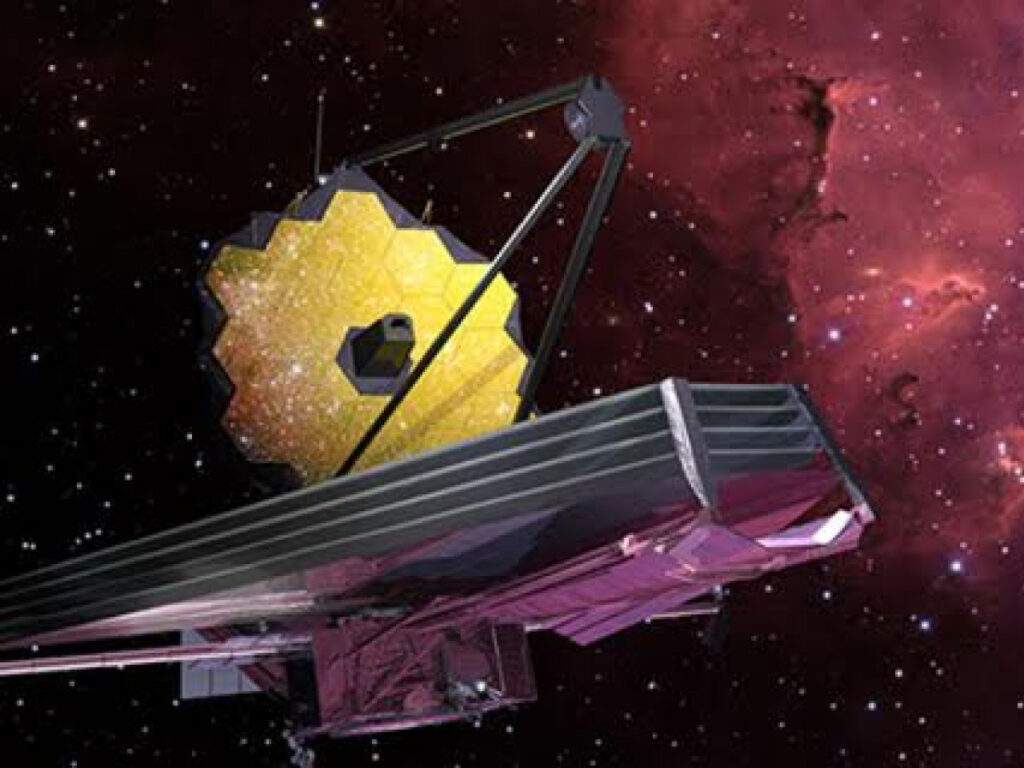
Jenny – It’s a six metre telescope that’s about three times wider than Hubble and it’s gold-plated and it has been optimised to see in the infrared. And the reason is that because the universe is expanding, as the light from the first galaxies and stars travel through the universe towards us, that light is stretched out. And so by the time it reaches the James Webb Space Telescope, it’s in the infrared. So if we want to see the very first stars and galaxies as they were forming, we need a telescope like James Webb.
Chris – Does the infrared offer us other advantages in the sense that because that’s longer wavelengths, it can see through things that visible light might be scattered or blocked by? I’m thinking gas and dust clouds that might obscure objects.
Jenny – That’s right. So even nearby clouds of gas and dust that are actively forming stars, what we might see with Hubble is basically the dust, but we can peer right through that and see the forming stars directly with James Webb. So the two actually work beautifully together. Another context for the power of James Webb would be studying the gas around extrasolar planets. So planets that are orbiting stars other than our sun. And we’ve been able to quite a lot about what those planets are made of and what’s in their atmospheres and whether they might harbour life because of James Webb.
Chris – How does it actually do that? What’s the physics behind being able to tell what the gases are in the atmosphere for a remote world?
Jenny – Basically, going into the infrared helps you because that’s where the star makes the least light. And so you boost the amount of light coming from the planet versus the star. And roughly speaking, the way that people do this is they pick planets that are eclipsing their star. And you can look at the difference in the light that comes from the star and then when the planet is in front of the star. And that allows you to take away the starlight and see only the planet light. And so you can, for instance, see molecules like water molecules that are in the atmosphere of the planet as the light from the star passes through that planet atmosphere.
Chris – What about things we can’t see? And I’m thinking specifically, you work on black holes and they don’t produce anything, which is or not directly from the black hole itself, which is why they’re a black hole. Can the James Webb, though, help to understand the fabric of the black hole and its environs?
Jenny – Yeah, so for sure. One of the reasons I became an astronomer in the first place is that even though you have these black holes, which are objects that are so dense that not even light can escape their gravitational pull, somehow as astronomers, we’ve been able to figure out that there are black holes in the universe and we can study them with light. And one of the key ways that we study the black hole is by looking at the light from the gas that’s falling into the black hole as it falls in. That gives us a lot of information. And the big promise with James Webb specifically was, in fact, to see the baby black holes as they’re forming, the ones that ultimately become supermassive black holes. Like we have a million sun black hole in the center of our own galaxy, but it didn’t start that way. It probably started much smaller. And the James Webb is sensitive enough that we should be able to take baby pictures of these black holes.
Chris – Has anyone seen any yet?
Jenny – We think that these little red dots that we’ve been talking about, there’s actually quite a bit of controversy in the community right now about how big those black holes are. But I belong to the camp that these are indeed what we call intermediate mass black holes. So maybe a thousand, ten thousand suns. There are a bunch of reasons we think so. So the light that we see from these little red dots look different from the light that we’ve seen from any other growing black holes in ways that make us think that a tremendous amount of material is falling onto this black hole right now, which is causing us to see a different kind of spectrum. The light looks different. And we see so many of them that that makes us think that they’re probably little black holes and little galaxies. And they’re just popping off all the time as they’re just starting to really get going in their growth.
Chris – If they’re black holes, why do you call them little red dots and where are they?
Jenny – So anywhere you look in the sky with James Webb, you’ll see with one picture, like four or five of these, they’re all radiating, growing within the first billion years since the Big Bang. So this is very early universe. Another reason we think they’re likely to be, you know, either babies or adolescent black holes. We call them little red dots because that’s what they look like. They are very red, which means most of their light comes out in optical wavelengths that we see with our eye. And, you know, at these cosmological distances, that makes them look red in the pictures. We call them little because they’re barely resolved with James Webb. James Webb has very crisp vision. And even with James Webb, they look basically the same as stars. So all of this light that they’re making is in a very small region.
Chris – If they are black holes in the primitive universe, what are the implications of that?
Jenny – Well, like I said, we have all of these hints now that they are basically the smallest growing black holes that we’ve been able to see at early times. And if that’s true, we can start asking questions about, well, what’s important for these black holes to grow? Like we typically see little blue friends next to the little red dots. So maybe it’s important that there’s a couple galaxies merging together when the little red dot is growing. How much metals have been formed already? Do you need really pristine gas to make one of these baby black holes? That’s the kind of thing we can start to learn now.
Chris – Are there not lots of black holes still being made somewhere in the universe, though? Because if you’re looking back and you’re seeing this to, what, 12, 13 billion years ago, and that’s happening, what’s happening now in the modern era? Is this still happening? Or was that one special period in the universe’s history when red dots, black holes were forming, but they’re not now?
Jenny – Most of the pictures that we have for how to grow supermassive black holes rely on very early universe conditions. Because the universe is expanding, it means that early times the universe was much denser. And so you can have these very extreme growth events. You also have much more, as you said, primitive or pristine gas, which allows you to make black holes actually much more rapidly at early times.
Chris – Does this mean then this sort of black hole species is an endangered species, as in the conditions were only right once, it was like Goldilocks and the porridge, and the universe has now changed in such a way that this won’t happen again?
Jenny – Well, we have looked for little red dots in the nearby universe. And people looked over about a quarter of the sky in the present day universe and found three. So in the first billion years, in every little tiny James Webb field, we see three or four of them. Today, total in basically the whole universe, we see three. So they’ve become extremely, extremely rare. So yes, it does seem that they are a Goldilocks phenomenon that only can happen at early times.
Chris – And how are you going to prove what you think they are?
Jenny – The dream is to really understand what the black hole mass is. And it’s not clear that we can do that with James Webb alone. I don’t think in this podcast, you’re talking about extremely large telescopes, but in the next decade, we will be getting those as well. And so there’s some dream that we can use those to peer all the way into the heart of the little red dots and get their black hole mass.