
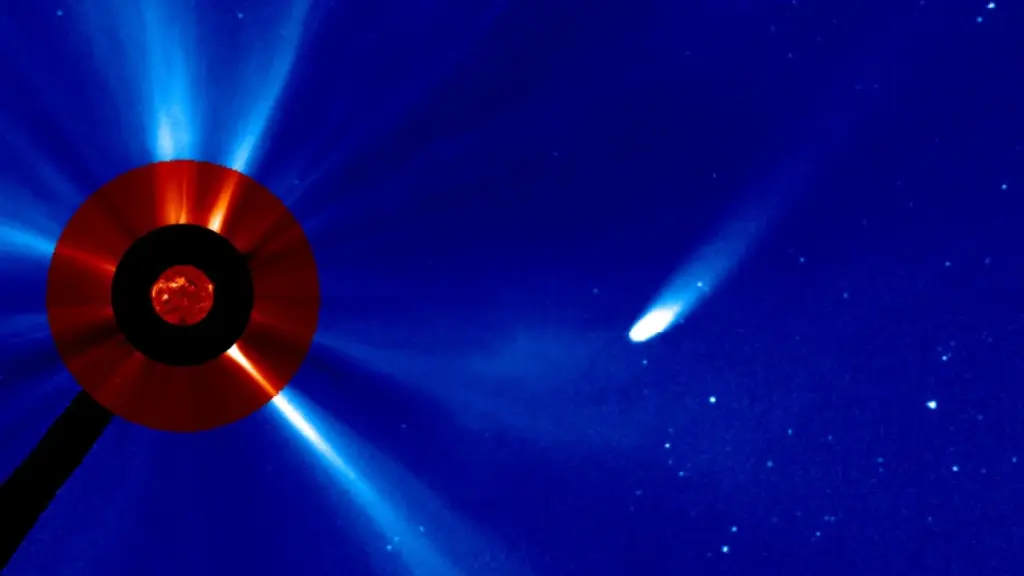
SOHO coronagraph imagery captured a distinct change in the ion tail of comet C/2025 R3 (PANSTARRS) during its April 2026 perihelion passage, with the tail brightening and aligning away from the Sun. The observation occurred as the comet approached within approximately 72 million km (45 million miles) of Earth.
Comet C/2025 R3 passed perihelion at 00:00 UTC on April 19, entering a region of intensified solar radiation and solar wind interaction. Coronagraph imagery from the SOHO spacecraft documented a directional adjustment in the comet’s ion tail during this phase, with the plasma stream aligning anti-sunward.
The ion tail formed as gas released from the comet’s nucleus became ionized and entrained by the solar wind and interplanetary magnetic field. As activity increased near the Sun, the ionized material extended into a narrow tail directed opposite the Sun, while the comet continued along its orbital path.
SOHO’s LASCO C3 coronagraph tracked the comet within its field of view from 13:18 UTC on April 23 to 19:17 UTC on April 26. The instrument blocks direct sunlight to image the solar corona, allowing continuous observation of objects passing close to the Sun and defining the interval during which the tail alignment was recorded.
During that interval, the ion tail maintained a more defined anti-sunward orientation, while the broader dust tail, composed of larger particles influenced primarily by solar radiation pressure, followed a curved trajectory offset from the plasma tail.
The comet approached Earth to within approximately 72 million km (45 million miles) during this period.
C/2025 R3 follows a hyperbolic trajectory consistent with an origin in the outer solar system. Its perihelion passage provided a limited observation window for recording solar-driven processes acting on cometary material under near-Sun viewing geometry.