
Topline
A newly brightening comet is now visible in the predawn sky — and Monday morning offers a great chance to find it, close to a beautiful crescent moon. After 170,000 years in the depths of the solar system, comet C/2025 R3 (Pan-STARRS) is slowly becoming easier to spot as it approaches the sun — but it will disappear from view for most after next weekend. Check my feed for a daily “comet tracker” with sky-charts and tips for viewing comet Pan-STARRS.
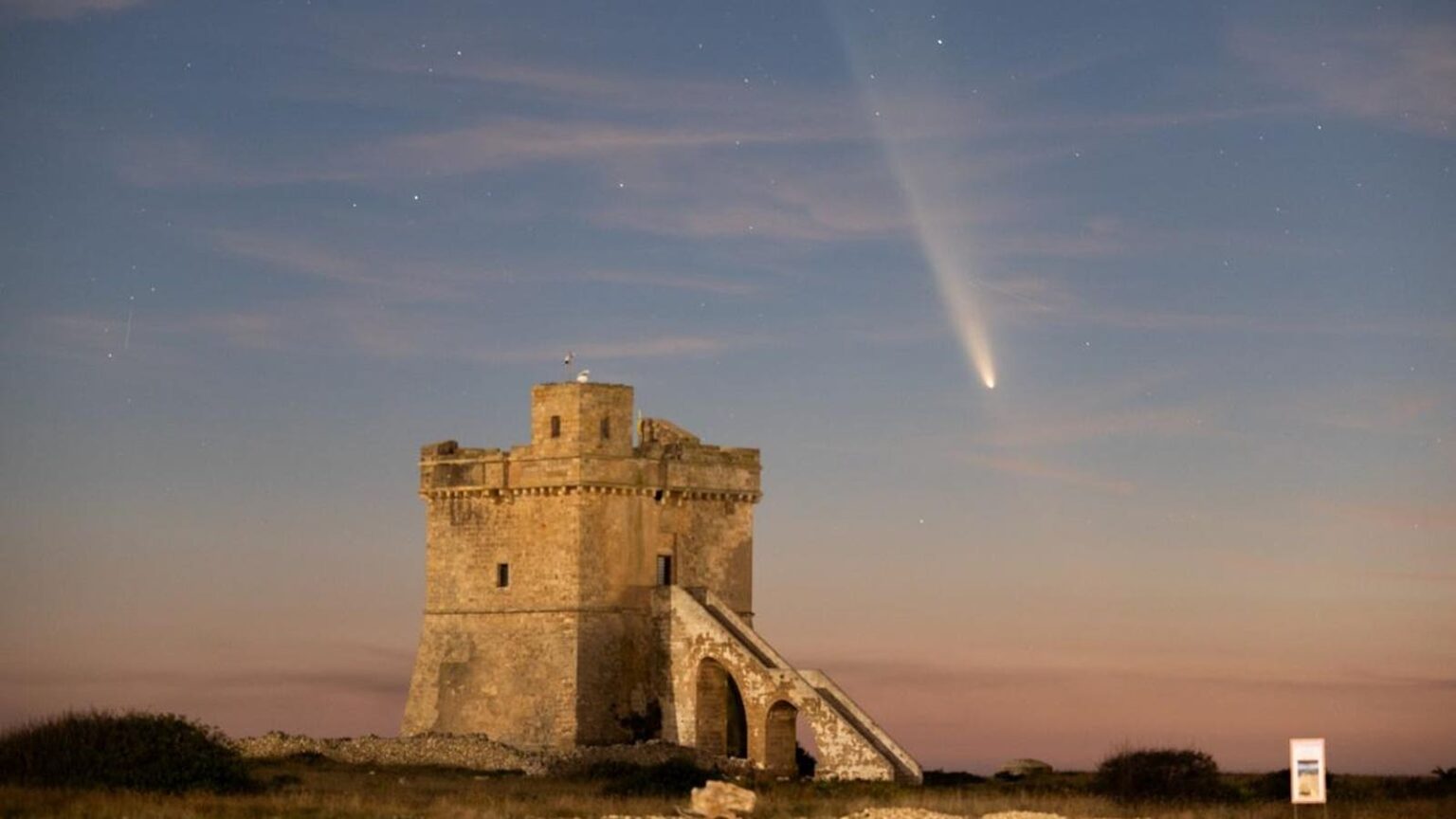
Comet Pan-STARRS, also known as comet C/2025 R3 (Pan-STARRS), is now visible before sunrise. (Image shows 2024’s Comet Tsuchinshan-ATLAS (C/2023 A3)). (Photo by Manuel Romano/NurPhoto via Getty Images)
NurPhoto via Getty ImagesKey Facts
On April 13, the comet sits in Pegasus, just below the Great Square of Pegasus, positioned close to bright star Markab at the square’s lower-right corner, in the eastern sky before dawn.
Comet C/2025 R3 (Pan-STARRS) is visible from about 90 minutes before dawn until around April 20.
On Monday, April 13, it will appear close to a delicate 19%-lit waning crescent moon, with elusive planet Mercury nearby.
According to the Comet OBServation database, the comet is currently shining at around magnitude +5 — already technically a naked-eye object in very dark skies. However, it will likely require binoculars for most observers until it brightens further later this week.
It was discovered by the Pan-STARRS survey in Hawaii in September 2025 and is thought to orbit the sun roughly every 170,000 years.
The comet will reach perihelion (the closest it will get to the sun) on April 19, passing the sun at a safe distance of about 0.5 AU, meaning it is expected to survive and continue brightening.
It will make its closest approach to Earth on April 27, when it is likely to be at or near its peak brightness, but by then it will be impossible to see from the Northern Hemisphere.
The position of comet C/2025 R3 (Pan-STARRS) is shown 90 minutes before sunrise on Monday, April 13, 2026.
StellariumComet Tracker For Monday, April 13
On April 13, Comet C/2025 R3 (Pan-STARRS) is about 0.82 AU (122 million kilometers) from Earth and 0.53 AU (79 million kilometers) from the sun, steadily brightening as it drops inward toward perihelion later this week. To see the comet in the Great Square of Pegasus, a clear, unobstructed horizon is essential. Sky maps can be viewed and downloaded from The Sky Live and In-The-Sky.com.
How To Find Comet Pan-Starrs
For now, the comet appears as a faint, diffuse glow — easy to miss in twilight, but steadily brightening as it approaches the sun.
Go outside about one hour before sunrise where you are and look low in the eastern sky. The key is to first locate the Great Square of Pegasus rising due east — a large, diamond-shaped pattern of four stars. Look above Markab, one of the square’s four brightest stars, for a small, misty patch of light. A pair of 10×50 binoculars will make it much easier to locate. Comet Pan-Starrs: What To Expect Next
This is the beginning of the comet’s best viewing window, but it’s short. Over the coming days, Pan-STARRS will brighten before sunrise, making it easier to find, but only until around April 20, when it will be lower in the sky, rising too close to sunrise, and lost in the light of dawn.
How To Photograph A Comet
If you’re heading out to find the comet, bring a camera. Set it on a tripod, use night or manual mode, and focus on a bright star. With the comet in sight, take a series of 5-20 second exposures. Try ISO between 800 and 3200 and use the widest aperture available. A single shot could reveal what your eyes cannot, with early images also showing a tail.
The Oort cloud is a theoretical cloud of predominantly icy planetesimals proposed to surround the Sun, it lie beyond the heliosphere and in interstellar space. Kuiper belt and outer solar system planetary orbits. 3d render
gettyWhat Is The Oort Cloud?
Comet Pan-STARRS likely originates from the Oort Cloud, a vast, spherical reservoir of icy objects surrounding the solar system far beyond the planets. If the planets orbit the sun like a flat disk, the Oort Cloud is a sphere enclosing that disk on all sides. It may extend tens of thousands of times farther from the sun than Earth does. Occasionally, gravitational nudges — perhaps from passing stars — send comets inward. As one approaches the sun, heat turns its ice into gas and dust, creating the glowing coma and tail that make comets visible from Earth.
Check my feed for a daily “comet tracker” with sky charts and tips for finding Comet Pan-STARRS.
Further ReadingForbes‘Comet Of The Year’ Vaporized — But Another Will Peak Late AprilBy Jamie CarterForbesHow To Photograph The Green Comets This Weekend, According To ExpertsBy Jamie CarterForbesAstronauts Share Spectacular Earth Images From Halfway To The MoonBy Jamie CarterForbesArtemis Astronauts See Earthrise, Earthset And A Total Solar EclipseBy Jamie CarterForbes11,000 Asteroids Have Just Been Found — 33 Are Near-Earth ObjectsBy Jamie CarterForbesAstronauts Share Spectacular Earth Images From Halfway To The MoonBy Jamie Carter