
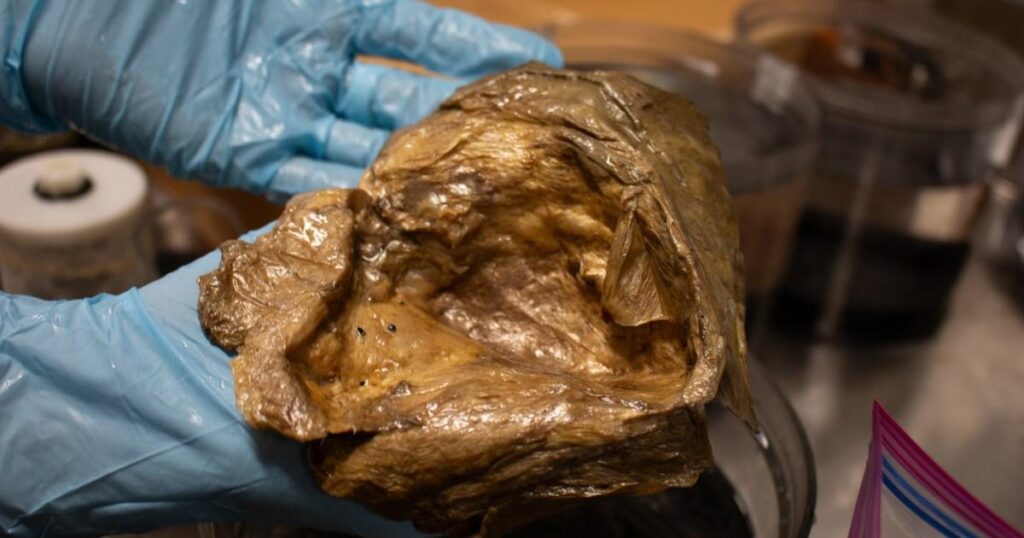
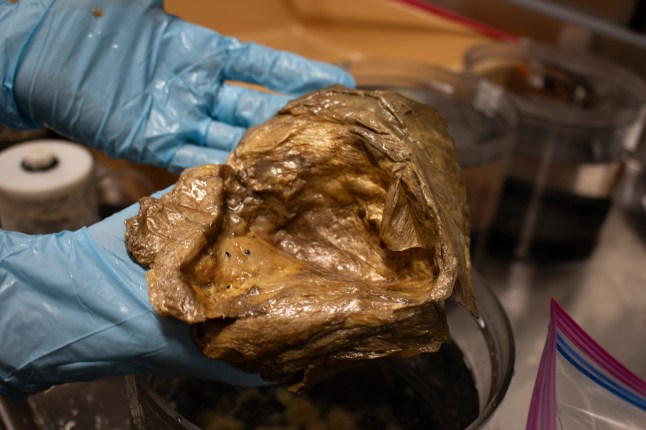
A two-and-a-half-year-old mystery of a ‘golden orb’ has been solved (Picture: NOAA)
An enigmatic golden orb sparked alien fears after being found by explorers during an expedition in the Gulf of Alaska but its origins have now been solved, the U.S. National Oceanic and Atmospheric Administration have said.
Almost three years after remotely operated vehicle Deep Discoverer found the strange entity – measuring a little over four inches (10cm) – scientists have determined that the ‘golden egg’ or ‘golden orb’ is actually a relic of a deep-sea anemone.
Found over two miles (3.25km) underwater, below the Gulf of Alaska, it made sense why the ‘egg’ sparked a lot of speculation; the strange, golden, mound-shaped object had a hole in it and was stuck to a rock.
As with most deep-sea specimens, there was a spooky air surrounding it – with speculation over whether something had crawled in, or found a way out.
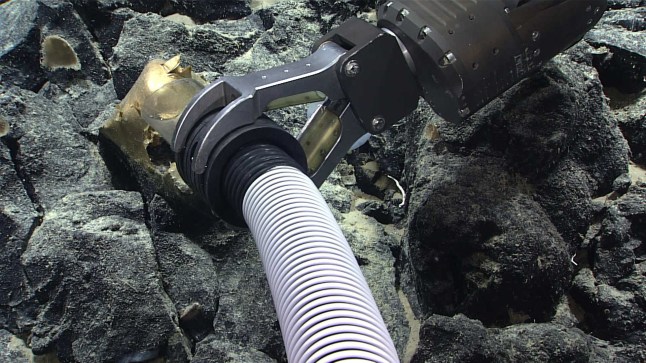
Remotely operated vehicle Deep Discoverer found the strange entity(Picture: NOAA Ocean Exploration)
Hoping to find answers to this puzzling discovery, the at-sea team collected the ‘egg’ using a suction sampler and sent it to the Smithsonian National Museum of Natural History (NMNH) to have a closer look.
While it’s common for scientists to find organisms in the deep ocean that they don’t immediately recognise, this particular mystery took years to be uncovered.
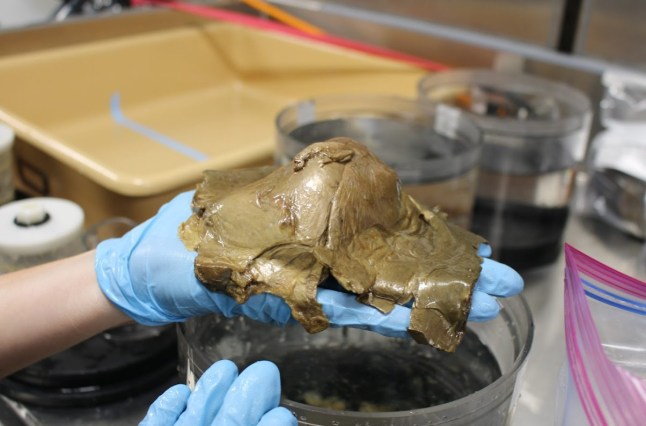
The ‘egg’ was the part of the anemone that attached to the rock substrate (Picture: NOAA Ocean Exploration)
Though the ‘egg’ may have resembled something alien, scientists discovered that the ‘egg’ was actually remnant of the dead cells that formed at the base of a giant deep-sea anemone, Relicanthus daphneae.
The ‘egg’ was the part of the anemone that attached to the rock substrate.
‘We work on hundreds of different samples and I suspected that our routine processes would clarify the mystery,’ explained Allen Collins, Ph.D, zoologist and director of NOAA Fisheries’ National Systematics Laboratory, which is physically located within the Smithsonian National Museum of Natural History, to the National Oceanic and Atmospheric Administration.
‘But this turned into a special case that required focused efforts and expertise of several different individuals.
‘This was a complex mystery that required morphological, genetic, deep-sea and bioinformatics expertise to solve.”
Arrow
MORE: Trump hopes mysterious deaths and vanishings of ten scientists are ‘random’
Arrow
MORE: ‘Aliens are real – what I’ve been told will keep you up at night’
Arrow
MORE: UK government UFO investigator who was ‘just like X-Files character’ dies
Comments
Add Metro as a Preferred Source on Google
Add as preferred source
News Updates
Stay on top of the headlines with daily email updates.