
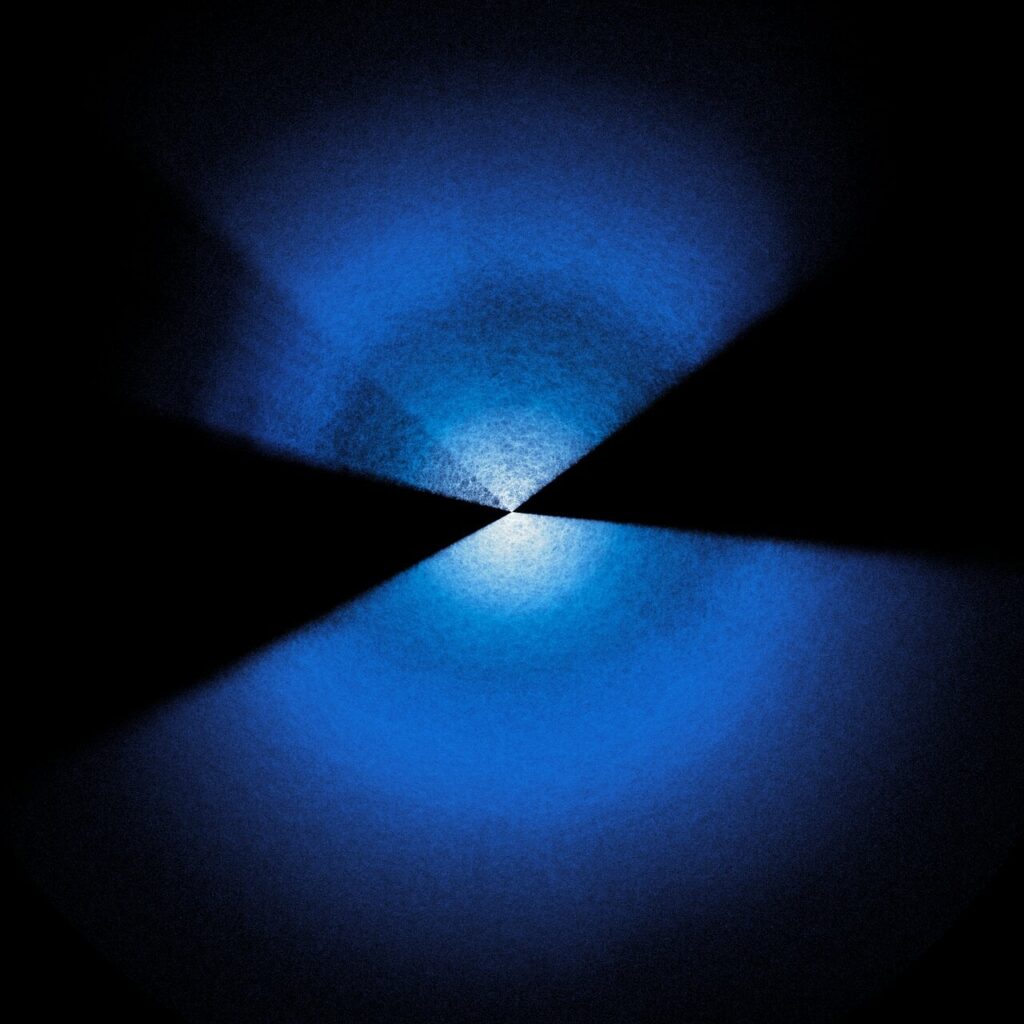
A team of scientists at the University of Virginia is using data from an instrument in Arizona to study cosmic structure and the result is the largest 3D map of the Universe ever created. The Dark Energy Spectroscopic Instrument (DESI) sits on a telescope high above the Sonoran Desert, and is one of the tools of choice to get a handle on the mystery of dark energy by charting the positions of galaxies and other objects.
Dark energy is a not-at-all well-understood part of the Universe that appears to be changing over time. How and why and what it is remains a challenge to scientists to explain. For now, they’re mapping it as best they can using DESI, and will continue to do so using the Rubin Observatory in Chile, the Euclid mission, and the upcoming Nancy Grace Roman Telescope.
The DESI instrument has mapped more than 47 million galaxies as part of its survey, and its work will continue into 2028. According to study leader Satya A Gontcho, the idea is to map the galaxies in order to understand where the dark matter is and how the visible matter in galaxies is distributed along that substructure.
“If you are able, from a picture, to add a third dimension in the form of a very precise distance measurement of where galaxies are, you are effectively creating a 3D map of where galaxies are located compared to each other, from your viewpoint here on Earth,” Gontcho said. “Galaxies are not located at random – they follow a subtle, special pattern. They are located on a substructure made of dark matter in the universe.”
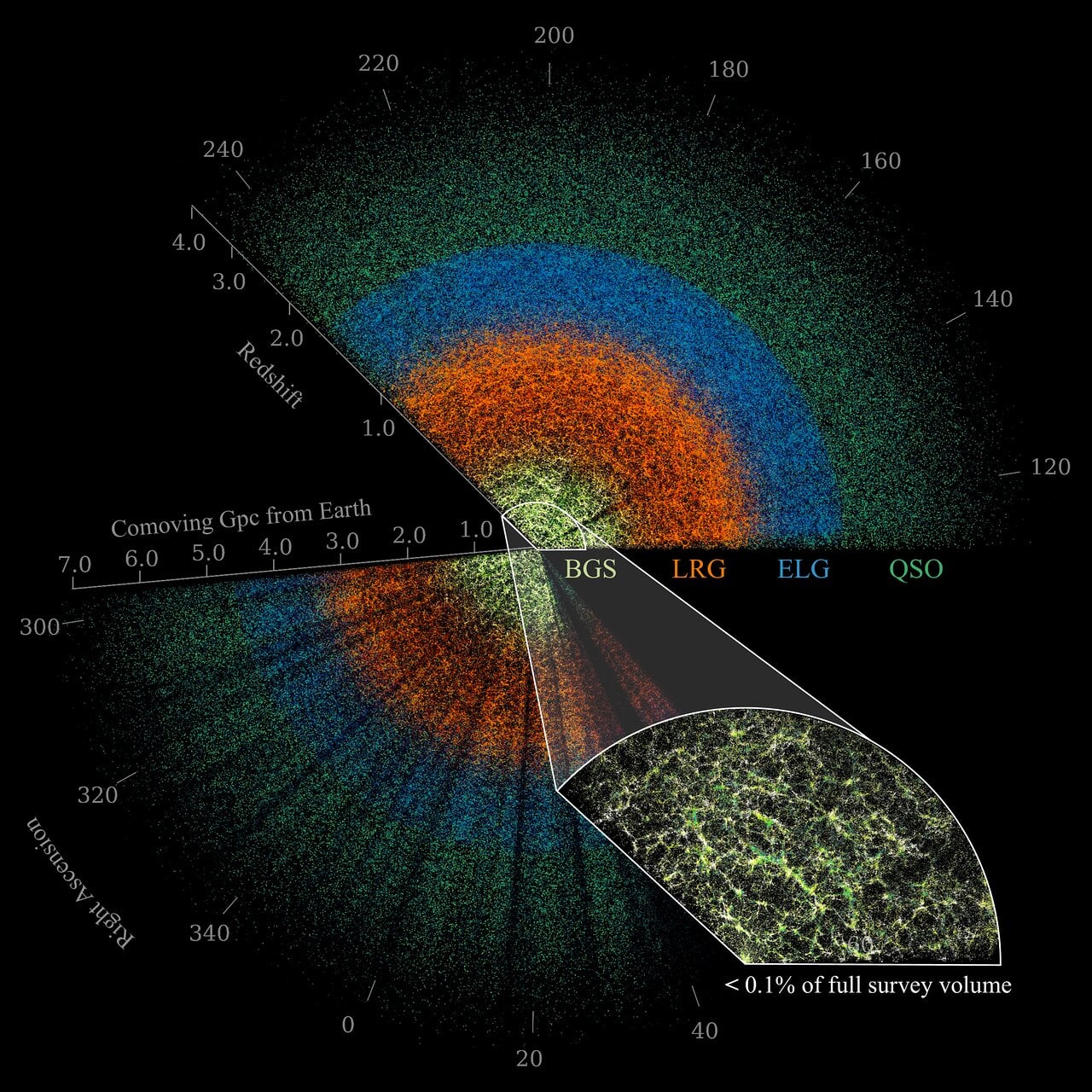 *This slice of the DESI data maps celestial objects from Earth (center) to billions of light-years away. Among the objects are nearby bright galaxies (yellow), luminous red galaxies (orange), emission-line galaxies (blue), and quasars (green). The large-scale structure of the Universe is visible in the inset image, which shows the densest survey region and represents less than 0.1% of the DESI survey’s total volume. DESI is mounted on the U.S. National Science Foundation Nicholas U. Mayall 4-meter Telescope at Kitt Peak National Observatory (KPNO), a Program of NSF NOIRLab. Credit: DESI Collaboration/DOE/KPNO/NOIRLab/NSF/AURA/C. Lamman*
The Role of Dark Energy
The data from DESI basically helps put the locations of galaxies into locational relationship with each other. Their light then traces the underlying structure of the cosmos. Think of them as candles in a dark room filled with dark matter and dark energy. “With these data, we are able to look at this pattern that has been imprinted in every age of the universe, and we see how this pattern has grown between two different moments of the evolution of the Universe,” Gontcho said.
Dark energy provides an important clue to understanding the evolution of the Universe since the first moments of its existence. While scientists don’t understand much about it, they do know that it makes up about 70 percent of cosmic “stuff”. It basically pushes galaxies apart, and seems to speed up the expansion of the Universe. It’s a uniform force, meaning that it exists everywhere. There are various theories about what it is. Some ideas suggest that this “cosmological constant” is a constant energy density that is part of the vacuum of space. If true, then the energy increases as space expands, a sort of spreading cosmic forest fire. Other theories suggest that it could be a form of modified gravity, and others invoke the idea of scalar fields. They would provide a dynamic (changing) energy field that evolves over time. None of these theories have been proven, yet. All scientists know so far is that dark energy acts as an accelerant that pushes galaxies apart, despie dark matter’s role in holding everything together.
Goncho describes dark energy as a sort of “growth hormone.” “It compels the universe to expand faster and faster,” she said. “But that’s the limit of the knowledge that we have. We know what it does, but we do not know what it is. It pushes things away from each other, but it doesn’t emit any light, so we can’t see it. We only know it by the effect that it has on things around it.”
DESI and Dark Energy
Gontcho’s team works continuously to extend the completed DESI survey to fill in the 3D map of the Universe’s hidden structure. “With these data, we are able to look at this pattern that has been imprinted in every age of the Universe, and we see how this pattern has grown between two different moments of the evolution of the universe,” Gontcho A Gontcho said.
The survey has been five years in the making, and its principle work was completed ahead of schedule. The instrument delivered far more data than the organizers expected. That helps fill in the 3D map of the Universe and allows scientists to compare how galaxies were arrayed in the past with their current positions in space in the “modern” Universe. This also lets researchers trace dark energy’s influence over 11 billion years of cosmic history.
This first full set of data gives researchers enough data to test an important characteristic of dark energy: whether and how it evolves over time. Understanding the hints from the DESI data about dark energy’s actions over time would mark a major shift in how we think about our Universe and its potential fate, which hinges on the balance between matter and dark energy.
How DESI Does It
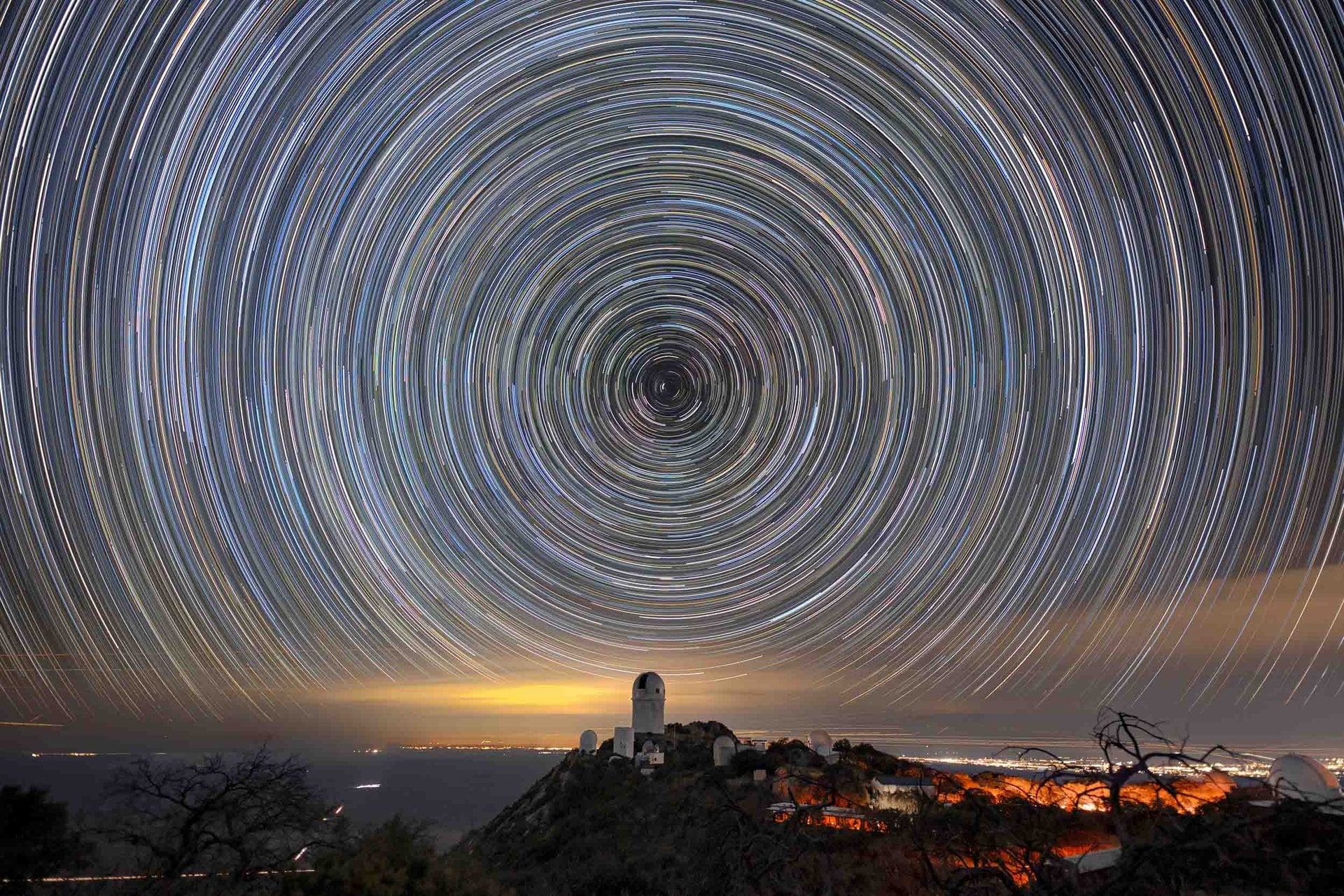 Blended star trails as they appear over the Mayall Telescope in Arizona that houses the Dark Energy Spectroscopic Instrument. DESI has completed its five-year mission and has been extended to 11 years to continue its work. (Contributed photo by Luke Tyas/Berkeley Lab and KPNO/NOIRLab/NSF/AURA)
DESI is a robotic survey instrument mounted on the 4-Meter Mayall telescope in Kitt Peak. It uses 5,000 robotic eyes that control individual optical fibers within the instrument. It’s highly configurable, meaning that each piece can point at a specific target during observations. The light they collect gets sent to spectrographs, which act as prisms to split the light from all the objects into its component wavelengths. That results in a redshift measurement for each object, which, in turn, gives a precise distance for all the objects in a given field of study. The data is then translated into the 3D map that DESI is helping to create.
The DESI instrument’s extended survey has already captured location data about millions of galaxies, quasars, and nearby stars, ehough to give scientists their map. “It’s almost like an impressionist painting, where we place all these galaxies in 3D and then we’re able to recognize the structures on which they sit,” Gontcho said. “And what’s interesting is that the structure has a pattern and that pattern can be found throughout time.”
Gontcho’s team will continue to analyze the current results and should be able to give a more complete report on dark energy’s role in 2027 based on the completed five-year survey. DESI began collecting data in May 2021 and will continue that work through 2028. That should allow the map to grow substantially, from covering 14,000 square degrees of sky to 17,000 square degrees. (For comparison, the full sky has over 41,000 square degrees). This will allow the science team to observe parts of the sky that are more difficult to study, such as the crowded plane of the Milky Way.
For More Information
Mapping the Hidden Structure of the Universe
DESI Completes Planned 3D Map of the Universe and Continues Exploring
?
DESI Completes Planned 3D Map of the Universe and Continues Exploring