
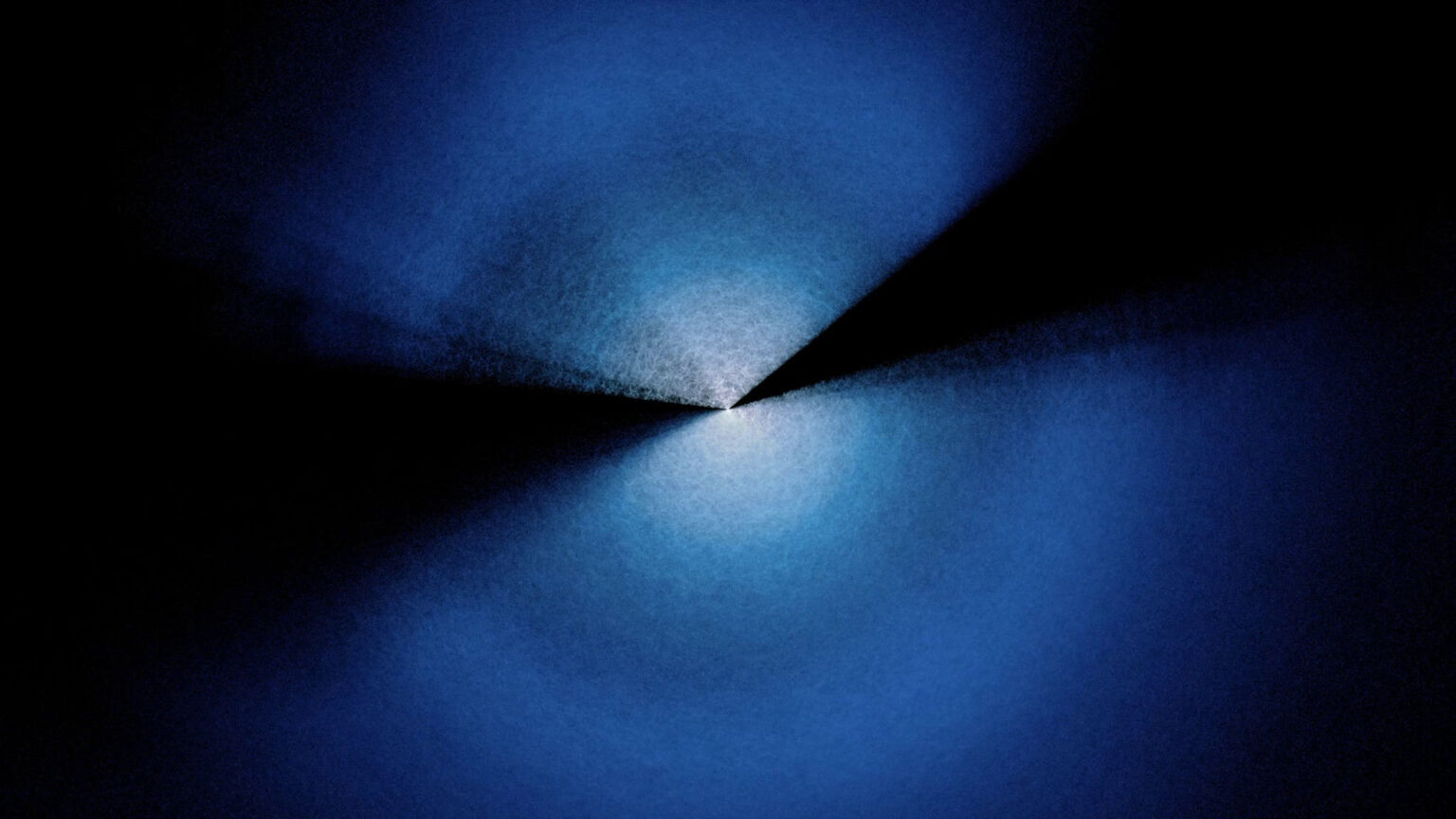
“From its inception, we envisioned a project that would push the boundaries of cosmology, and to see it come to such a spectacularly successful completion for its initial survey, ahead of schedule and with such rich data, is incredibly rewarding,” Turner added. “The dedication and ingenuity of the entire DESI collaboration have made this world-leading science a reality, and I am immensely proud of the groundbreaking results we are already seeing and the discoveries yet to come as we continue to explore the mysteries of our cosmos.”
DESI is a remarkable instrument, composed of 5,000 fibre-optic ‘eyes’, all of which adjust position in a coordinated ‘dance’ with those around them, to collect and feed the light from distant stars and galaxies into an array of 10 spectrographs attached to the telescope. These spectrographs then split the light into its component colours, revealing each object’s distance, speed, and what elements it is composed of.
Watch below: See a small patch of DESI’s array of eyes at work
By observing for longer and longer periods in overlapping fields of view, the instrument was able to peer farther and farther back in time, mapping out the positions of galaxies when the cosmos was younger than it is now. This has allowed the team to observe how dark energy has been driving the expansion of the universe over the past 11 billion years, which has revealed something very intriguing.
The Hubble Tension
Nearly a century ago, astronomer Edwin Hubble published a paper that showed that all the galaxies in the universe we could observe were moving away from us, and the farther away any particular galaxy was, the faster it was receding. The source of the expansion was named “Dark Energy,” since there was (and still is) no indication of exactly what is driving it.
The Hubble Telescope, launched roughly 47 years after its namesake’s death, showed that his results were correct, and made extremely accurate measurements of the rate of expansion, at 70-76 kilometers per second per megaparsec.
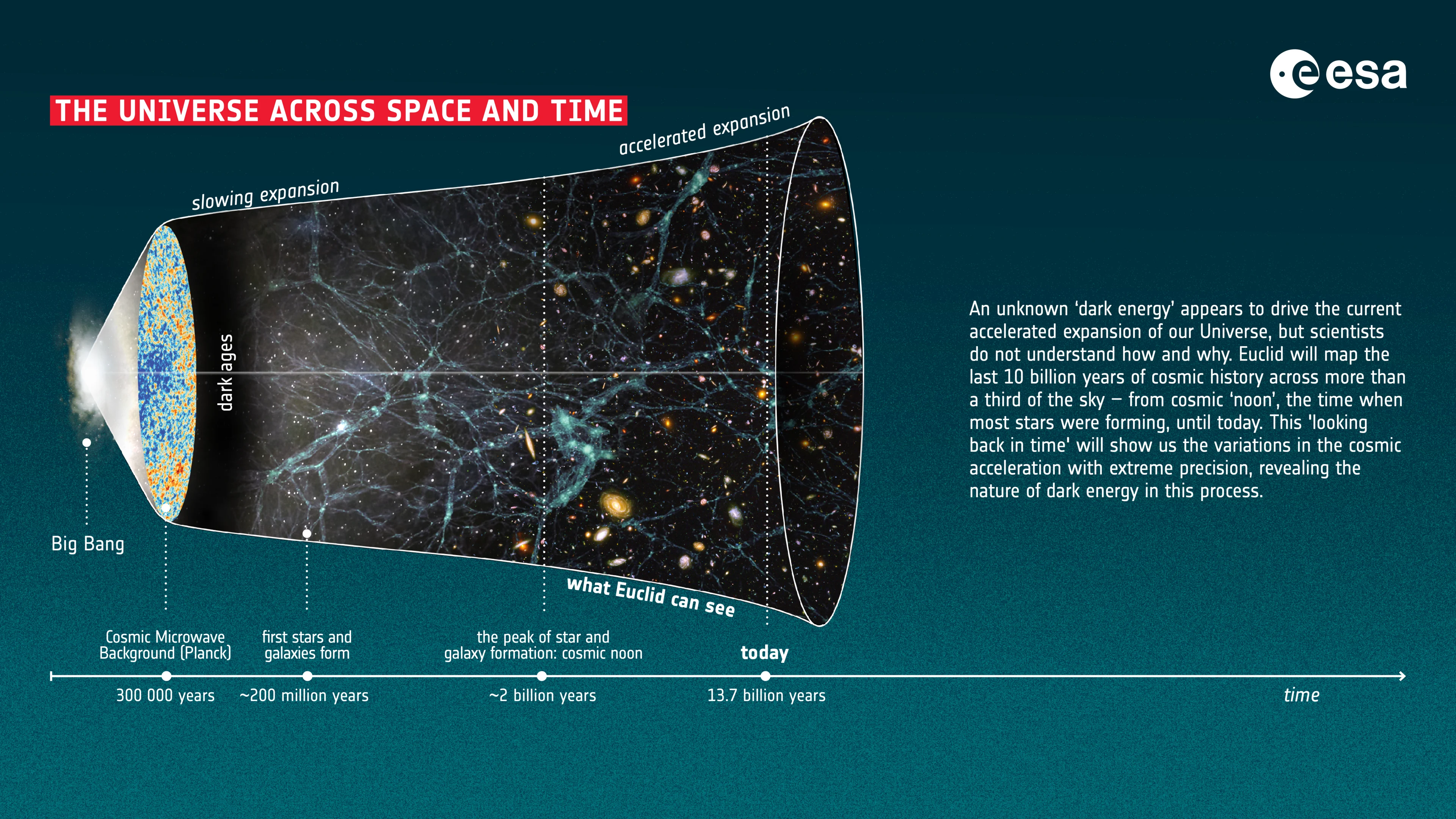
The evolution of the Universe across space and time, starting with the Big Bang and the Cosmic Microwave Background (left), up until the present day, 13.7 billion years later. (ESA)
However, other astronomers taking measurements of the Cosmic Microwave Background (CMB) — the light from the Big Bang stretched out over 13.7 billion years — showed a rate of expansion, equal to around 60-68 kilometers per second per megaparsec.