
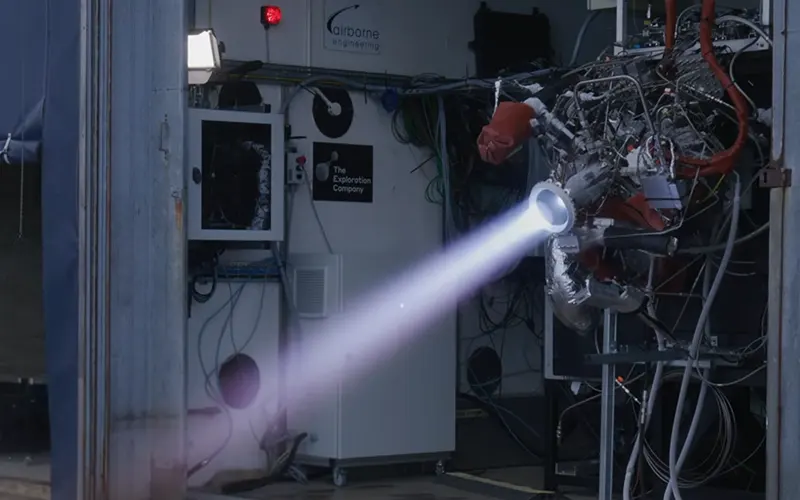
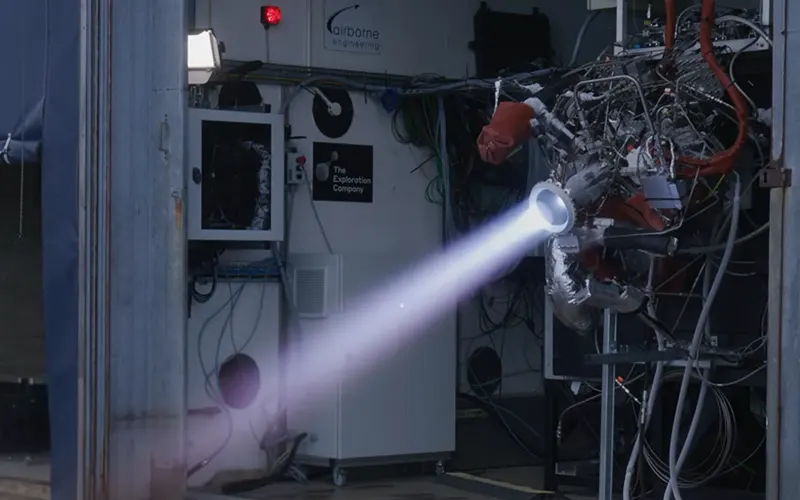
 Credit: The Exploration Company
The Exploration Company has successfully test fired a prototype of its 15 kN Huracan rocket engine. The engine is designed to enable the company’s future lunar vehicles to land on the surface of the Moon and to be restarted for ascent and orbital rendezvous.
While The Exploration Company is currently focused on delivering its Nyx Earth spacecraft, which will transport cargo to and from low Earth orbit, the company is also preparing for future variants of the vehicle, including a lunar lander. In November 2025, CEO Hélène Huby told European Spaceflight that while the company is not actively marketing lunar missions yet, it has “engaged in exploratory conversations with potential public and private stakeholders to assess market demand and has signed several LOIs.”
On 6 May, The Exploration Company announced that it had completed a hot-fire test campaign of its Huracan Development Model 1 rocket engine at Airborne Engineering’s facilities in Westcott, UK. The campaign was supported by the European Space Agency (ESA) through the Huracan Step‑2 contract. The testing marked the first time a complete Huracan engine assembly fired up, with the company having completed several thrust chamber test campaigns in 2024 and 2025.
Over the seven-week test campaign, the company completed 26 hot fire tests, with the engine prototype accumulating 375 seconds of total burn time. Testing included the evaluation of two engine configurations, each with a distinct injector head and main chamber. The longest single burn lasted 53 seconds at full power. The company also completed throttling tests, sweeping from 50% to 100% power during a single burn.
The company now plans to move ahead with a second development model, described as a “flight-representative” version of the engine, that includes a heat exchanger, inverter, and engine control unit. The company is also building a new dedicated facility in Bordeaux, where this second version of the engine will be tested in early 2027.
Huracan is one of several lunar lander rocket engines being developed across Europe. Norwegian aerospace and defence company Nammo is currently developing its RELIANCE engine for ESA’s Argonaut lunar lander, which is expected to be flown for the first time in the early 2030s. ArianeGroup is developing Greta, an ESA-backed project that could be used aboard both lunar landers and large rocket kick stages. Only one, however, has already flown on a mission to the Moon.
In March 2025, the Firefly Aerospace Blue Ghost lunar lander completed a historic touchdown on the surface of the Moon. The lander was powered by the LEROS 4-ET rocket engine, developed and built by Nammo UK. Unlike Huracan, which runs on liquid methane and liquid oxygen, the LEROS 4-ET uses MMH fuel and MON-3 oxidiser, a storable hypergolic propellant combination commonly used for deep-space propulsion. The LEROS 4-ET engine is also less powerful, with a maximum thrust of 1.1 kN.
Keep European Spaceflight Independent
Your donation will help European Spaceflight to continue digging into the stories others miss. Every euro keeps our reporting alive.