
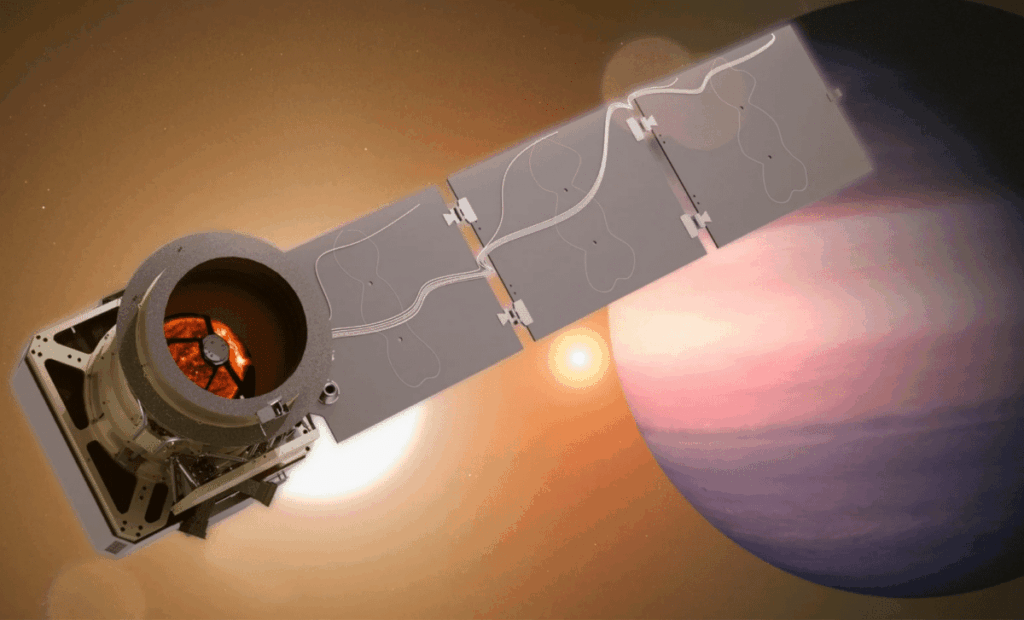
NASA’s Pandora exoplanet mission has delivered its first engineering images, setting the stage for a new era in exoplanet science. Launched earlier this year, Pandora is already demonstrating the power of small, cost-effective space missions with its precise measurements and advanced instruments designed to explore distant worlds. As scientists eagerly await more data, these first images represent a crucial step in unraveling the mysteries of exoplanets, a frontier that promises to reshape our understanding of the cosmos.
The Pandora Mission: A New Frontier in Exoplanet Discovery
The Pandora mission, part of NASA’s Astrophysics Pioneers Program, launched on January 11, 2026, from Vandenberg Space Force Base aboard a SpaceX Falcon 9 rocket. Unlike traditional, large-scale observatories, Pandora is a small, cost-effective mission that aims to gather crucial data on exoplanets in the visible and near-infrared wavelengths. The project is a collaboration between NASA, Lawrence Livermore National Laboratory (LLNL), and other key partners like Blue Canyon Technologies and Corning Incorporated.
Pandora’s primary goal is to observe the atmospheres of exoplanets in unprecedented detail. With its two state-of-the-art instruments, CODA, a Cassegrain telescope, and NIRDA, a repurposed instrument from NASA’s James Webb Space Telescope, Pandora will provide valuable insights into the composition and behavior of distant planets. According to Universe Today, the spacecraft will focus on analyzing the atmospheric conditions of 20 known exoplanets, helping scientists identify water vapor, hydrogen, and other critical elements that could indicate habitability.
As Pandora enters its mission phase, the spacecraft’s groundbreaking observations will pave the way for future missions, showing that even small-scale projects can yield big scientific breakthroughs. The early success of Pandora is a testament to the potential of low-cost, high-reward missions in the exploration of deep space.
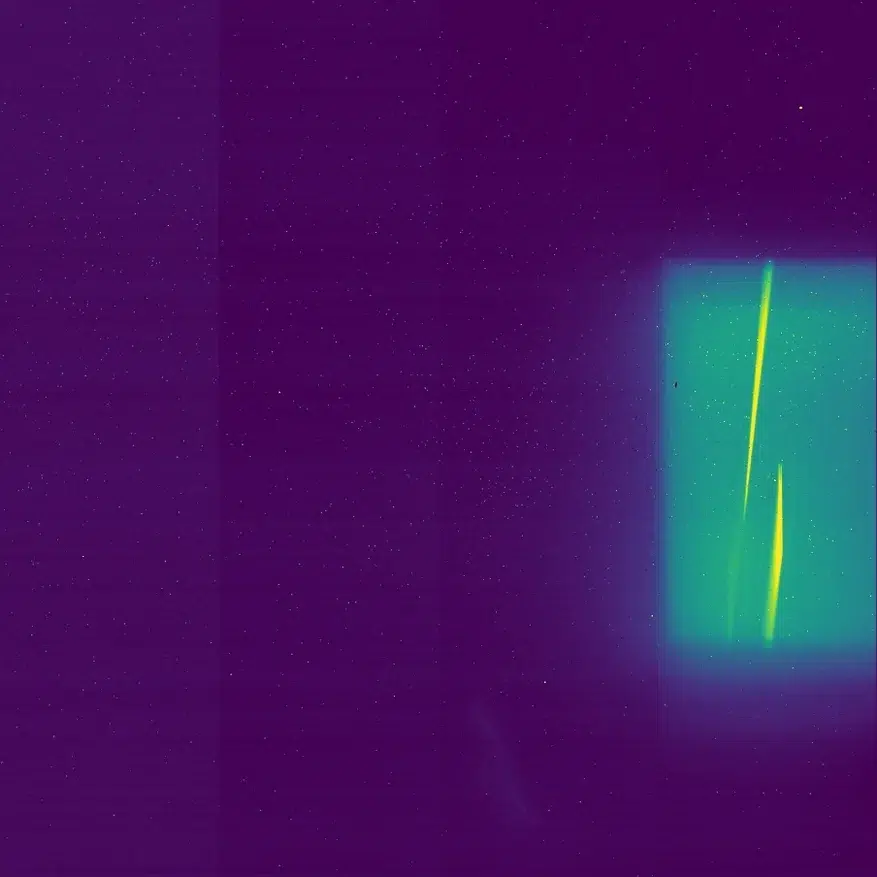 A test calibration image from the NIRDA instrument. The inset shows the dispersal of light into vertical lines. Credit: LLNL.
Pandora’s First Images and Instrument Readouts
The first engineering images transmitted by Pandora, released on January 19, 2026, provide a stunning preview of the spacecraft’s capabilities. These images, taken just eight days after launch, demonstrate the precision of Pandora’s instruments and its ability to maintain perfect stability while observing distant exoplanets.
Among the first data received was an image from the NIRDA instrument, which dispersed light into vertical lines, a key indicator of the system’s functionality. The image’s clarity and detail suggest that Pandora is operating at optimal efficiency, despite the challenging environment of space. The instruments on board Pandora are designed to capture both visible and infrared light, enabling scientists to detect even the faintest signals from exoplanets.
“The team is exceptionally pleased with the system’s pointing stability,” says Jordan Karburn (LLNL), in a recent press release. “It was a driving factor that led to LLNL’s partnership with BCT to provide the spacecraft.”
This stable performance is essential for Pandora to observe exoplanets over extended periods, without distortion from movements or vibrations, ensuring highly accurate data.
In addition to the visible light data, NIRDA’s cryo-cooler assembly is performing well, maintaining a steady temperature of 110 Kelvin (-163º Celsius). This is critical for ensuring that the infrared instruments function as expected, providing scientists with reliable data for their analysis.
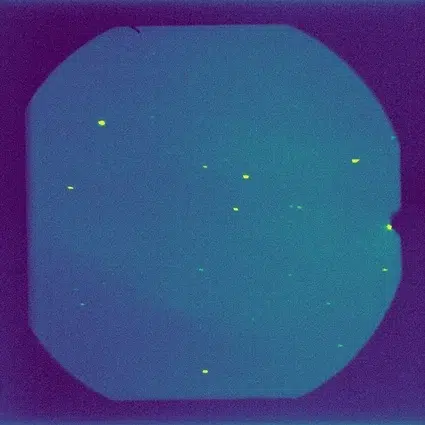 A first image from the VISDA camera, highlighting the instrument’s sensitivity across visible into infrared wavelengths. Credit: LLNL.
A Glimpse Into the Future: What Pandora’s Data Means for Exoplanet Research
Pandora’s mission is set to redefine the way we study exoplanets. Unlike earlier missions, which focused primarily on detecting exoplanets, Pandora is designed to go beyond detection and focus on understanding the planets’ atmospheres. The spacecraft will perform follow-up observations of 20 known transiting exoplanets, with a goal of making 10 transit measurements per planet. This will allow scientists to study the variability in light emitted by these planets and gain a deeper understanding of their composition and behavior.
Pandora’s unique ability to observe both visible and infrared wavelengths simultaneously will help differentiate between exoplanet signals and false data caused by stellar activity, such as starspots. This advancement is a crucial step toward accurate exoplanet studies and may lead to the discovery of new worlds with atmospheres similar to Earth’s.
Pandora’s observations will be conducted in a Sun-synchronous orbit, which ensures that the spacecraft can maintain continuous observation of its targets without interference from the Sun’s glare. This stability is a key feature of the mission, allowing Pandora to achieve sub-millimeter pointing accuracy while orbiting the Earth every 97 minutes.
This precise data is expected to help researchers refine models of exoplanet variability and transit times, contributing to our understanding of planetary systems across the galaxy.