
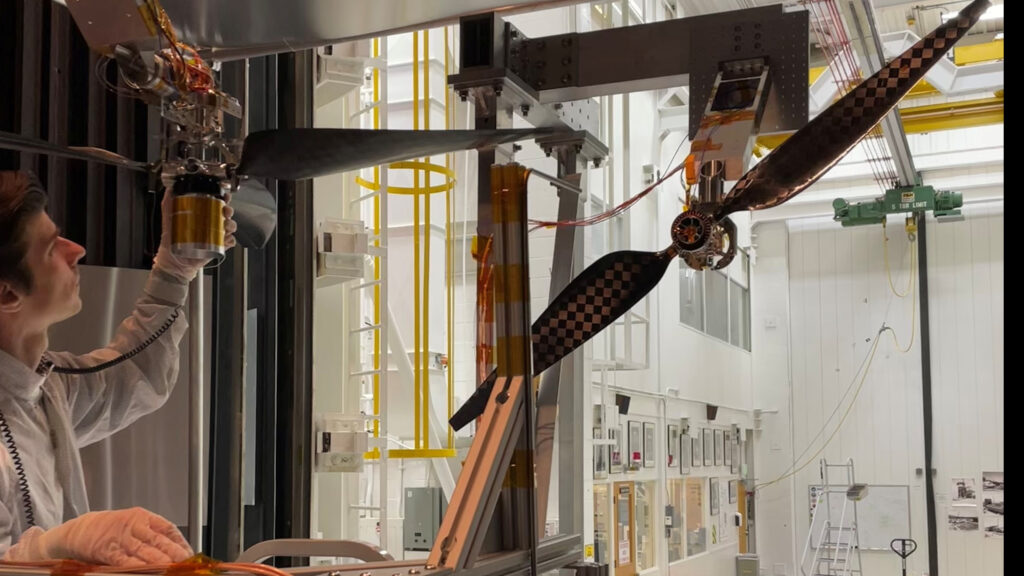
The rotor blades that will carry NASA’s next-generation helicopters to new Martian heights broke the sound barrier during March tests at NASA’s Jet Propulsion Laboratory in Southern California. Data from the tests, which took place in a special chamber that can simulate environmental conditions on the Red Planet, indicate that the fastest traveling part of the rotor blade, the tips, can be accelerated beyond Mach 1 without breaking apart. Data gathered from 137 test runs will enable engineers to design aircraft capable of carrying heavier payloads, including science instruments.
“NASA had a great run with the Ingenuity Mars Helicopter, but we are asking these next-generation aircraft to do even more at the Red Planet,” said Al Chen, Mars Exploration Program manager at JPL. “That’s not an easy ask. While everything about Mars is hard, flying there is just about the hardest thing you can do. That’s because its atmosphere is so incredibly thin that it is hard to generate lift, and yet Mars has significant gravity.”
By pushing rotors beyond the speed of sound during recent testing at NASA’s Jet Propulsion Laboratory, engineers are unlocking new possibilities for low-altitude aerial exploration of Mars. Credit: NASA/JPL-Caltech
Ingenuity, which performed the first powered, controlled flight on another world just over five years ago on April 19, 2021, was a trailblazing technology demonstration that did not carry science instruments. The agency’s recently announced SkyFall project and other potential future Mars aircraft will be capable of carrying payloads — including science instruments and sensors — to collect data in support of future human and robotic missions, leveraging the advantages that come with low-altitude aerial exploration.
In the fast-moving world of rotors, more thrust comes from a quicker spin or a larger diameter. Although this axiom holds true on Earth, engineers designing aircraft for the Red Planet must be much more aggressive. Because the Mars atmosphere is only 1% as dense as Earth’s, maximizing thrust requires pushing blade tips toward the speed of sound to achieve significant lift. While small-diameter rotors on Earth can also rotate at thousands of revolutions per minute, they have more air molecules to push and don’t need to approach the sonic edge.
The Ingenuity flight team never allowed the rotational speed of their composite-skinned foam rotors to exceed 2,700 rpm during the helicopter’s 72 flights at Mars for two reasons: to avoid the unpredictable physics of the sound barrier and to make sure that an unexpected gust of wind (from a dust devil, for instance) wouldn’t send the rotor tips over the sonic edge.
“If Chuck Yeager were here, he’d tell you things can get squirrely around Mach 1,” said JPL’s Jaakko Karras, the rotor test lead. “With that in mind, we planned Ingenuity’s flights to keep the rotor blade tips at Mach 0.7 with no wind so that if we encountered a Martian headwind while in flight, the rotor tips wouldn’t go supersonic. But we want more performance from our next-gen Mars aircraft. We needed to know that our rotors could go faster safely.”
While Mach 1 on Earth at sea level is approximately 760 mph (1,223 kph), the speed of sound on Mars is significantly slower — roughly 540 mph (869 kph) — due to the planet’s thin, cold, carbon-dioxide-rich atmosphere.
To begin evaluating the rotors, which were developed and manufactured by AeroVironment in Simi Valley, California, Karras and his team mounted a three-bladed rotor that could be used in future Mars helicopter designs inside the historic 25-Foot Space Simulator at JPL. They evacuated the air and replaced it with just enough carbon dioxide to match the Martian atmosphere, then blasted the rotor with wind as it spun at increasing speeds.
The test engineers had taken the precaution of lining part of the chamber with sheet metal in case the blades broke apart during the supersonic experiment. From a control room a few yards away from the chamber, the team watched displays showing data and a view inside the chamber as the rpm climbed as high as 3,750. At that rate, the tips were traveling at Mach 0.98. Then the engineers activated a fan inside the chamber that pelted the rotors with headwinds. After each run, they increased in wind velocity for the next run.
The team pushed rotor tip speeds to Mach 1.08, boosting the Mars vehicle’s lift capability by 30%. This breakthrough allows future missions to support heavier scientific payloads, including advanced sensors and larger batteries for extended flight.
Next the team tried their luck with the two-bladed SkyFall rotor. Because it is slightly longer than the three-bladed version, only 3,570 rpm was needed to achieve the same near-supersonic speed at the rotor tips prior to introducing the headwinds.
“The successful testing of these rotors was a major step toward proving the feasibility of flight in more demanding environments, which is key for next-gen vehicles,” said Shannah Withrow-Maser, an aerodynamicist from NASA’s Ames Research Center in Silicon Valley and member of the test team. “We thought we’d be lucky to hit Mach 1.05, and we reached Mach 1.08 on our last runs. We’re still digging into the data, and there may be even more thrust on the table. These next-gen helicopters are going to be amazing.”
The SkyFall mission design team has incorporated the test team’s findings into the performance specifications. Inspired by Ingenuity, the only rotorcraft to fly on another planet to date, SkyFall is designed to carry three next-gen Mars helicopters to the Red Planet in December 2028.
The faster-than-sound spin test campaign was funded by the agency’s Mars Exploration Program in pursuit of maximizing the capability of future aircraft flying at the Red Planet. A division of Caltech in Pasadena, JPL manages the Mars Exploration Program for NASA’s Science Mission Directorate in Washington.
For more information about NASA’s Mars Exploration Program, visit:
Media Contacts
DC Agle
Jet Propulsion Laboratory, Pasadena, Calif.
818-393-9011
agle@jpl.nasa.gov
Karen Fox / Alana Johnson
NASA Headquarters, Washington
240-285-5155 / 202-672-4780
karen.c.fox@nasa.gov / alana.r.johnson@nasa.gov
2026-029