
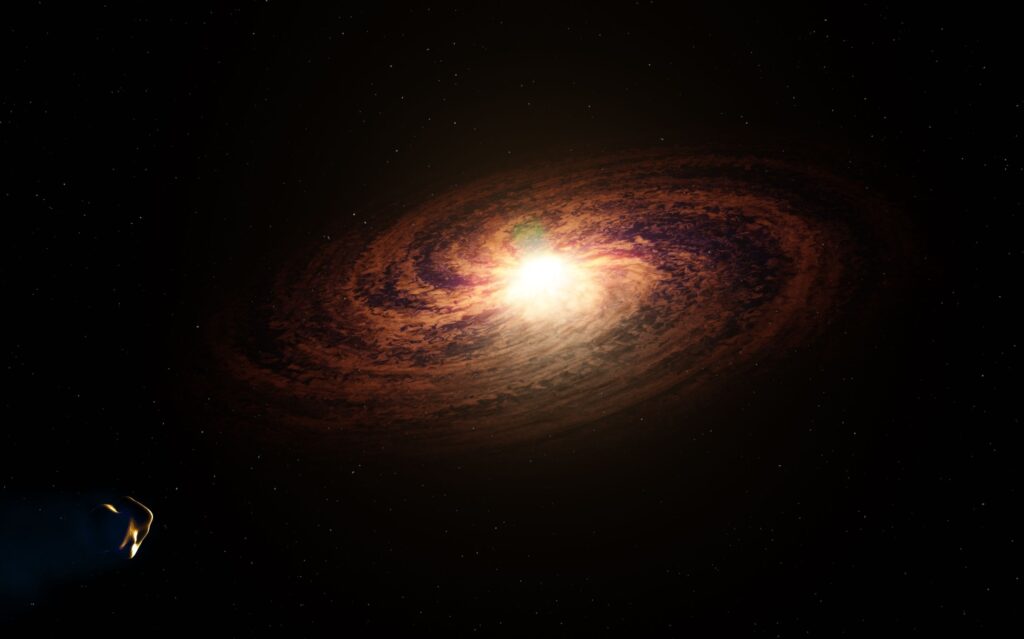
Most galaxies rotate. Our Milky Way rotates. The Andromeda Galaxy rotates. Nearly every galaxy in the cosmic neighborhood spins on a central axis, with stars and gas circling in roughly orderly patterns.
So when astronomers find a galaxy that does not spin, they take notice.

Experts have now found a strange one. It sits roughly 12 billion light-years away, ranks among the most massive galaxies in the early universe, and shows almost no rotation.
Its name is XMM-VID1-2075. The puzzle is not the galaxy’s slow spin. The puzzle is its age.
Slow galaxy spin takes billions of years
In the universe we observe today, slow rotators tend to be the cosmic elders. These are large, mature galaxies that have endured plenty of cosmic upheaval.
They gained their slow spin by colliding repeatedly with other galaxies over billions of years.
Each merger contributed a bit of spin or canceled some of it out. Over time, the stars inside lost their orderly circulation and instead ended up moving in random directions.
That kind of history takes time – considerable amounts of it. Which is why finding a slow rotator in the early universe creates a real puzzle. The clock simply does not allow for it.
Webb uncovers a galaxy mystery
A team led by Ben Forrest, a research scientist at the University of California, Davis (UC Davis), used the James Webb Space Telescope (JWST) to study three massive galaxies from the early universe.
One of them was XMM-VID1-2075. The team had already been watching this galaxy.
Earlier observations from the W.M. Keck Observatory in Hawaiʻi, part of a project called the MAGAZ3NE survey, had flagged it as something special.
“Previous MAGAZ3NE observations had confirmed this was one of the most massive galaxies in the early universe, and also confirmed that it was no longer forming new stars, making it a compelling target for follow-up observations,” Forrest said.
A galaxy with almost no spin
Webb gave the team enough resolution to measure how material inside each galaxy was actually moving.
Of the three they observed, one was clearly rotating. Another was, in Forrest’s words, “kind of messy.” The third, XMM-VID1-2075, showed no real rotation at all. Its stars moved in random directions.
“This one in particular did not show any evidence of rotation, which was surprising and very interesting,” Forrest said.
The light from this galaxy began its journey to Earth when the universe was less than 2 billion years old. That is a very early period in cosmic history.
That behavior matches some of the most massive galaxies seen in the nearby universe, though astronomers did not expect to find it so early in cosmic history.
A violent collision may explain it
So how does a galaxy stop spinning before it has barely had a chance to start? One option is a slow process involving many mergers spread across long stretches of time. But this galaxy had not existed long enough for that scenario.
The other option is faster and considerably messier. A single head-on collision between two galaxies rotating in opposite directions could cancel both spins almost overnight on cosmic timescales.
The Webb data leans toward the collision idea. There is extra light off to one side that does not seem to belong to the main galaxy.
“For this particular galaxy, we see a large excess of light off to the side,” Forrest said. “That’s suggestive of some other object that has come in and is interacting with the system and potentially changing its dynamics.”
Studying galaxies at the edge of time
Measuring stellar motion inside a galaxy this distant presents an entirely different challenge from studying nearby galaxies.
“This type of work has been done a lot with nearby galaxies because they’re closer and larger,” Forrest said.
“You can do these kinds of studies from the ground, but it’s very difficult to do with high-redshift galaxies because they appear much smaller in the sky.”
The James Webb Space Telescope is allowing astronomers to study these distant galaxies in ways that were previously out of reach. That capability is a large part of why this finding carries weight.
Until now, every massive galaxy spotted at such distances has turned out to be a fast rotator. XMM-VID1-2075 is the first slow rotator astronomers have confirmed this far back in cosmic time.
Rewriting the story of galaxy evolution
Some computer simulations predict that a small number of non-rotating galaxies should exist this early in the universe, though astronomers expect them to be rare.
Finding one gives astronomers a way to test whether those models match reality.
Forrest highlighted that finding more of these slow-spinning galaxies could help researchers measure how rare they really are and determine whether current theories of galaxy evolution hold up.
The search continues for similar objects. If Forrest and other teams keep discovering galaxies that do not fit established models, the textbook story of how massive galaxies assemble themselves may need a serious rewrite.
The study is published in the journal Nature Astronomy.
—–
Like what you read? Subscribe to our newsletter for engaging articles, exclusive content, and the latest updates.
Check us out on EarthSnap, a free app brought to you by Eric Ralls and Earth.com.
—–