
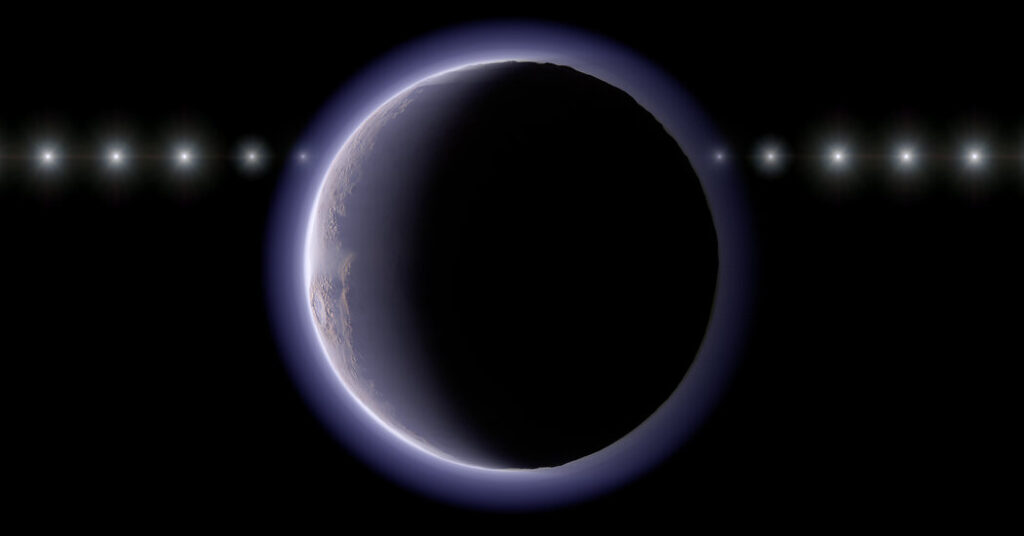
A small world about 300 miles wide and 3.5 billion miles from the sun — nearly as far away as Pluto — appears to be swaddled in a layer of air, astronomers reported on Monday.
“I was genuinely surprised,” Ko Arimatsu of the National Astronomical Observatory of Japan said. He led a team of Japanese astronomers who reported their findings in the journal Nature Astronomy.
The discovery of the air layer — an atmosphere — is doubly befuddling. First, the gravitational pull of such a small celestial body is weak, and any air surrounding it should have long ago floated away into space.
In addition, at the outer edge of the solar system where this distant world, known as 2002 XV93, orbits, temperatures are so cold that most of the molecules that exist as gases in Earth’s atmosphere freeze solid. Air that did not float away would be expected to turn into ice and fall to the surface.
“It is really super weird that 2002 XV93 has an atmosphere,” said Michael Brown, a planetary astronomer at the California Institute of Technology who was not involved with the new research. “So weird that I find it pretty hard to believe.”
But “the data look pretty convincing,” Dr. Brown said. “This one has me baffled.”
Dr. Arimatsu and his colleagues made their key measurements in a couple of minutes on a single night — Jan. 10, 2024 — when 2002 XV93 passed in front of a distant star. Telescopes in two locations in Japan, Kyoto and Kiso, captured the vanishing of the star’s light — for about 16.5 seconds at Kiso and 18 seconds at Kyoto — and then its reappearance.
The length of each disappearance — what astronomers call an occultation — helped refine estimates of the size of 2002 XV93, one of thousands of icy worlds known as trans-Neptunian objects, or TNOs, in the outer solar system.
But curiously, the star did not blink out suddenly and instead dimmed over 1.5 seconds. When it reappeared, its brightening was similarly gradual, pointing to the presence of an atmosphere.
The effect was similar to sunrises and sunsets on Earth, when the sun is dimmer, and the sky does not instantly turn dark, because the sunlight bends and scatters as it passes through the atmosphere.
Observations made by a third telescope at Fukushima, to the northeast, showed the star dimming but not disappearing entirely, suggesting that it passed behind the atmosphere but not the solid part of 2002 XV93. (At a fourth telescope, in Okayama, to the southwest of Kyoto and Kiso, clouds obscured the view that night.)
The atmosphere, however, is very thin, with only a few gas molecules to exert any pressure. The researchers estimate the atmospheric pressure there to be one to two 10-millionths that of Earth’s.
Until the 1990s, the expanse of the solar system beyond Neptune was thought to be largely empty, save for an oddball planet named Pluto. Then astronomers discovered the first few members of an icy ring of debris out there.
Two decades ago, Dr. Brown spearheaded a survey that systematically scanned the night sky for such trans-Neptunian objects. The search by Dr. Brown and his colleagues yielded a bonanza of additions to the solar system, including 2002 XV93 and Eris, a TNO. that is as big as Pluto but farther from the sun.
The discovery of Eris led to a reckoning over the definition of “planet.” In 2006, astronomers decided to strip Pluto’s planetary status and created a new category, dwarf planets, to encompass Pluto and Eris.
Like Pluto, 2002 XV93 is locked in a 3:2 resonance with Neptune, which circles the sun three times in the time it takes them to complete two orbits. For that reason, 2002 XV93 and other smaller objects caught in that 3:2 resonance are known as plutinos.
Dr. Brown said he and his colleagues never came up with a name to replace the temporary designation, 2002 XV93. “We only named the ones for which we know something interesting,” he said.
Now, 2002 XV93 appears to be more interesting.
Dr. Arimatsu said a thin, transitory atmosphere could have formed around 2002 XV93 from material that erupted out of ice volcanoes or that was kicked up by a recent impact of a smaller object.
It is also possible that the dimming of 2002 XV93 was caused by a Saturn-like ring instead of by an atmosphere. However, Dr. Arimatsu said that was less likely because the ring would have to be close to the surface to generate the observed pace of dimming and brightening, and such a ring would probably not be stable. “An atmosphere is the most self-consistent explanation,” he said.
Pluto, which is nearly 1,500 miles wide, has an atmosphere, as does Triton, which is about the same size as Pluto and is believed to have formed in the outer part of the solar system before it was captured as a moon of Neptune.
But stellar occultations of other trans-Neptunian objects, including Eris and others larger than 2002 XV93, all blinked off and on quickly.
The light curves of the starlight disappearing behind 2002 XV93 “are clearly different from typical occultations by atmosphere-free TNOs of similar size,” Dr. Arimatsu said.
There is one other trans-Neptunian object, Makemake, that appears to possess an atmosphere. Scientists using a different technique known as spectroscopy, which examines specific colors of light, identified wisps of methane gas floating above Makemake, an 890-mile-wide TNO that also qualifies as a dwarf planet.
However, similar measurements of 2002 XV93 by the James Webb Space Telescope have not detected molecules like methane, nitrogen or carbon monoxide in the form of ice on the surface of the Plutino, Dr. Brown said. If those were present, some of that material could turn to vapor to produce the atmosphere.
“Nature continues to be more imaginative than we are,” said Leslie Young, a planetary scientist at the Southwest Research Institute in Boulder, Colo., who was not involved in the research. “No matter what we call this collection of unique worlds, they each can teach us about how these distant atmospheres work.”