
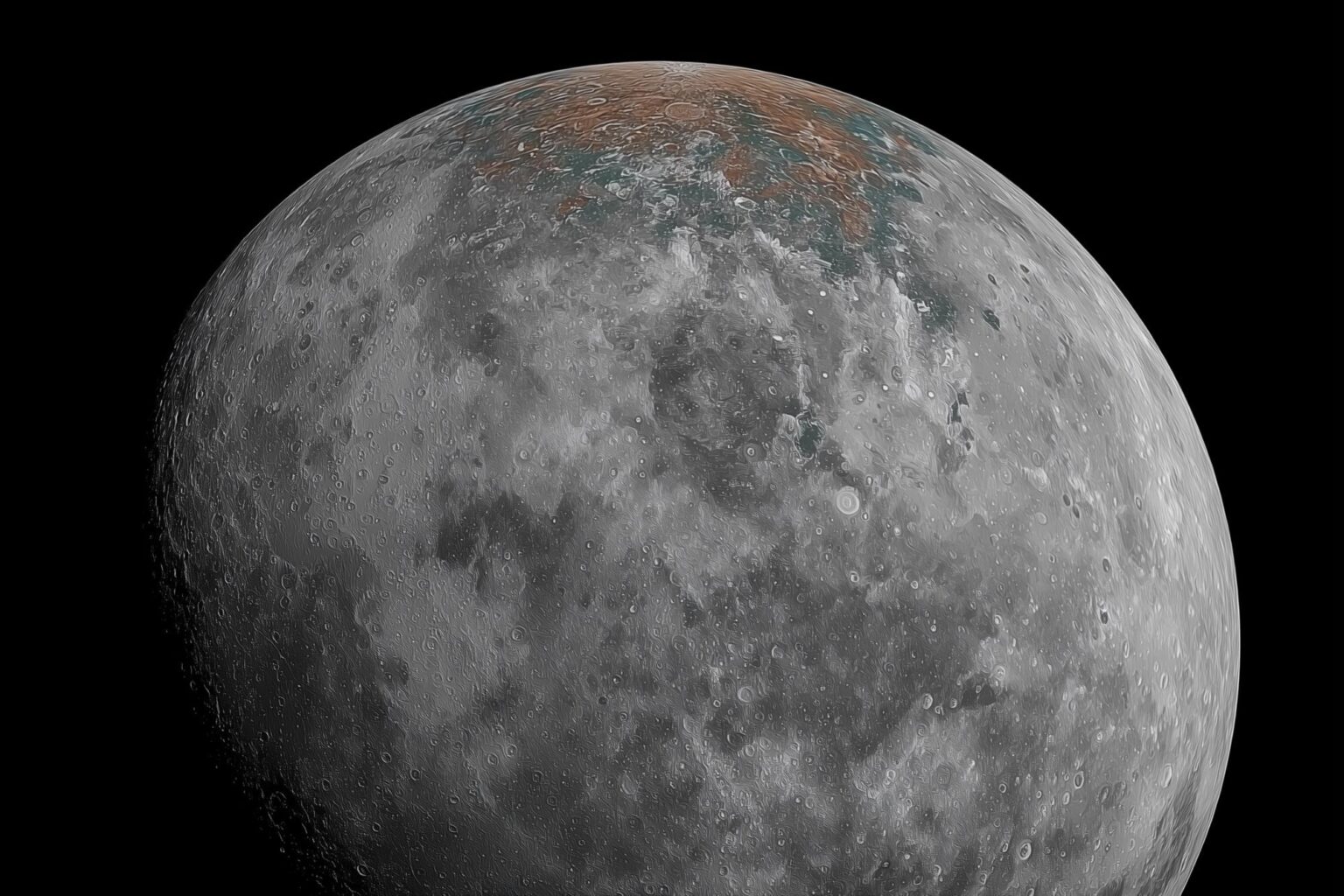
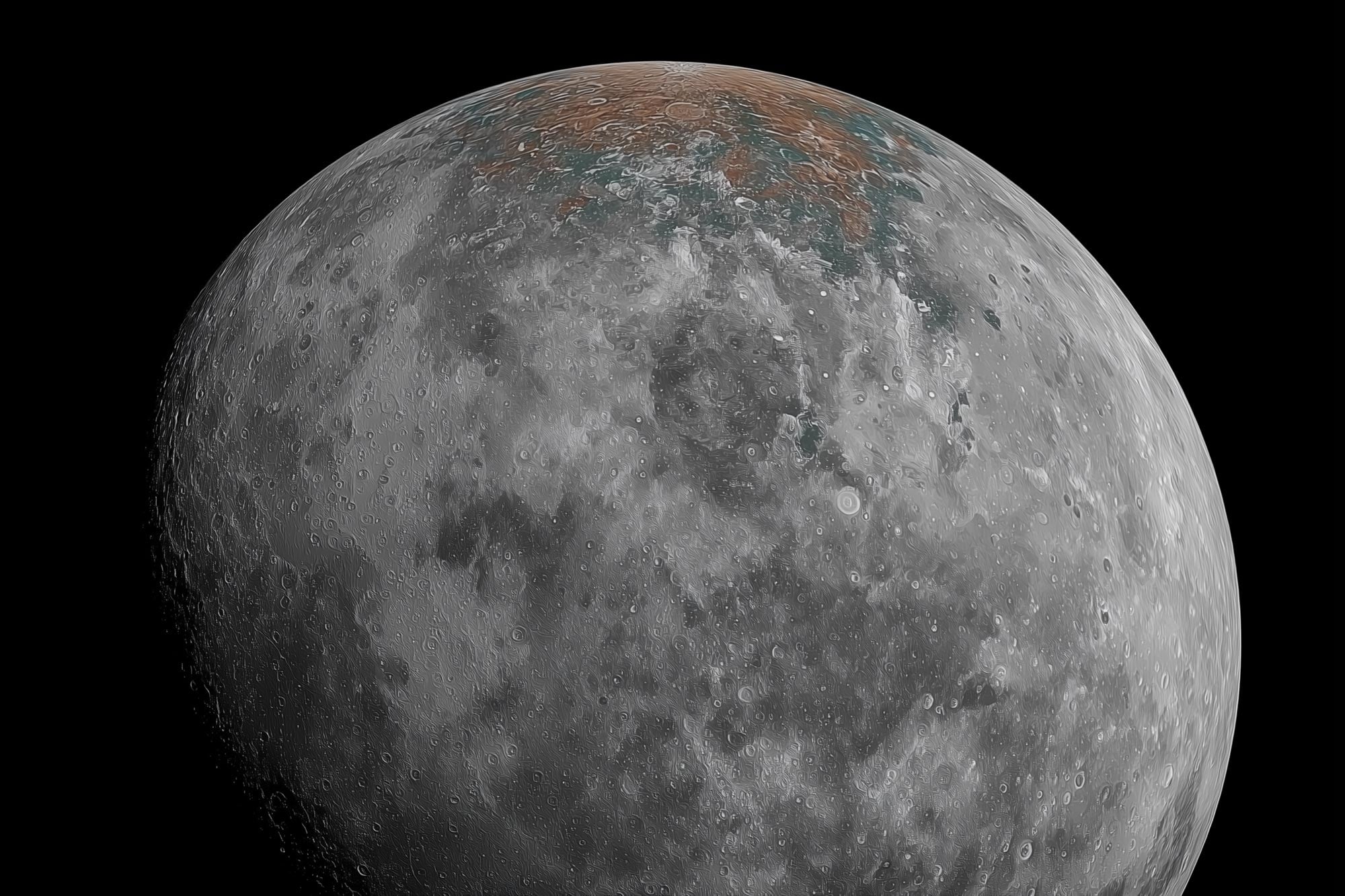
 A blazing exoplanet has been revealed as a dark, airless world with a surface unlike Earth’s. Instead of active geology, it is likely covered in weathered rock and dust, similar to Mercury. (Artist’s concept.) Credit: SciTechDaily.com
A nearby “super-Earth” is giving scientists a rare look at the bare surface of a distant world, and it’s far from Earth-like.
Using MIRI (Mid Infrared Instrument) on board the James Webb Space Telescope (JWST), scientists have taken a closer look at the surface of a distant rocky planet called LHS 3844 b. The research team was led by former MPIA (Max Planck Institute for Astronomy, Heidelberg, Germany) PhD student Sebastian Zieba (Center for Astrophysics | Harvard & Smithsonian, Cambridge, USA) along with Laura Kreidberg, MPIA Director and study PI (principal investigator). Instead of focusing only on atmospheres, this work pushes into a newer area of study that examines the geology of planets beyond our Solar System. The findings were published in the journal Nature Astronomy.
A Hot, Tidally Locked Super-Earth With No Atmosphere
LHS 3844 b is a rocky planet about 30% larger than Earth. It orbits a cool red dwarf star extremely quickly, completing one orbit in about 11 hours. The planet sits very close to its star, at a distance of only three stellar diameters. Because of this tight orbit, it is tidally locked. One side constantly faces the star while the other remains in darkness.
The dayside is intensely hot, reaching about 1000 Kelvin (approximately 725 Degrees Celsius or 1340 Degrees Fahrenheit). The system itself is relatively nearby at a distance of 48.5 light-years (14.9 parsecs).
“Thanks to the amazing sensitivity of JWST, we can detect light coming directly from the surface of this distant rocky planet. We see a dark, hot, barren rock, devoid of any atmosphere,” said Laura Kreidberg, MPIA.
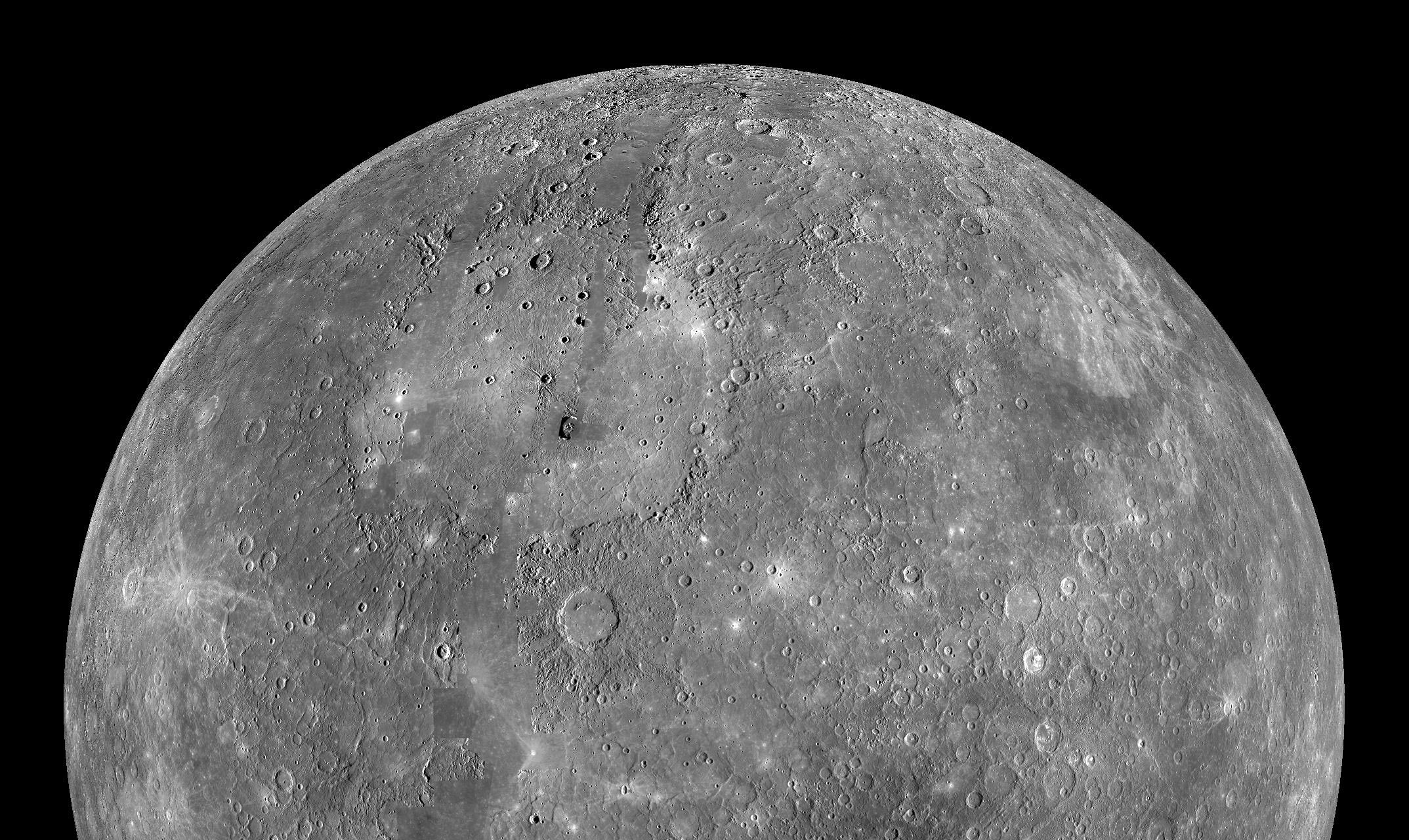 This high-resolution photo of the planet Mercury probably resembles the rocky exoplanet LHS 3844 b. Results from JWST observations favor an airless rocky planet with a dark, basalt-like surface, likely space-weathered by irradiation and meteorite impacts. Credit: NASA/Johns Hopkins University Applied Physics Laboratory/Carnegie Institution of WashingtonHow Scientists Measured the Planet’s Surface
The planet’s dark appearance suggests it may resemble a larger version of the Moon or Mercury. Researchers reached this conclusion by analyzing infrared radiation coming from the planet’s hot dayside. Since the planet cannot be directly imaged, scientists instead track subtle changes in the combined brightness of the star and the planet as it orbits.
MIRI measured infrared light between 5 and 12 micrometers and split it into smaller wavelength ranges. This produced a spectrum, which shows how light is distributed across different wavelengths. A previous dataset from the Spitzer Space Telescope was also included to strengthen the results.
Ruling Out an Earth-Like Crust
To interpret the data, the team compared the observed spectrum with models based on known rocks and minerals from Earth, the Moon, and Mars. This approach allowed them to test different possible surface compositions under the extreme conditions on LHS 3844 b.
The results ruled out a surface similar to Earth’s crust, which is typically rich in silicate minerals such as granite. While this may not be surprising, since Earth is unique in this regard, it still offers insight into the planet’s history. On Earth, such crusts form over long periods through tectonic activity and often require water. Repeated melting and mixing with mantle material gradually produces lighter minerals that rise to the surface.
“Since LHS 3844 b lacks such a silicate crust, one may conclude that Earth-like plate tectonics does not apply to this planet, or it is ineffective,” says Sebastian Zieba. “This planet likely only contains little water.”
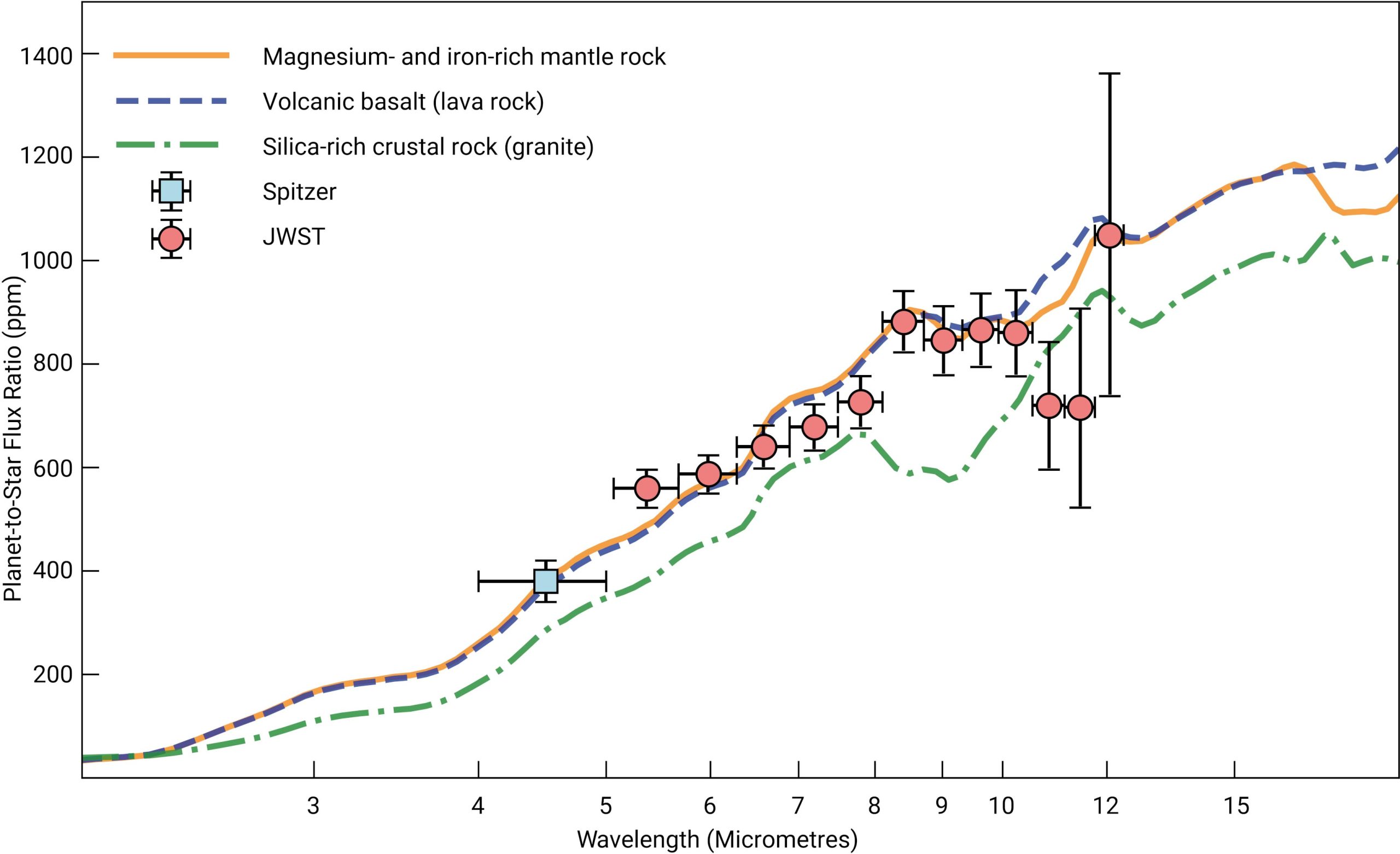 Infrared spectrum of LHS 3844 b’s hot dayside derived from the brightness contrast to its host star in ppm (parts per million = 0.0001%) at different wavelengths. The observational data obtained from the James Webb and Spitzer Space Telescopes (circles and squares) are consistent with mantle (solid orange line) or lava rock (dashed blue line), whereas they rule out an Earth-like crust (dash-dotted green line). Credit: Sebastian Zieba et al./MPIAEvidence for a Basalt-Rich Surface
Instead of granite-like material, the data point to a surface dominated by basalt or mantle-derived rock, similar to volcanic material found on Earth or the Moon. The researchers carried out a detailed statistical comparison between the observed spectrum and different mineral combinations.
They found that large areas of solid basalt or magmatic rock provide the best match. These materials are rich in magnesium and iron and can include minerals like olivine. Coarser material such as rocks or gravel also fits the data fairly well. Fine dust or powder alone does not match as well because it would appear brighter.
Space Weathering Shapes the Surface
Without an atmosphere, the planet is fully exposed to radiation from its star and constant impacts from meteorites. These processes gradually break down surface rocks.
“It turns out, these processes not only slowly dissolve hard rocks into regolith, a layer of fine grains or powder as found on the Moon,” explains Zieba. “They also darken the layer by adding iron and carbon, making the regolith’s properties more consistent with the observations.”
Two Possible Surface Scenarios
Based on the data, scientists proposed two possible explanations for the planet’s surface. One possibility is that it is covered in solid basaltic rock that is relatively fresh. This would suggest recent geological activity such as widespread volcanism.
The second possibility is a surface shaped over long periods by space weathering. In this case, large regions would be covered by darkened regolith, similar to the dusty surfaces seen on the Moon or Mercury. This scenario points to a planet that has been inactive for a long time.
No Evidence of Active Volcanism
A key difference between these scenarios is whether the planet is still geologically active. Active planets often release gases through volcanic activity. One important example is sulfur dioxide (SO2), which is commonly linked to volcanism.
If such activity were occurring on LHS 3844 b, MIRI should have detected this gas. However, no trace was found. This makes recent volcanism unlikely and supports the idea that the planet’s surface is old and weathered. If so, LHS 3844 b may closely resemble Mercury.
Future JWST Observations Will Refine the Picture
To better understand the surface, the research team is working on additional JWST observations. These new measurements will look at how light is emitted and reflected at different angles, which depends on the texture of the surface.
Rough surfaces and smooth rock reflect light differently, allowing scientists to distinguish between solid slabs and loose material. This technique has already been used successfully to study asteroids in our Solar System.
“We are confident the same technique will allow us to clarify the nature of LHS 3844 b’s crust and, in the future, other rocky exoplanets,” concludes Kreidberg.
Reference: “The dark and featureless surface of rocky exoplanet LHS 3844 b from JWST mid-infrared spectroscopy” by Sebastian Zieba, Laura Kreidberg, Brandon P. Coy, Aaron Bello-Arufe, Kimberly Paragas, Xintong Lyu, Renyu Hu, Aishwarya Iyer, Edwin S. Kite, Daniel D. B. Koll, Kay Wohlfarth, Emerson Whittaker, Heather Knutson, Robin Wordsworth, Caroline Morley and Laura Schaefer, 4 May 2026, Nature Astronomy.
DOI: 10.1038/s41550-026-02860-3
Laura Kreidberg is the only MPIA astronomer involved in this study.
Other researchers were: Sebastian Zieba (Center for Astrophysics | Harvard & Smithsonian, Cambridge, USA), Brandon P. Coy (Department of the Geophysical Sciences, University of Chicago, USA), Aaron Bello-Arufe (Jet Propulsion Laboratory, California Institute of Technology, Pasadena, USA [JPL]), Kimberly Paragas (Division of Geological and Planetary Sciences, California Institute of Technology, Pasadena, USA), Xintong Lyu (Peking University, Beijing, China), Renyu Hu (The Pennsylvania State University, University Park, USA and JPL), Aishwarya Iyer (NASA Goddard Space Flight Center, Greenbelt, USA), Kay Wohlfarth (Technische Universität Dortmund, Germany)
The JWST observations used in this study were conducted as part of GO program #1846 (PI: Laura Kreidberg, co-PI: Renyu Hu) titled “A Search for Signatures of Volcanism and Geodynamics on the Hot Rocky Exoplanet LHS 3844 b.”
The MIRI consortium comprises the ESA (European Space Agency) member states: Belgium, Denmark, France, Germany, Ireland, the Netherlands, Spain, Sweden, Switzerland, and the United Kingdom. National science organisations fund the consortium’s work – in Germany, the Max Planck Society (MPG) and the German Aerospace Center (DLR). Participating German institutions include the Max Planck Institute for Astronomy in Heidelberg, the University of Cologne, and Hensoldt AG in Oberkochen, formerly Carl Zeiss Optronics.
The James Webb Space Telescope is the world’s leading observatory for space research. It is an international program led by NASA and its partners ESA and CSA (Canadian Space Agency).
The Spitzer Space Telescope was operated by the Jet Propulsion Laboratory, California Institute of Technology, under a contract with NASA.
Never miss a breakthrough: Join the SciTechDaily newsletter.
Follow us on Google and Google News.