
The biggest challenge in getting humans to Mars is pretty simple to understand: how do make a thruster that moves faster without carrying tons of fuel?
Right now, rockets burn through propellant fast, and that limits their range. Engineers have been working on possible solutions for decades.

A recent test hints at a different path forward. Inside a specialized chamber in Southern California, a new kind of engine has come to life.
It doesn’t roar like a rocket. Instead, it glows, hums, and pushes matter using electricity. The result could reshape how spacecraft travel across the solar system.
NASA’s electromagnetic thruster
Earlier this year, rocket scientists at NASA fired up an electromagnetic thruster powered by lithium metal vapor.
It marked the first time in years that this type of engine reached such high power levels in the United States. The system pushed up to 120 kilowatts, a level far beyond what current spacecraft use.
This test took place at NASA’s Jet Propulsion Laboratory (JPL). During five separate ignitions, the engine’s tungsten core heated to over 5,000 degrees Fahrenheit (2,760 degrees Celsius).
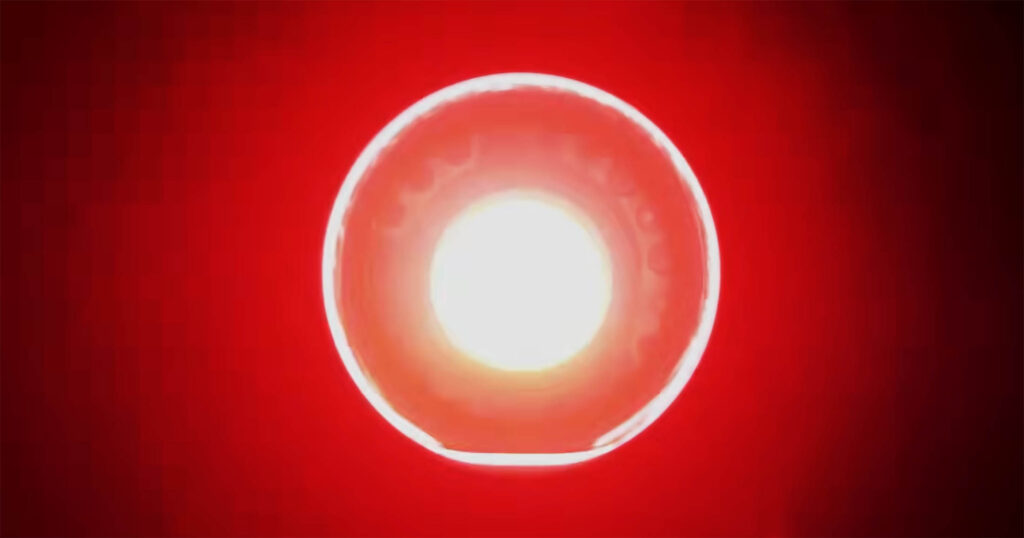
It glowed bright white, while a red plume streamed out from the nozzle. The chamber itself stretched 26 feet (7.9 meters) long, and was built to handle extreme heat and energy.
How electric propulsion changes the game
Traditional rockets rely on chemical reactions to create powerful bursts of thrust. They work well for launch but consume large amounts of fuel.
Electric propulsion works differently. It uses electricity to accelerate particles, producing a steady push over long periods.
This approach can use up to 90 percent less propellant. That efficiency matters in deep space, where every pound counts.
NASA already uses electric thrusters on missions like Psyche, where they slowly build speed over time. In the vacuum of space, that gentle push can eventually reach speeds of 124,000 miles (199,559 kilometers) per hour.
What makes this thruster stand out
The engine tested at JPL is called a magnetoplasmadynamic, or MPD, thruster. Unlike earlier designs, it uses strong electric currents and magnetic fields to push lithium plasma out of the engine. That interaction creates thrust that is both efficient and stronger than most electric systems flying today.
James Polk, senior research scientist at JPL, has worked on this technology for years.
“Designing and building these thrusters over the last couple of years has been a long lead-up to this first test,” he said.
“It’s a huge moment for us because we not only showed the thruster works, but we also hit the power levels we were targeting. And we know we have a good testbed to begin addressing the challenges to scaling up.”
Mars needs electromagnetic thrust
Sending humans to Mars will require far more power than current spacecraft can handle. A single mission could need between 2 and 4 megawatts of energy. That means multiple thrusters working together for long stretches, possibly more than 23,000 hours.
This new system shows promise because it can scale. Engineers aim to push each thruster to between 500 kilowatts and 1 megawatt in future tests.
If paired with a nuclear power source, these engines could cut down launch weight and carry heavier payloads, including supplies needed for human crews.
A step that builds momentum
NASA Administrator Jared Isaacman pointed to the broader goal behind the test. “At NASA, we work on many things at once, and we haven’t lost sight of Mars,” he said.
“The successful performance of our thruster in this test demonstrates real progress toward sending an American astronaut to set foot on the Red Planet.”
“This marks the first time in the United States that an electric propulsion system has operated at power levels this high, reaching up to 120 kilowatts,” added Isaacman. “We will continue to make strategic investments that will propel that next giant leap.”
The road ahead is still long. High temperatures, long operating times, and system durability remain real challenges.
But this test offers something solid to build on. It shows that a long-studied idea can move closer to reality, one controlled burst of plasma at a time.
Information from a press release by NASA’s JPL.
—–
Like what you read? Subscribe to our newsletter for engaging articles, exclusive content, and the latest updates.
Check us out on EarthSnap, a free app brought to you by Eric Ralls and Earth.com.
—–