
 4 min read
Here’s what you’ll learn when you read this story:
Researchers have long wondered where the Milky Way’s edge might be, but its exact location has remained elusive—until now.By analyzing survey data, a research team from the University of Malta determined that the galaxy’s edge lies at its outermost star-formation site, roughly 40,000 light-years from the center.At its farthest reaches, the Milky Way produces one final burst of star formation, beyond which only ancient stars that migrated outward remain.
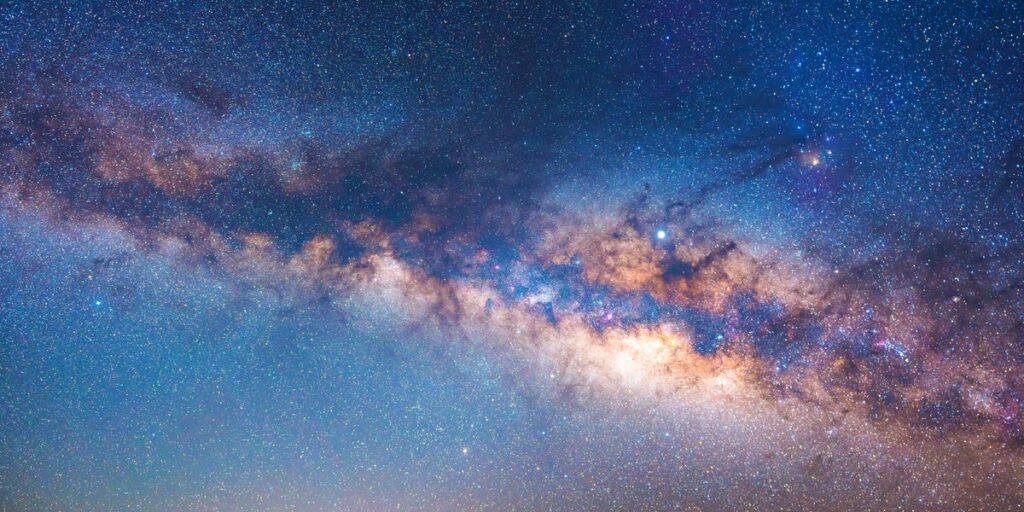
The Milky Way, from our perspective, appears to be a swath of stars that reaches into eternity. For someone standing on terra firma and gazing up into the night sky, it seems like it never ends, but our galaxy does have an outer limit. That limit can be found in a far-flung region where star formation fades into the vacuum of space.
Galaxies evolve over billions of years. When star-forming gas grows cold or diffuses, star formation slows down in some areas and sometimes ceases entirely, while hot and dense clouds of dust and gas give birth to stars elsewhere, constantly changing the makeup of galaxies.
Our galaxy, the Milky Way, is a spiral galaxy with a rotating disk, the edge of which is the galaxy’s most distant region where stars are still forming. As a team of researchers from the University of Malta found after analyzing over 100,000 giant stars in datasets from several different surveys, including APOGEE-DR17, Gaia, and LAMOST-DR3, the stars closest to the galactic core are some of the oldest.
Related Story
Hundreds of billions of stars populate the Milky Way, and the farther out from the galaxy’s center you go, the younger the stars get. That is, until they reach a point where they become older again. Previous observations made with the Hubble Space Telescope and the James Webb Space Telescope identified areas where the galaxy’s brightness doesn’t change in the usual way with distance from its center. Instead, there are breaks in the light profiles of these regions. But exactly why such breaks exist in the Milky Way’s light profile has been difficult to determine. Another thing that’s been hard to grasp is the stellar density of different zones. That’s because of the way dust and gas absorb and scatter electromagnetic radiation, a phenomenon known as dust extinction.
“While breaks among disc galaxies are common, whether the Milky Way has such a broken profile remains an open question,” the researchers said in a study recently published in Astronomy & Astrophysics. “This is partially due to our position within the galactic disk, which makes the stellar density profile difficult to determine directly due to dust extinction.”
Previous studies attempted to find where that break was located. The APOGEE survey detected signs of a break in stellar density in the outermost region of the Milky Way. In similar spiral galaxies, breaks are usually linked to thresholds in star formation. Another possible factor is the migration of stars, driven by shifting spiral arms and the Milky Way’s central stellar bar—a dense structure that rotates at a different speed from the stars themselves. This difference is thought to result from gravitational instabilities. The same process may also move stars from the inner disk to the outer disk. Beyond the break, stellar ages increase.
Because stellar ages decrease up to the break and then increase beyond it, the Milky Way has a U-shaped stellar age profile, a pattern common in other Type II galaxies. Simulations also suggest that many stars now found in the outer disk originally formed closer to the galaxy’s center and later migrated outward. The relationship between stellar age and metal content supports this idea: stars with higher abundances of elements heavier than helium are generally younger and more concentrated toward the center, while stars with lower metal content are typically older and found farther from the galactic core.
Related Story
Observations from APOGEE-DR17, LAMOST-DR3, and Gaia showed that the ages of stars in the outer disk keep increasing towards its edge. Even the Sun most likely migrated outwards. Distribution of star ages in the Milky Way can be at least partially explained by massive amounts of gas and dust from its formation, much higher than what remains now, near the supermassive black hole at its core, Sagittarius A*, when the galaxy came into being. It created swarms of ancient stars that have since morphed into red giants. Dust and gas grow more diffuse away from the core, slowing down star formation processes, so stars that formed on the galaxy’s outer edges also took longer to form, which is why they are mostly younger. The stars past that last frontier of star formation are much older because they formed earlier in the inner regions and migrated.
Using these data, the researchers concluded that the Milky Way’s outer disk extends to about 40,000 light-years from the galactic center. Additional evidence comes from the cold, slow-moving gas beyond this region, which appears too diffuse and low in energy to form new stars. The galaxy’s central bar may also contribute by trapping gas and disrupting its movement outward. If that gas continues to spread out, especially as the Milky Way’s slight warp disperses it further, it may not be able to cool down enough to accrete into the cosmic clouds where stars are born.
“In the Milky Way, the root cause of the star-formation drop beyond the break radius remains unclear,” the researchers said. “The break could be primarily driven by bar-related dynamics [or] by a thermally regulated transition in gas phases, by the onset of a warp in the gaseous and stellar discs, or by a combination of these mechanisms operating together.”
Great Deals You Don’t Want to Miss

Best Portable Charger Deal
 Anker 3-Port USB-C Nano Charger
Now 30% Off
Best Vacuum Deal
 Dyson V8 Plus Cordless Vacuum
Now 35% Off
Best TV Deal
 INSIGNIA 55-inch 4K UHD Smart Fire TV
Best Headphones Deal
 Sony WH-1000XM5 Noise Canceling Headphones
Now 30% Off
Best Jump Starter Deal
 GOOLOO GT3000 Jump Starter
Now 30% Off

Elizabeth Rayne is a creature who writes. Her work has appeared in Popular Mechanics, Ars Technica, SYFY WIRE, Space.com, Live Science, Den of Geek, Forbidden Futures and Collective Tales. She lurks right outside New York City with her parrot, Lestat. When not writing, she can be found drawing, playing the piano or shapeshifting.