
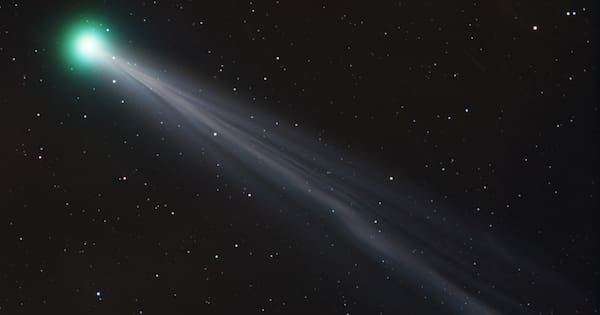
An astronomer says it may actually be easier to see a dazzling and rare comet making its way across the Southern Hemisphere this coming week as the full moon wanes.
The comet – known as C/2025 R3 PanSTARRS – has swung around the sun and has been visible with telescopes, binoculars and cameras for just over a week.
Wellington Astronomical Society’s curator of instruments Matt Balkham told 1News that although the comet was getting further away, it may actually be a better time to photograph it.
“The best is yet to come, absolutely, in terms of being able to photograph it. Every day it’s kind of a trade-off between it getting further away and therefore fainter and smaller, and the moon getting less bright and getting higher in the sky.
“We’ve been battling with the full moon the last few nights as well, which tends to wash out the sky so it just looks very white, not very black.”
He said over the next few days was “probably the best window”.
“It’s kind of going to get better the next few nights, but I think we’ve got cloud forecast the next few nights. And it’ll start to get further away and fainter and harder to see,” he explained.
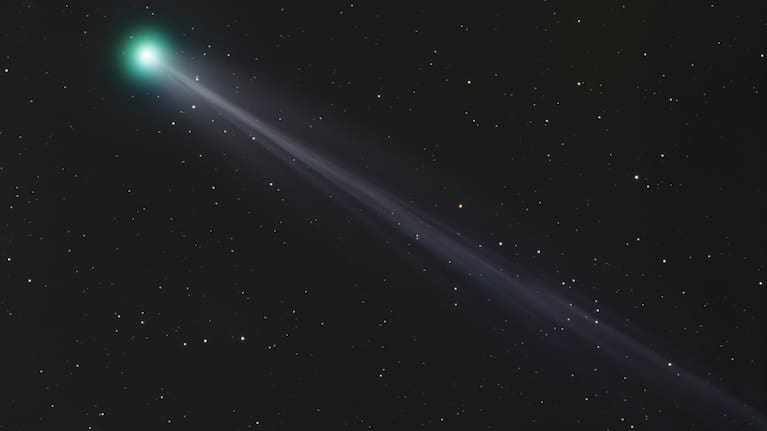
The 45-year-old civil engineer shared images taken remotely from the Wairarapa observatory where he volunteers using a 16in reflecting telescope and a dedicated astro camera taking “a series of different images” that were then superimposed together.
“It’s a mono camera, so we put a red filter, a green filter, and a blue filter in front of the camera automatically, take the different exposures, and then combine them together.”
He said the images were “about an hour’s worth of data” taken shortly after dusk between 6.30pm and 7.30pm, with 20 minutes’ worth of images taken with each coloured filter applied.
“We’re tracking the apparent movement of the sky, counteracting the rotation of the Earth with the telescope while we do that. But also the comet’s moving relative to the stars, which you also wouldn’t see otherwise.”
The images are then superimposed on top of one another to create the final piece.
“So there’s quite a lot of work after actually taking the image to process it, to make sure that the stars don’t streak and they look like stars and the comet looks like a comet,” he laughed.
He said being able to capture the images of the comet was “really interesting”.
“It’s only visible in our southern skies for a short period in the next hundreds of thousands of years,” he said. “So when we have those sorts of events we obviously really wanted to try and capture it within the small window.”
Balkham said that data acquisition would then be made available for astronomical society members to look at, and astronomers from other partner organisations.
“As a society is we’re trying to encourage more people to get involved in looking through telescopes, get involved in using them… it’s all part of the learning and outreach programme of what we do.”
Where in the sky should you look?
John Drummond from the Royal Astronomical Society of New Zealand said people won’t be able to simply look up and see a “massive comet with a big tail” streaking across the sky. (Source: Breakfast)
John Drummond from the comet department of the Royal Astronomical Society of New Zealand said the best place to spot the comet from would be a clear area with as little light pollution as possible.
“Find a place with a low western horizon, then you might be able to see it,” he told Breakfast.
He added that stargazers would need a pair of binoculars, as it was “not as bright as possibly what the media has portrayed it to be”.
A rare comet is dazzling NZ skies, here’s how you can spot it – watch on TVNZ
“You’ll need a pair of binoculars, and for those people who know the pot, in the constellation of Orien it looks like the pot of a handle, that’s sitting down towards the west at the moment.
“And there’s a star, a bright bluish star to the left of the pot called Rigel. And if you look at the binoculars, if you look around Rigel for a small, fuzzy blob, that’ll be the comet.
“So it’s not like [people] can walk outside and, hey presto, there’s this massive comet with a big huge tail or anything like that.”
He said the comet has been in the sphere around the sun since the formation of the solar system 4.6 billion years ago and has taken “about 170,000 years to come to us”.
Drummond said the interesting thing was the comet actually had a “gravity assist”, and picked up speed as it hurtled toward our solar system.