
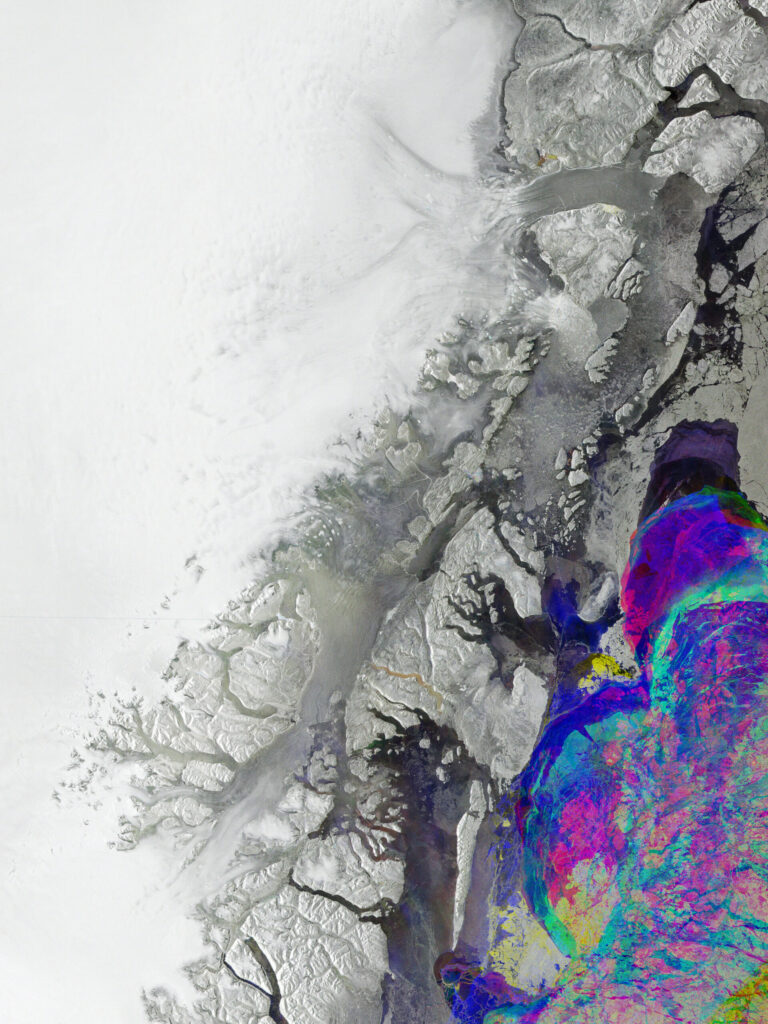
Part of the rugged and deeply indented coast of northeastern Greenland is featured in this radar image captured by Copernicus Sentinel-1.
Zoom in to explore this image at its full resolution.
Greenland is the world’s largest island and about 80% of its surface is covered by the Greenland Ice Sheet, the second largest ice mass on Earth after the Antarctic Ice Sheet.
This image combines three acquisitions taken by Sentinel-1’s radar over the same area in January, February and March 2026. Radar images are not usually in colour, but here each acquisition has been assigned a different colour, and, when overlaid, the resulting colours represent variations that have occurred on the surface between the three scans.
Stable ice can be seen in white in the left of the image, while the shades of grey depict surfaces that have either not changed or changed very little. Colours are mainly concentrated in the water along the coast and show visible changes in type and cover of the constantly moving sea ice.
Three main outlet glaciers are visible in the image: the 79N (Nioghalvfjerdsfjorden) and the Zachariae Isstrøm to the north and the Storstrømmen to the south. These glaciers constitute the main front ends of the Northeast Greenland Ice Stream (NEGIS), a long ice stream that connects the interior to the ocean, draining approximately 12–17% of the Greenland Ice Sheet into the North Atlantic through these three glaciers.
Global warming is driving the rapid melting of the Greenland Ice Sheet. Current ice mass loss is already affecting coastal regions, including low-lying areas vulnerable to flooding and storm surges. The Greenland Ice Sheet contains 12% of the world’s glacier ice and if it melts completely, the global seas will rise by up to 7 m with catastrophic consequences.
Furthermore, any increase in melting from this ice sheet can cause an influx of freshwater into the North Atlantic, weakening the Gulf Stream and potentially seriously affecting the climate of northern Europe as well as other continents.
It is therefore vital to monitor its changing shape and the rate at which it is melting in a sustained manner. The Sentinel-1 constellation images the entire Earth every six days, which is important for monitoring rapid change. Each satellite carries an advanced radar instrument that captures images of Earth’s surface through cloud and rain and regardless of whether it is day or night. This is particularly useful when observing these vast, inaccessible areas which are prone to long periods of bad weather and extended darkness.
Observations of Greenland runoff from space can be used to verify how climate models simulate ice sheet melting, which will allow improved predictions of how much Greenland will contribute to the global rise of sea level in the future.