
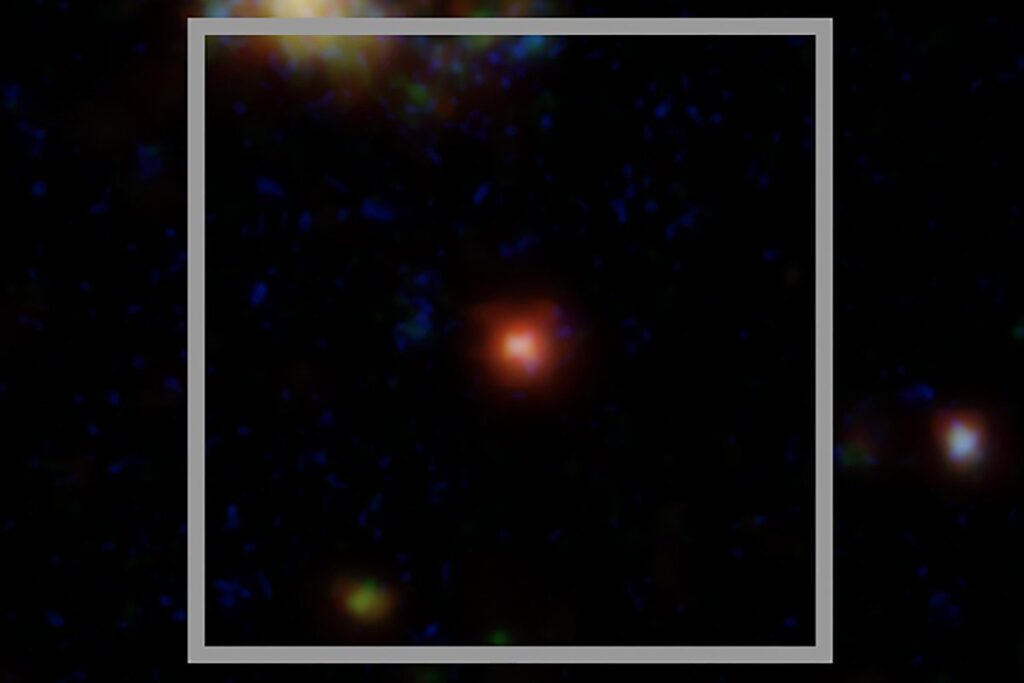
Astronomers have discovered an ‘X-ray dot’ that could be key to solving the mystery of a strange class of sources found in the early Universe.
The X-ray dot is located about 11.8 billion lightyears from Earth, and because the Universe is 13.8 billion years old, that means we’re seeing it as it existed at the dawn of the cosmos.
What’s more, astronomers think it could provide a crucial bridge between black hole stars and supermassive black holes.
 Credit: solarseven / Getty Images
Video explaining the discovery of X-ray dot 3DHST-AEGIS-12014. Credit: NASA/CXC/A. Hobart
Did we nearly miss the dot?
One of the biggest mysteries to come out of the wealth of data gathered by the James Webb Space Telescope so far is the so-called ‘little red dots’.
Since JWST began studying the Universe, astronomers have found hundreds of small, red objects.
These mysterious dots are about 12 billion lightyears from Earth or further, and have become known as little red dots.
One prevailing theory is that little red dots are supermassive black holes enshrouded in clouds of dense gas.
The dense gas clouds could be masking some of the usual signatures that astronomers observe in different kinds of light, including X-rays.
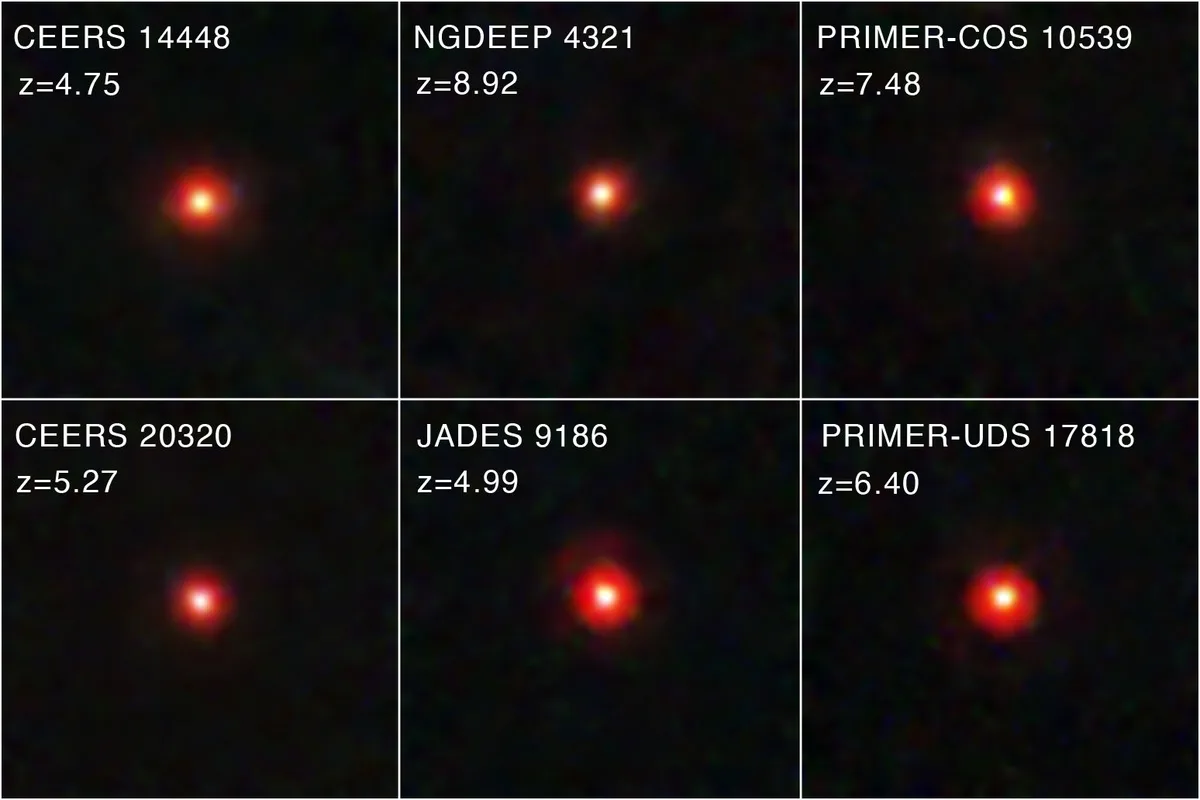 Little red dots (LRDs), as seen by the James Webb Space Telescope. Credit: NASA, ESA, CSA, STScI, Dale Kocevski (Colby College)
Supermassive black holes at the centres of galaxies are not normally embedded in dense gas, and so ultraviolet light and X-rays from material orbiting the black holes is able to be observed.
The newly-discovered object – known as 3DHST-AEGIS-12014 – is small, red and very far away, but it glows in X-ray light, unlike other little red dots.
“Astronomers have been trying to figure out what little red dots are for several years,” says Raphael Hviding of the Max Planck Institute for Astronomy in Germany, lead author of the study.
“This single X-ray object may be – to use a phrase – what lets us connect all of the dots.”
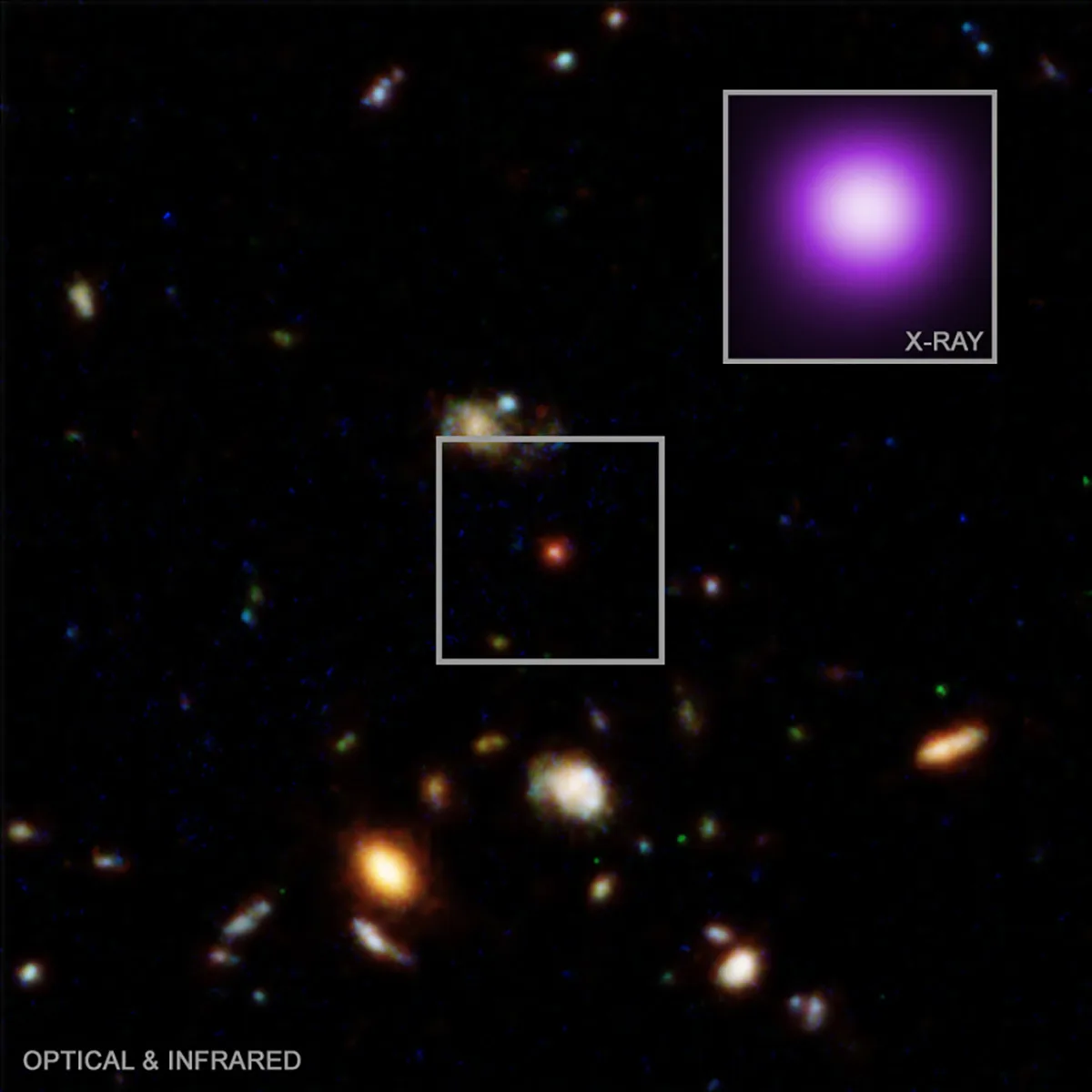 Image of the X-ray dot in X-ray and optical light. X-ray: NASA/CXC/Max Plank Inst./R. Hviding et al.; Optical/IR; NASA/ESA/STScI/HST; Image Processing: NASA/CXC/SAO/N. Wolk
The team found the object while comparing new data from the James Webb Space Telescope with a previous survey of deep space performed by the Chandra X-ray Observatory.
“If little red dots are rapidly growing supermassive black holes, why do they not give off X-rays like other such black holes?” says co-author Anna de Graaff of the Center for Astrophysics, Harvard & Smithsonian.
“Finding a little red dot that looks different from the others gives us important new insight into what could power them.”
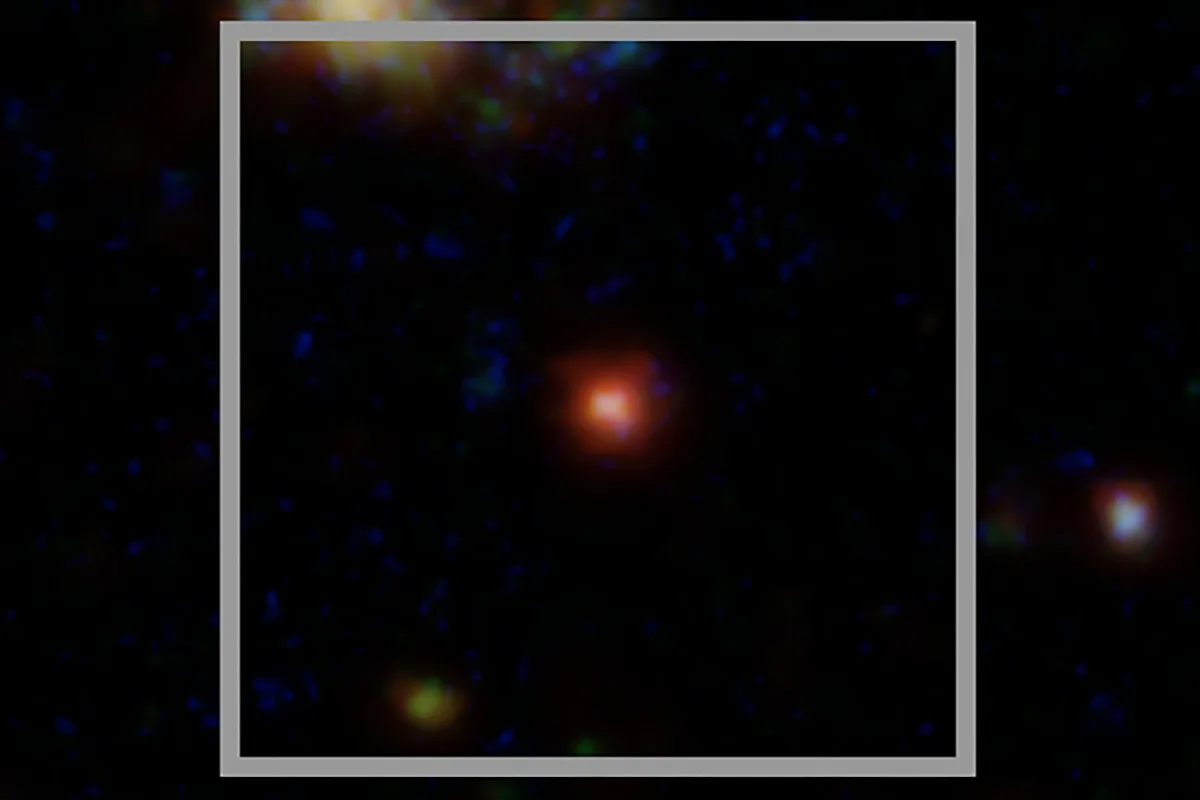 Close-up image of the X-ray dot in X-ray and optical light. X-ray: NASA/CXC/Max Plank Inst./R. Hviding et al.; Optical/IR; NASA/ESA/STScI/HST; Image Processing: NASA/CXC/SAO/N. Wolk
A black hole bridge?
The team say the X-ray dot could be a bridge between a little red dot and a growing supermassive black hole.
This ‘black hole star’ may be consuming the gas that’s surrounding it, causing patches to appear in the gas cloud.
That would enable X-rays from material falling onto the black hole to shine through and be observed by Chandra.
Eventually all the gas will be consumed, and the black hole star will cease to exist.
Chandra has potentially detected variations in X-ray brightness coming from the object, which would support the idea the black hole is partly obscured.
Like a sort of cosmic lighthouse, as the cloud of gas rotates, patches in the gas could be moving across the black hole, causing changes in brightness.
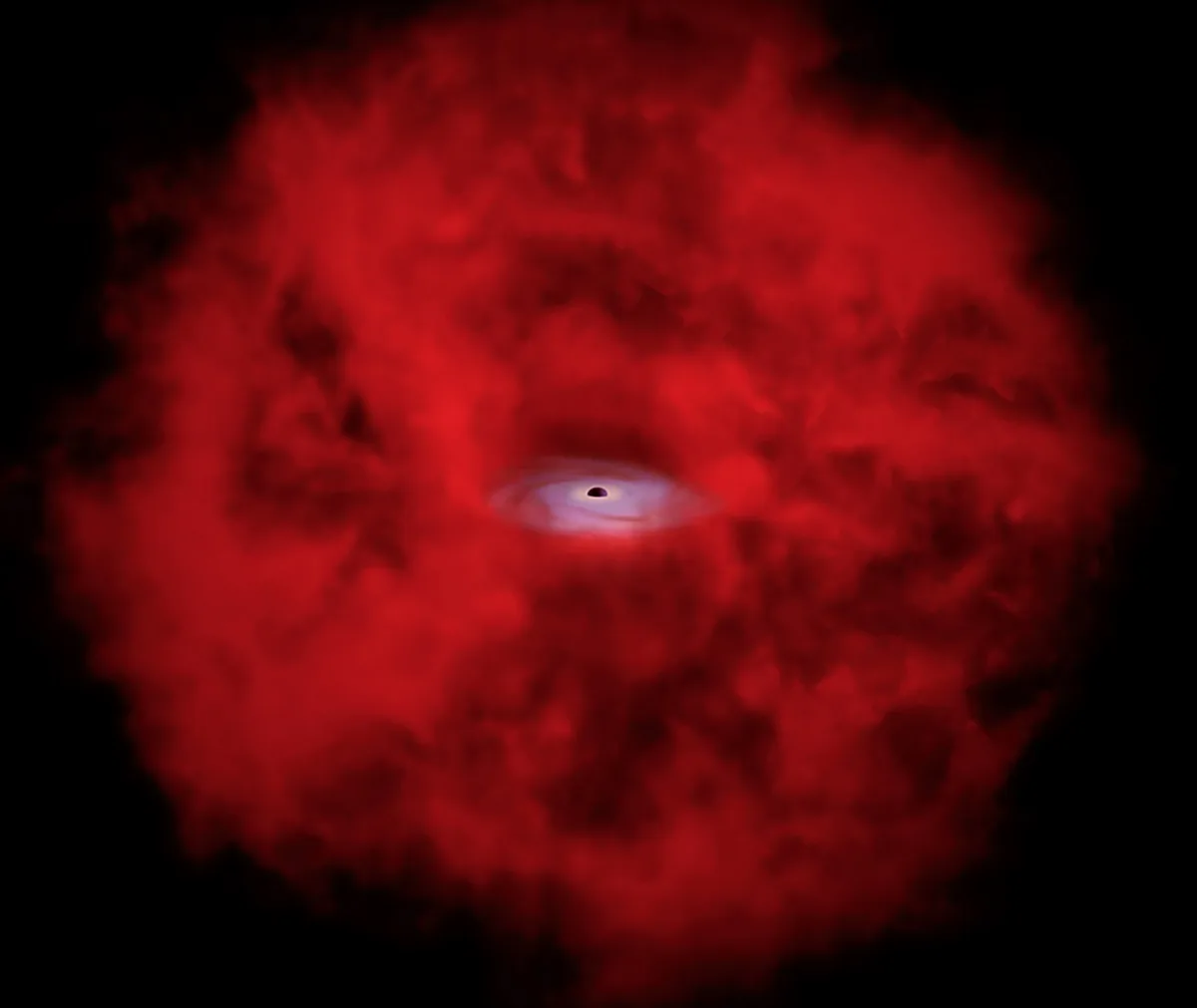 Artist’s impression of X-ray dot 3DHST-AEGIS-12014. Credit: NASA/CXC/SAO/M. Weiss; adapted by K. Arcand & J. Major
“If we confirm the X-ray dot as a little red dot in transition, not only would it be the first of its kind, but we may be seeing into the heart of a little red dot for the first time,” says co-author Hanpu Liu of Princeton University in New Jersey.
“We would also have the strongest piece of evidence yet that the growth of supermassive black holes is at the centre of some, if not all, of the little red dot population.”
The team say another theory is that the X-ray dot is a more common type of growing supermassive black hole, but covered in an unusual type of dust not seen before.
“The X-ray dot had been sitting in our Chandra survey data for over ten years, but we had no idea how remarkable it was before Webb came along to observe the field,” says co-author Andy Goulding of Princeton.
“This is a powerful example of collaboration between two great observatories.”