
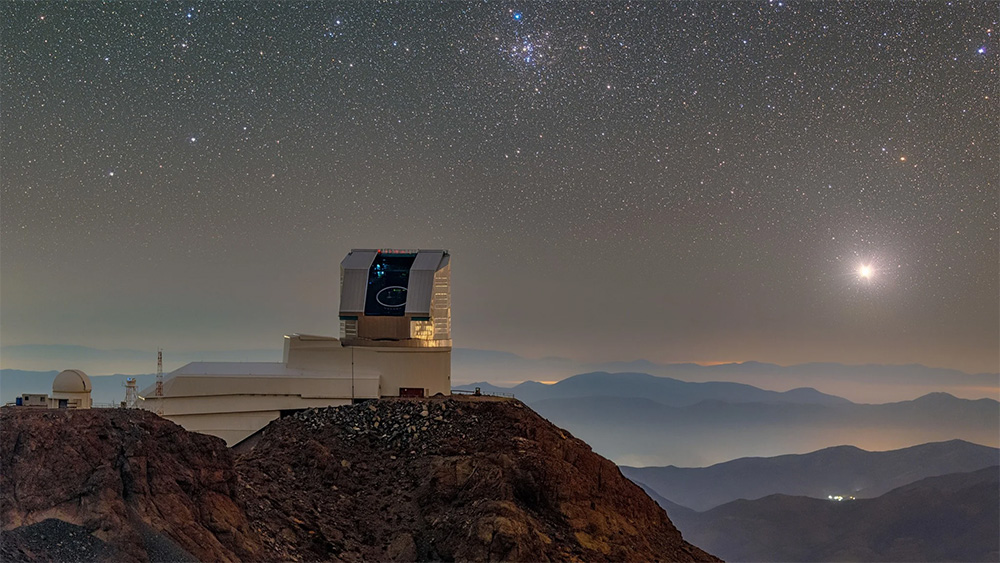
When the Coordinate Metrology Society (CMS) gathers for the 42nd annual conference this July in Dallas, one of the most anticipated talks won’t be about machining tolerances or inspection gauges but the cosmos itself. Sandrine J. Thomas, associate director for Summit Operations at the Vera C. Rubin Observatory, is delivering a keynote that connects the meticulous art of measurement on Earth with the vast scale of the universe beyond.
Thomas leads the team responsible for acquiring all data for the Legacy Survey of Space and Time (LSST), an audacious decade-long astronomical project that maps the entire southern sky every few nights using the largest digital camera ever built. At 3.2 gigapixels, the LSST camera can detect objects 100 million times fainter than what the human eye can see—a cosmic extension of the precision disciplines CMS has championed for decades.
From precision parts to celestial calibration
 Dr. Sandrine J. Thomas, Vera C. Rubin Observatory
In her keynote, Thomas will explore how metrology plays a starring role in maintaining accuracy across systems that span mountaintops, continents, and ultimately, the universe. At the Rubin Observatory, even minute misalignments can distort the telescope’s sweeping view of space.
Her presentation, “Precision Beyond the Shop Floor,” promises to reveal how tools of dimensional metrology translate to cosmic scales: aligning multimirror optical assemblies, calibrating detectors operating in extreme environments, and ensuring repeatability across a decade of nightly sky surveys.
The mountaintop observatory
The Rubin Observatory, located on a mountaintop in northern Chile, reached a major milestone in March 2025 when the National Science Foundation (NSF) and U.S. Department of Energy (DOE) teams installed the LSST camera on the telescope.
Once operational, the system will generate an estimated 60 petabytes of data—roughly the equivalent of every selfie ever uploaded—capturing supernovae, galaxies, asteroids, and the uncharted dynamic life of the night sky. The resulting time-lapse of the universe will help researchers probe dark matter, understand dark energy, and shape our understanding of the cosmos for generations.
The legacy of Vera C. Rubin
The observatory’s namesake, Vera Cooper Rubin (1928–2016), was a trailblazer long before the term “STEM equity” existed. Her groundbreaking work on the rotation of galaxies provided the strongest evidence for dark matter—one of the biggest discoveries in modern astrophysics.
Rubin began her career in an era when women were often denied overnight access to observatories—an irony not lost on modern scientists, because that’s the only reasonable time to view the stars. Her persistence carved a path for generations of women who continue to measure, map, and model both the visible and unseen in our universe. Rubin’s influence extends directly to projects like LSST and to scientists like Thomas, who embody Rubin’s fusion of precision, curiosity, and resilience.
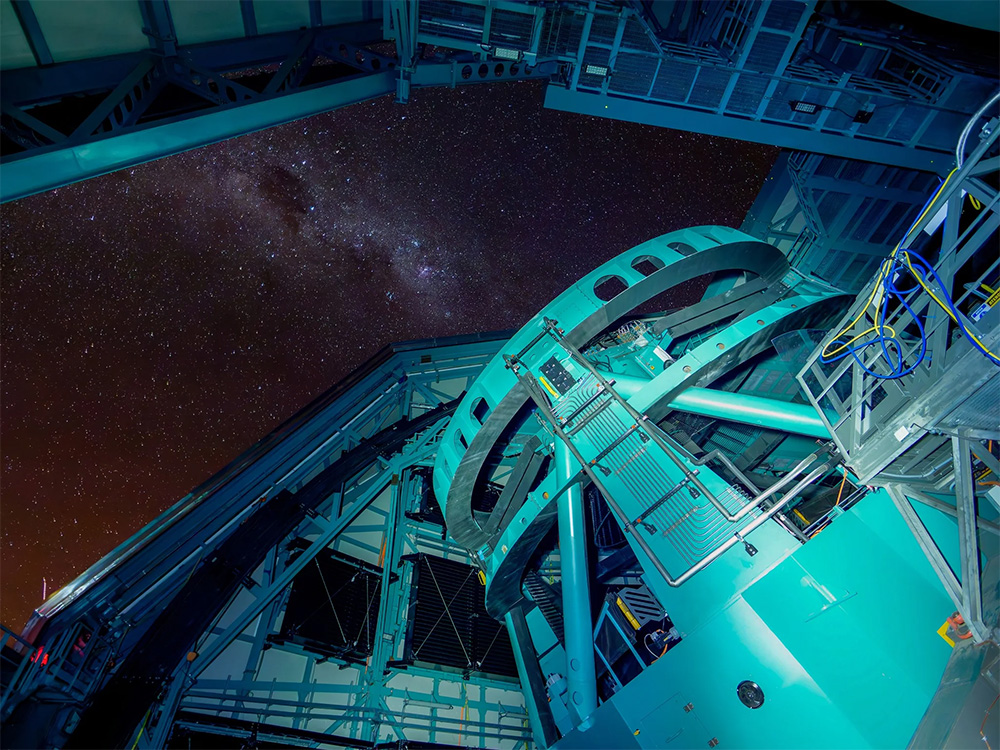
The night sky dazzles through the open dome of the Rubin Observatory. Rubin Observatory’s decade-long Legacy Survey of Space and Time (LSST) will generate an ultrawide, ultrahigh-definition, time-lapse record of the universe. Credit: RubinObs/NSF/DOE/NOIRLab/SLAC/AURA/W. O’Mullane
A measure of progress, not just distance
Women have long played transformative roles in fields that revolve around precision. Yet their contribution is often underrecognized. This year’s CMS theme, ”Women in Metrology,” aims to change that narrative by spotlighting experts who expand the boundaries of how and what we can measure.
As part of that ongoing focus, CMS has produced a short video conversation on the topic, featuring voices from across the community who are connecting fine-detail inspection to grand-scale exploration.
The cosmos, calibrated
Through both her scientific leadership and her presence at CMSC 2026, Thomas represents a bridge between the tech-heavy domain of precision metrology and the human story of discovery and innovation that makes it meaningful.
As the LSST begins its decade-long sweep of the sky later this year, every photo, every pixel, and every petabyte will depend on the discipline of measurement. In a way, every machinist, inspector, and metrologist has a small hand in making that cosmic time-lapse possible.
This July the cosmos comes to the conference floor, and its keynote speaker is proof that measurement doesn’t just shape our understanding of parts but our understanding of the universe itself.