
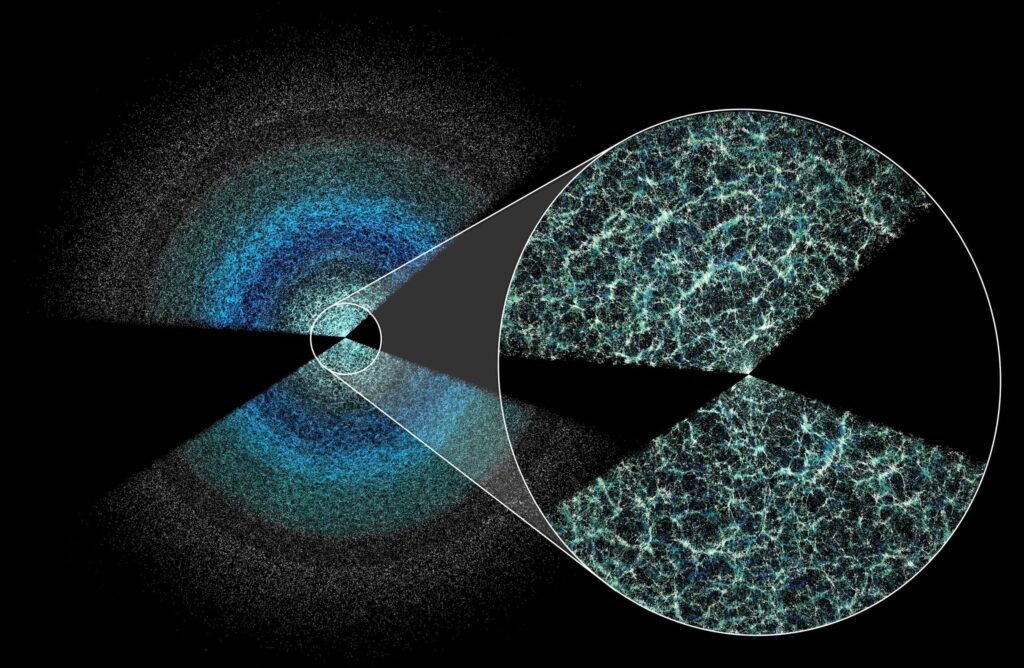
 A thin slice of the map produced by the DESI five-year survey shows galaxies and quasars above and below the plane of the Milky Way. Credit: Claire Lamman/DESI collaboration
A record-breaking 3D map of the universe is now complete, giving scientists a new way to study dark energy. The massive dataset could reveal surprising changes in how the universe is expanding.
Scientists have reached a major milestone in the effort to understand dark energy by finishing observations across the full target area of the Dark Energy Spectroscopic Instrument (DESI)’s 3D map of the universe.
The project wrapped up ahead of schedule and produced far more data than expected. The resulting map is the most detailed high-resolution 3D view of the universe ever created. Researchers will use it to investigate dark energy, the mysterious force thought to make up about 70% of the cosmos.
Mapping 47 Million Galaxies and Quasars
Over five years, DESI collected data on more than 47 million galaxies and quasars, along with 20 million stars. These observations have already provided important insight into how the universe is structured and how it has evolved over time, said Paul Martini, the instrument scientist during DESI construction and commissioning and a professor of astronomy at The Ohio State University.
“DESI has been a superb international collaboration, and its incredibly fruitful scientific results are a leading example of its impact on the broader scientific community,” he said.
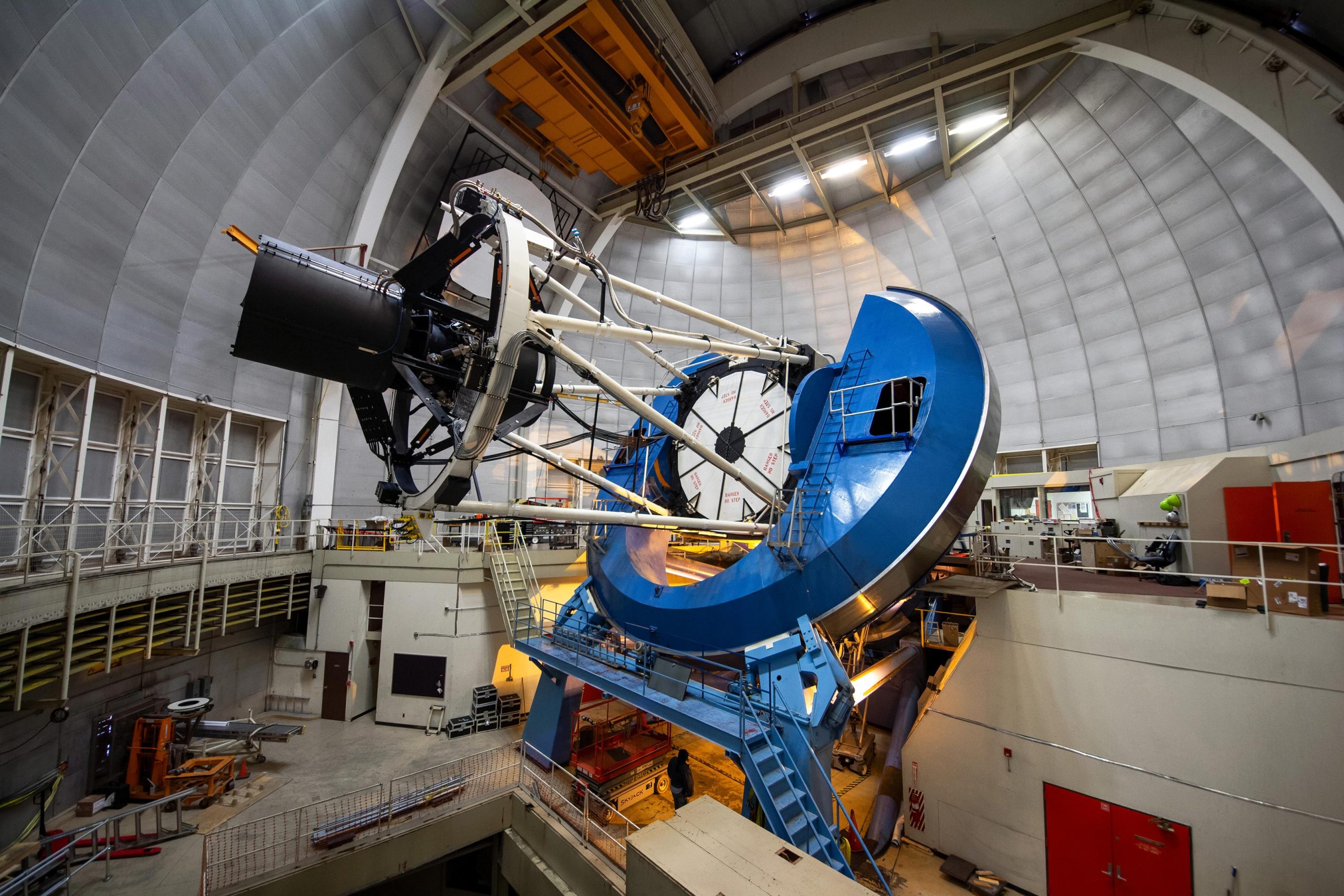 The Dark Energy Spectroscopic Instrument (DESI) is mounted on the U.S. National Science Foundation Nicholas U. Mayall 4-meter Telescope at Kitt Peak National Observatory, a Program of NSF NOIRLab. Credit: KPNO/NOIRLab/NSF/AURA/P. MarenfeldGlobal Collaboration Driving Dark Energy Research
The DESI project is a large international effort involving more than 900 researchers (including 300 PhD students) from over 70 institutions. It is managed by the Department of Energy’s Lawrence Berkeley National Laboratory. Scientists at Ohio State have played a key role in several major findings, including analyzing early data and studying how dark energy may be evolving in unexpected ways.
“Ohio State made the largest contributions to the instrumentation, operations, and analysis infrastructure of any university group in DESI,” said Klaus Honscheid, lead scientist of DESI instrument operations and a physics professor at Ohio State. “We are proud of our collaboration’s world-leading results on dark energy, as well as pleased with the substantial, international media attention they have received.”
Overcoming Challenges During the Survey
Despite an ambitious timeline, the team encountered several obstacles while completing the survey. One of the most significant disruptions came in 2022, when the Contras wildfire cut off power and internet access at the observatory for months. These issues were eventually resolved, allowing the project to continue, said Ashley Ross, lead scientist for the DESI large-scale structure catalogs and an assistant research professor of physics at Ohio State.
“By coming up with creative solutions to address unforeseen problems, the high-quality data we collected each night was carefully and confidently used to obtain the exciting cosmological constraints that DESI is now known for,” said Ross.
 The Dark Energy Spectroscopic Instrument (DESI) is installed on the Nicholas U. Mayall 4-meter Telescope on Kitt Peak National Observatory near Tucson, AZ. Credit: KPNO/NOIRLab/NSF/AURA/P. MarenfeldNew Data May Transform Understanding of the Universe
With the full dataset now complete, scientists have a powerful new resource to test long-standing ideas about the balance between dark energy and matter. The findings could significantly change how researchers understand the universe and its future.
DESI has gathered data on six times as many galaxies and quasars as all previous measurements combined. The team plans to begin processing the full dataset soon, with the first results from the complete five-year survey expected in 2027.
Next Phase of Observations Through 2028
Even though the initial mission is complete, DESI will continue collecting data through 2028. Future observations will expand into regions of the sky that are more difficult to study: Building an even more detailed map could help scientists examine nearby objects such as dwarf galaxies and stellar streams, offering a clearer picture of how the universe formed and evolved, said Honscheid.
Meanwhile, researchers at Ohio State will keep refining measurements of dark energy using data from the first three years, while also improving how the telescope is used to support new discoveries.
“A larger survey footprint will greatly improve our constraints on cosmological parameters and improve our dark matter program,” said Honscheid. “But these achievements are only possible because the operations team worked incredibly hard to keep the survey progressing.”
Contributors and Project Support
Other Ohio State contributors to DESI include Matthew Berno, Mikel Charles, Carl Coker, Rebecca Coles, Andrei Cuceu, Xinyi Chen, Mark Derwent, Ann Elliott, Jack Elvin-Poole, Lauren Ennesser, Kevin Fanning, Simon Filbert, Meagan Herbold, Jennifer Johnson, Naim Karacayli, Hui Kong, Claire Lamman, Thomas O’Brien, Daniel Pappalardo, Richard Pogge, Anna Porredon, Michael Rashkovetskyi, Jon Shover, Peter Taylor, Wynne Turner, David Weinberg, Molly Wolfson, and Erik Zaborowski.
DESI is supported by the DOE Office of Science and by the National Energy Research Scientific Computing Center, a DOE Office of Science national user facility. Additional support for DESI is provided by the U.S. National Science Foundation; the Science and Technology Facilities Council of the United Kingdom; the Gordon and Betty Moore Foundation; the Heising-Simons Foundation; the French Alternative Energies and Atomic Energy Commission (CEA); the Secretariat of Science, Humanities, Technology and Innovation (SECIHTI) of Mexico; the Ministry of Science and Innovation of Spain; and by the DESI member institutions.
The DESI collaboration is honored to be permitted to conduct scientific research on I’oligam Du’ag (Kitt Peak), a mountain with particular significance to the Tohono O’odham Nation.
Never miss a breakthrough: Join the SciTechDaily newsletter.
Follow us on Google and Google News.