
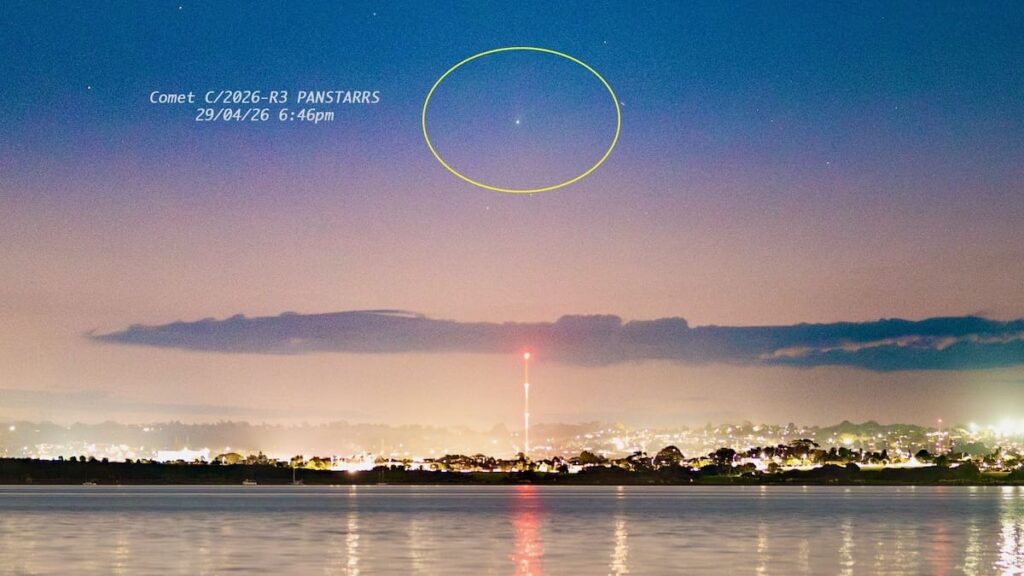
R3 has been making international headlines for its visibility.
Similar comets pass by Earth every month but can’t be seen, Aoraki said.
Comets are notoriously hard to predict because as they get closer to our sun they deteriorate.
Comet R3 is made of mostly ice, rock and dust.
“The sun’s basically ripping material off these comets,” Aoraki said. “It’s hard for us to calculate how bright it’s going to get, or even if it’s going to survive its encounter with the sun.”
Not all comets take 170,000 years to orbit the sun. Short-period comets orbit in under 200 years. Long-period comets, such as R3, originate from the distant Oort Cloud.
The Oort Cloud is a ring of small, orbiting objects known as planetesimals between 0.3 and 3.2 light years (or 3 trillion kilometres and 30 trillion kilometres) away.
R3’s “tail” behind the comet, which is ice vaporised by the sun and pushed away by solar wind, is part of the reason it’s visible to us, Aoraki said.
Amateur astrophotographer Rohit Vig was one of the first to capture a photo of the comet and share it on Instagram (@sujiva) after taking a shot from Point Chevalier Beach on Wednesday at 6.46pm.
You don’t have to be a professional to photograph or see the comet, Vig said. He snapped it with his Nikon camera and an 85mm lens.
“Now it’s easy with the star chart apps.”
Vig said he got “hooked” on astrophotography after the first time he saw the rings of Saturn.