
Astronomers have discovered that the angle at which one galaxy collides with another can determine whether their central black holes will merge at all. If the orbit of the accreting black hole is inclined by more than 45 degrees relative to the other black hole’s disk, the merger will not occur even in 14 billion years—that is, over the entire current age of the universe.
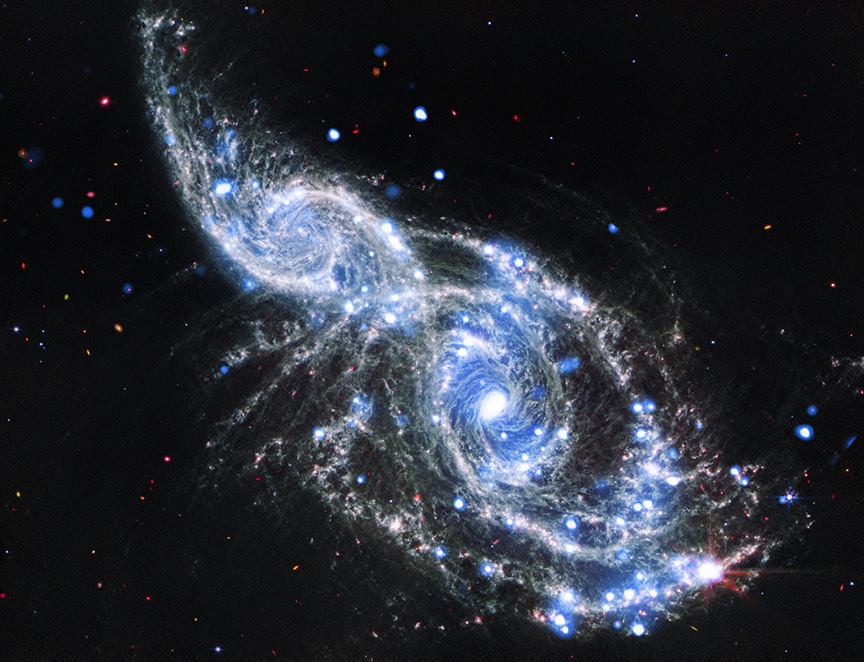
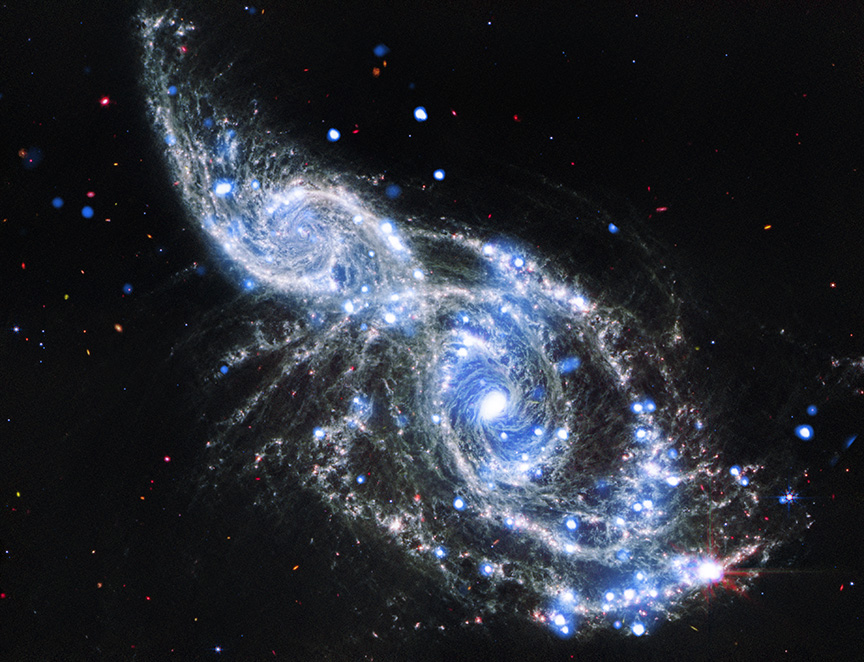 Galaxy merger in X-ray (NASA Chandra X-ray Observatory) and infrared (JWST) light. Image credit: NASA/CXC/SAO/L. Frattare.
When galaxies collide
Researchers have long known that when two galaxies approach each other and merge, the supermassive black holes at their centers form a pair and are eventually expected to merge as well.
It is precisely these mergers that are considered one of the sources of the gravitational-wave background—a faint “hum” of spacetime detected in recent years. However, the role played by the geometry of the collision in this process has remained an open question.
Simulations with different angles
Sena Ghobadi of the Georgia Institute of Technology, along with her colleagues, has developed three-dimensional dynamic models of such collisions.
In each simulation, a supermassive black hole with a mass ranging from one million to one hundred million solar masses was located at the center of a disk galaxy, while a smaller black hole spiraled toward it from a distance of about 3,300 light-years.
The team varied the inclination of the incoming orbit from 0 to 75 degrees and recorded how long it took for the pair to approach within 10 parsecs (about 33 light-years) of each other.
Critical threshold — 45 degrees
The results were clear. At inclinations of up to 20 degrees, the dynamic friction between the black hole and the galaxy’s matter—stars and gas—“pulled” the object toward the plane of the disk and accelerated the merger.
Between 20 and 45 degrees, the process slowed down but still completed. However, above 45 degrees, the orbit, on the contrary, became increasingly steep, and none of the simulated pairs managed to merge before the allotted time ran out.
In addition to the angle, the merger rate was influenced by the mass of the black holes and the rotation speed of the galactic disk: the greater the mass and the faster the disk rotates, the faster the merger occurs.
What does this mean for observations?
The results obtained offer a new perspective on familiar objects. Pairs of active galactic nuclei and supermassive black holes that produce gravitational waves today most likely formed from systems where the initial inclination angle did not exceed 20 degrees.
This places significant restrictions in terms of which mergers lead to registered events—and can help predict more accurately where to look for such pairs.
According to iopscience.iop.org