
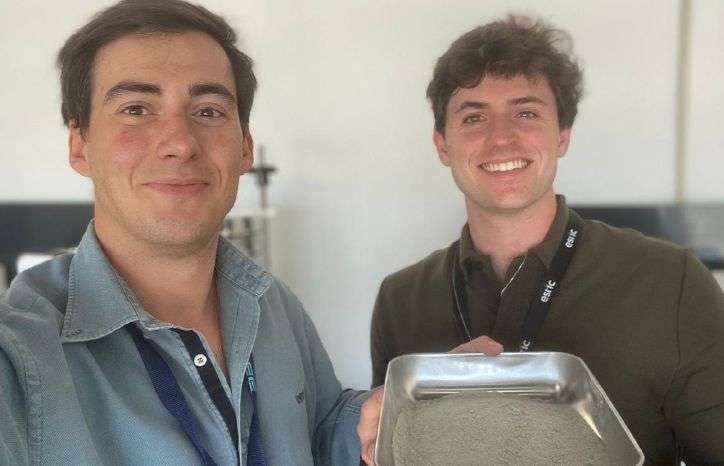
In the Technology Park of the Carlos III University campus in Leganés (Madrid), the company Hispansion develops lunar soil simulants that allow space agencies, companies, and research centers to test on Earth the technologies that will be deployed in future missions to the Moon, with the aim of reducing technical, economic, and strategic risks before their actual use over 380,000 kilometers away.
The push to return to the Moon has become a strategic, technological, and economic objective. The missions of the Artemis program, led by NASA with the participation of the European Space Agency (ESA) and the Canadian Space Agency, no longer aim just to return to the satellite but to establish a sustained human presence, with permanent infrastructures and the capacity to exploit local resources.
“The Moon is no longer just about exploring for exploration’s sake,” explained energy engineer Carlos Aguilar, co-founder of the startup that manufactures Moon soil, to Servimedia. “A satellite that concentrates critical resources, including rare earths that are essential for industrial and digital technology. There are countries and major players behind these minerals because they are strategic for the future economy,” he pointed out.
Transporting materials from Earth to the Moon is extremely complex and costly, which necessitates the development of technologies capable of using the resources available there, on the lunar surface. “Going to the Moon to explore or test things without guarantees is unfeasible. Each failure costs a lot of money and can compromise not only a mission but also human lives and years of planning, investments, and international credibility,” he stressed.
What is lunar regolith
Lunar regolith, the layer of dust and rock fragments that covers the Moon’s surface, is “an essential raw material to test, before undertaking them, practically all planned activities”: from constructing landing platforms, roads, or habitats to extracting oxygen for life support, generating energy, or operating vehicles and robotic systems. “Everything depends on how that material behaves; and that behavior needs to be understood and reproduced before getting there,” indicated Jaime Abella, an engineer specialized in Biology and founding partner of Hispansion.
Before these space technologies are deployed on the lunar surface, they must be tested and validated on Earth. Therefore, it is essential to have materials that reproduce as faithfully as possible the composition and real behavior of lunar regolith. “If a technology is developed in an environment that is not sufficiently faithful, it will fail when it reaches the Moon, and there is no room for trial and error there,” according to Abella.
The material produced, named Terralun, reproduces the chemical composition of the regolith, its mineralogy, and its physical and mechanical properties. Aguilar and Abella developed these soil simulants of the Moon’s major regions: the highlands, lighter, and the lunar mares, low in titanium, darker. At the end of the process, they incorporated Fernando Alberquilla, a PhD candidate in Planetary Geology.
To calibrate the different scenarios, Hispansion used the international standard of NASA known as Figures of Merit (FoM), which analyzes the similarity between the simulant and the real lunar regolith in parameters such as composition, grain size distribution, density, or mechanical resistance. The product achieves average scores between 89 and 91 out of 100, ranking among the highest recorded worldwide.
At 25 euros for 5 kilos
Production can reach more than 1,000 tons annually of simulant. The company sells its regoliths directly, from small quantities (at a price of 25 euros per 5 kg bag) to large industrial volumes, and already maintains commercial contacts with space agencies and companies in Europe, the United States, Canada, Japan, and Australia.
Hispansion is committed to developing and scaling its activity from Madrid and being “an international reference supplier of test materials and technologies associated with the use of lunar resources, a discreet but essential role in the new space economy,” Aguilar concludes.
In the Technology Park of the Carlos III University campus in Leganés (Madrid), the company Hispansion develops lunar soil simulants that allow space agencies, companies, and research centers to test on Earth the technologies that will be deployed in future missions to the Moon, with the aim of reducing technical, economic, and strategic risks before their actual use over 380,000 kilometers away.
The push to return to the Moon has become a strategic, technological, and economic objective. The missions of the Artemis program, led by NASA with the participation of the European Space Agency (ESA) and the Canadian Space Agency, no longer aim just to return to the satellite but to establish a sustained human presence, with permanent infrastructures and the capacity to exploit local resources.
“The Moon is no longer just about exploring for exploration’s sake,” explained energy engineer Carlos Aguilar, co-founder of the startup that manufactures Moon soil, to Servimedia. “A satellite that concentrates critical resources, including rare earths that are essential for industrial and digital technology. There are countries and major players behind these minerals because they are strategic for the future economy,” he pointed out.
Transporting materials from Earth to the Moon is extremely complex and costly, which necessitates the development of technologies capable of using the resources available there, on the lunar surface. “Going to the Moon to explore or test things without guarantees is unfeasible. Each failure costs a lot of money and can compromise not only a mission but also human lives and years of planning, investments, and international credibility,” he stressed.
What is lunar regolith
Lunar regolith, the layer of dust and rock fragments that covers the Moon’s surface, is “an essential raw material to test, before undertaking them, practically all planned activities”: from constructing landing platforms, roads, or habitats to extracting oxygen for life support, generating energy, or operating vehicles and robotic systems. “Everything depends on how that material behaves; and that behavior needs to be understood and reproduced before getting there,” indicated Jaime Abella, an engineer specialized in Biology and founding partner of Hispansion.
Before these space technologies are deployed on the lunar surface, they must be tested and validated on Earth. Therefore, it is essential to have materials that reproduce as faithfully as possible the composition and real behavior of lunar regolith. “If a technology is developed in an environment that is not sufficiently faithful, it will fail when it reaches the Moon, and there is no room for trial and error there,” according to Abella.
The material produced, named Terralun, reproduces the chemical composition of the regolith, its mineralogy, and its physical and mechanical properties. Aguilar and Abella developed these soil simulants of the Moon’s major regions: the highlands, lighter, and the lunar mares, low in titanium, darker. At the end of the process, they incorporated Fernando Alberquilla, a PhD candidate in Planetary Geology.
To calibrate the different scenarios, Hispansion used the international standard of NASA known as Figures of Merit (FoM), which analyzes the similarity between the simulant and the real lunar regolith in parameters such as composition, grain size distribution, density, or mechanical resistance. The product achieves average scores between 89 and 91 out of 100, ranking among the highest recorded worldwide.
At 25 euros for 5 kilos
Production can reach more than 1,000 tons annually of simulant. The company sells its regoliths directly, from small quantities (at a price of 25 euros per 5 kg bag) to large industrial volumes, and already maintains commercial contacts with space agencies and companies in Europe, the United States, Canada, Japan, and Australia.
Hispansion is committed to developing and scaling its activity from Madrid and being “an international reference supplier of test materials and technologies associated with the use of lunar resources, a discreet but essential role in the new space economy,” Aguilar concludes.
Become a premium member for free!