
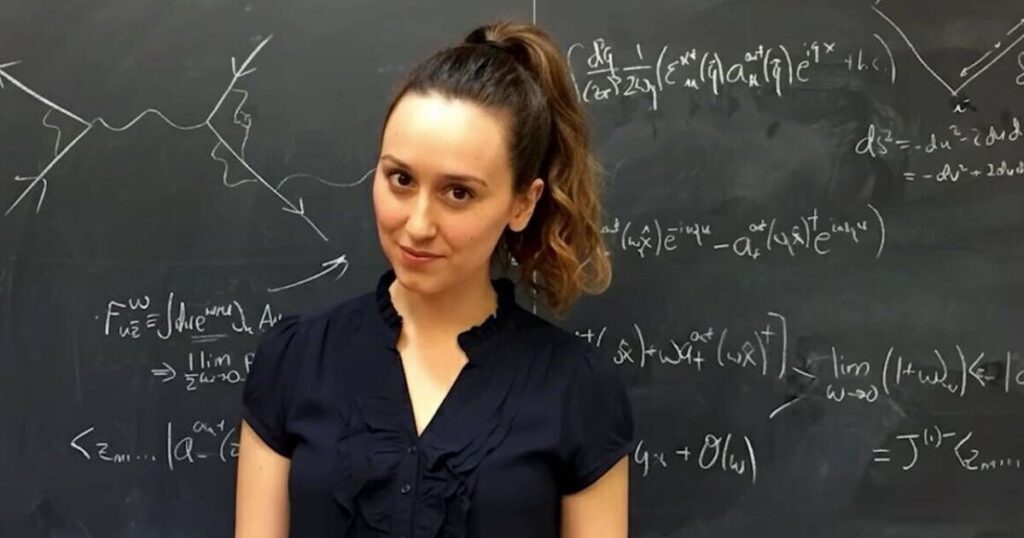

Sabrina Gonzalez Pasterski has been dubbed the ‘new Einstein’ (Image: Turing/YouTube)
A woman who built her own aircraft at just 12 could dethrone Albert Einstein as the greatest mind of all time — and she doesn’t “want to make billionaires richer.”
32-year-old Sabrina Gonzalez Pasterski built an aeroplane when she was 12, was turned down by MIT, convinced them to accept her anyway, graduated top of her class in physics, and went on to study at Harvard.
But she rejects the Einstein moniker. She said: “When Harvard University called me ‘the next Einstein’, I expressed my rejection of that title, stating, ‘I am just a grad student. I have so much to learn. I do not deserve the attention’”.
Pasterski is tackling problems Einstein could not fully explain — but she has always been ahead of the curve. As a child she built a real aeroplane from scratch, mastering engineering, aerodynamics and physics.
At 16, she piloted the plane she built herself in Canada with no instructor or safety net. She said: “Belief doesn’t make planes fly. Physics does”, reports the Mirror US.
READ MORE: UK scientists invent pillow cases that warn deaf sleepers of fires and burglars
READ MORE: Stephen Hawking was stumped by it – but a 7 dimension universe could explain all

She built a plane at 12 (Image: Turing/YouTube)
She applied to MIT and was turned down — so she sent MIT a video of her flying the plane and they invited her to join the next semester.
Three years later she graduated from MIT with a perfect GPA.
Now she specialises in quantum gravity, black holes and the structure of spacetime.
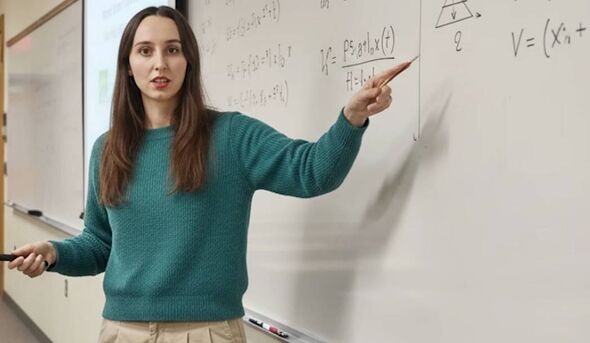
Pasterski turned down working with Jeff Bezos (Image: Turing/YouTube)
Stephen Hawking cited her work and Jeff Bezos invited her to Blue Origin, his private space launch company.
She said no, saying: “I don’t want to make billionaires richer. I want to understand how the universe works.”
While there, Pasterski and her colleagues uncovered a phenomenon known as the ‘spin memory effect’, and upon publishing her findings, she was cited by Professor Stephen Hawking.
According to SD2, Brown University put forward an offer of $1.1 million for her to join their ranks, yet she declined in favour of The Perimeter Institute for Theoretical Physics, where she is currently based.
Having joined in 2021, she now heads their Celestial Holography Initiative, which involves encoding the universe as a hologram as part of a project “uniting our understanding of spacetime with quantum theory”.
She explained: “Celestial holography consists of two words: celestial and holography. Celestial literally means looking up at the night sky to understand how to encode the physical universe as a hologram”.
Should that all seem a little too complex, there’s no need to worry — Pasterski also runs a YouTube channel, PhysicsGirl, where she breaks down her research in an accessible manner.