

China will unveil its latest achievements in deep space exploration, commercial space activities, and research on lunar samples at the launch ceremony of the main events of Space Day, according to China National Space Administration (CNSA) in Beijing on Friday.
April 24 marks the 11th Space Day of China.
The main events for the occasion, including a launch ceremony, a series of space science popularization exhibitions, and a space culture and arts forum, will be held in Chengdu, capital city of southwest China’s Sichuan Province.
Concurrent activities will also include the China Space Conference, space science popularization programs in schools, and technical exchanges.
The launch ceremony will be held in the morning of April 24, during which a promotional video and theme song will be released, along with major announcements regarding the space sector.
“At the space science popularization exhibition, lunar samples collected from both the near side and far side of the Moon by Chang’e-5 and Chang’e-6, respectively, will be displayed side by side. The large-scale space VR (virtual reality) science popularization and science fiction show Footprints in the Stars: Rendezvous on the Lunar Far Side will also invite public participation. The launch ceremony will also feature the release of a series of major announcements, including the latest achievements in deep space exploration, commercial space activities, and research on lunar samples collected by Chang’e-5,” said Liu Yunfeng, deputy director of the CNSA’s system engineering department, at a press conference on the upcoming Space Day of China.
More than 30 provinces, autonomous regions and municipalities across the country will host activities such as space open houses, science popularization lectures, knowledge competitions, and exchange and discussion sessions to mark the Space Day.
Outstanding space-themed films and television programs, including Missions to the Moon – China’s first documentary on its lunar exploration – will be broadcast in succession.

Space Day events to spotlight China’s latest space exploration feats in Chengdu
Teams attending the 2026 humanoid robot half-marathon are racing to fine-tune every detail before hitting the course on Sunday.
As the world’s first humanoid robot marathon, this year’s event will see a record 112 teams taking part, including five international teams from countries including Germany, France and Brazil.
Co-hosted by the Beijing Municipal People’s Government and China Media Group, the event covers two main categories – autonomous navigation and remote control – with autonomous navigation teams accounting for nearly 40 percent of the total.
One week ago, a full-scale test of the event has already been conducted in Beijing’s E-Town Economic and Technological Development Area.
“Really impressive! When I see what they’ve done in the first marathon that happened last year and what we saw this year, I’m impressed by the advancements that have been made. Last year, some robots had some hard time to just stay standing, but now this year almost every robot is able to stand. And they all focus on performances and that’s very exciting,” said Etienne, a member of Paris-Saclay University Team.
The 21-kilometer race route covers more than 10 types of terrain including flat ground, slopes, curves, and narrow sections. It features 12 left turns and 10 right turns, including several near-90-degree curves, providing complex environment for robots to test their adaptation and decision-making capabilities.
“This event requires robots to achieve such high mobility autonomously on the course, which poses a significant test of their agility. Even for humans, executing sharp turns under such complex conditions is quite challenging. For robots, this setup further increases the technical difficulty and challenge,” said Zhao Mingguo, a researcher at the Department of Automation of Tsinghua University.
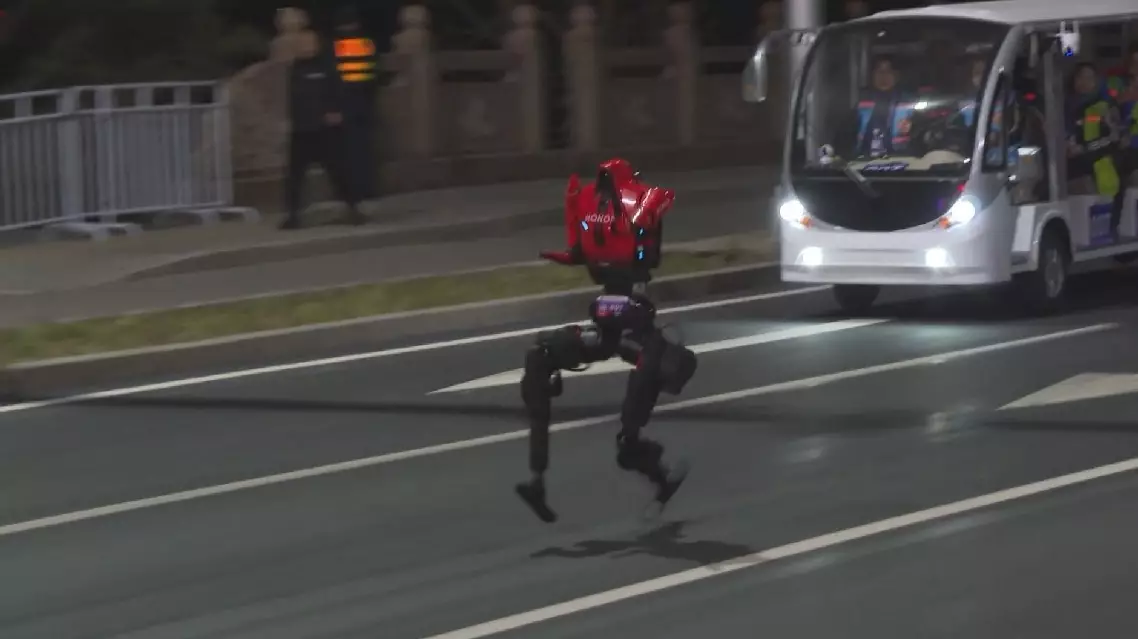
Humanoid robots gear up for Beijing half-marathon