
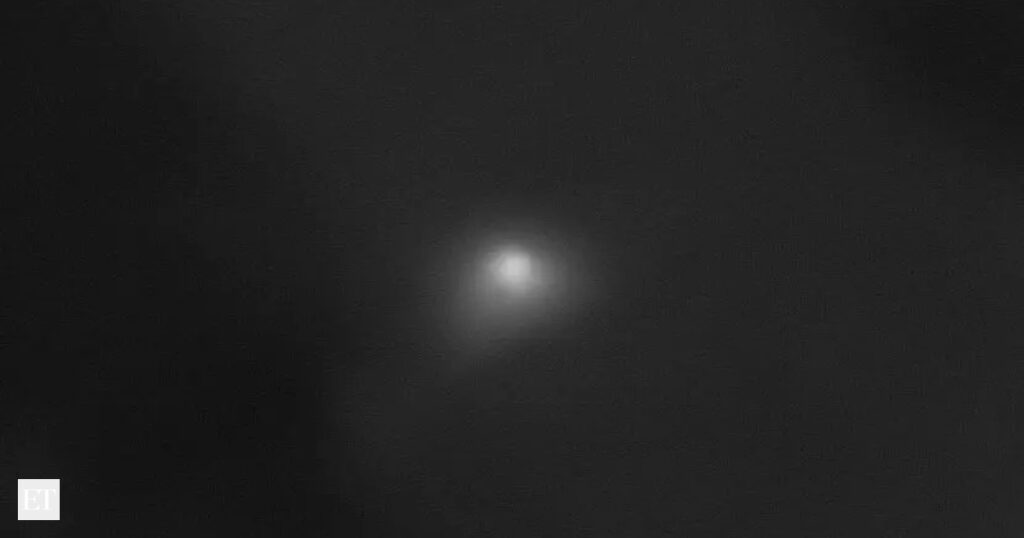
The mysterious interstellar visitor 3I/ATLAS, only the third known object from beyond our solar system, is now near Jupiter as it heads back into deep space. After looping around the Sun within 1.5 AU in October 2025, scientists analyzing its billion-year journey have identified methane streaming from the comet, a powerful greenhouse gas that is about 80 times stronger than carbon dioxide, offering new clues about its unusual composition and distant origins
Methane (CH₄) is a colorless, odorless, and highly flammable gas composed of carbon and hydrogen. It is also a potent greenhouse gas that affects climate change by contributing to increased warming, according to the United States Environmental Protection Agency (USEPA).
The gas is about 80 times more powerful at warming the atmosphere than carbon dioxide over a 20-year period, according to the United Nations Environment Programme.
Methane detected as comet warmed
A new study published in The Astrophysical Journal Letters confirmed that 3I/ATLAS increasingly emitted methane as it passed close to the Sun. As the comet warmed, volatile ices on its surface turned directly into gas, revealing what the interstellar object is made of. Researchers believe these observations could help explain the comet’s unusual origins. Live Events”It’s a very interesting object,” said lead author Matthew Belyakov, a graduate student at the California Institute of Technology, in a statement. “It has been traveling through the galaxy for at least a billion years. The high speed at which it flew past us gave just a narrow window to study it,” he continued, explaining why tracking this comet was so difficult.
Observations using James Webb Space Telescope
Scientists used the James Webb Space Telescope to examine mid-infrared signatures emitted by 3I/ATLAS as it approached the Sun. These wavelengths, about 10 times longer than visible light, allowed researchers to analyze the comet’s chemical composition and the distant environment where it formed.3I/ATLAS is more than a kilometer wide and consists of dust and ice from a far-off planetary system. As the comet warmed, its volatile surface layers began to sublimate, exposing deeper material and providing insight into its internal composition.
Two other interstellar objects have previously visited the solar system: ʻOumuamua, discovered in 2017, which showed no comet-like activity; and 2I/Borisov, found in 2019, which was relatively faint. In contrast, 3I/ATLAS is brighter, making it easier to study.
What this 3I/ATLAS’s methane emission means
Cosmic rays irradiated the comet’s surface during its billion-year journey, weakening the outgassing of volatile ices such as methane as it first approached Earth. However, as 3I/ATLAS began leaving the solar system, observations showed methane emissions increasing as sunlight warmed deeper icy layers.
This suggested the comet shed its ancient outer surface and exposed its inner composition. Researchers say the observations taken after its close approach reveal the underlying chemistry of the object rather than just its outer irradiated layers.
“JWST is going to look at 3I/ATLAS one more time this spring,” Belyakov says. “It’s already getting tough to observe; it’s now out by Jupiter.” The team also investigated the dust composition of 3I/ATLAS, which will be reported in a future paper.
Add  as a Reliable and Trusted News Source