
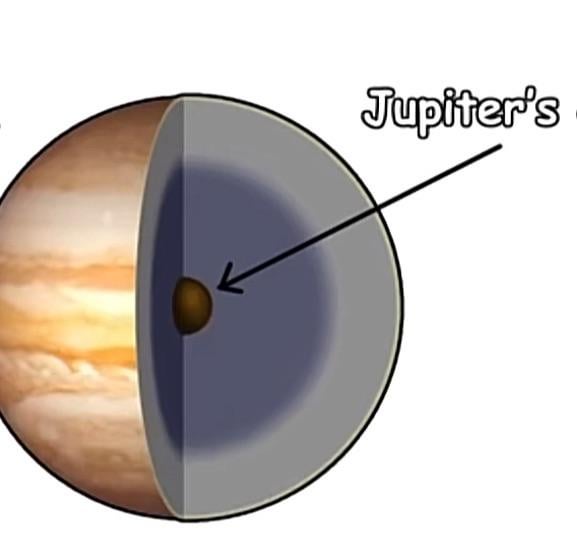
So right now I’m thinking If both Jupiter and Saturn are gas giants then wouldn’t it be the same that they are really small as the core of the planets are basically the planet like for earth we have like ground and stuff sourrounding our core but it’s not the same on Jupiter or Saturn as there is gas surrounding they’re planet so basically in theory the gas is just a atmosphere around the small rock with lot of mass and so Jupiter and Saturn are super small planets also I sound like such a dweeb and I’m sorry I’m out my mind 😭😭 but like in the photo you see how the rock in the middle is solid and the rest of it is gas instead of being solid like all the other planets
by Upbeat-Paint1892
13 Comments
You’re correct, but you’re omitting ridiculously high pressure, radioactive decay, and residual heat.
Put all those together and your “atmosphere” is a super-hot material that doesn’t behave like a solid.
Pressure makes the gas turn into a solid state. It’s impenetrable; therefore, effectively being a “ground”
Bro punctuation is free. Use a period once in a while.
write this up coherently if you want anyone to bother lmao
Jupiter actually has what is referred to as a “dilute core.” No sharp boundaries, but a fuzziness that blends into the extremely dense, supercritical gas above it.
We typically think of air/solid in terms of earth. Our air has a density of .001g/cm^3 and our ground is ~3g/cm^3.
You sense the ground because of a huge density contrast (1000:1).
On gas giants, as you go deeper, the density of the gas just continues going up – up to 20+g/cm^3 in the case of Jupiter. So it’s much denser than what you’d sense here on earth as rock. There’s no density contrast like you typically think of for atmosphere/solid.
It’s just a gradient of density all the way down.
On Earth, most of the planet’s mass is heavy elements like iron and other metals, the atmosphere is just a fraction of the total mass.
Gas giants like Jupiter and Saturn are the opposite: most of their mass is hydrogen and helium. Even though those elements aren’t “gas” deep inside (they’re liquid-like or even metallic under immense pressure), they still make up most of the mass of the planet. There also seem to be no exact point where the “atmosphere” ends and a solid core or surface begins. If i remember correctly, data from the Juno mission suggests Jupiter’s core might be “fuzzy” and not a just a neat rocky sphere.
Also, please use punctuation…
From the Juno Mission webpage:
>According to most theories, Jupiter has a dense core of heavy elements that formed during the early solar system. The solid core of ice, rock, and metal grew from a nearby collection of debris, icy material, and other small objects such as the many comets and asteroids that were zipping around four billion years ago. These bits of matter clumped together due to their mutual gravity, becoming larger chunks called planetesimals, which, in turn, collided and stuck together to form Jupiter’s core.
>Soon, the core grew big enough so that it had enough gravity to attract even hydrogen and helium, the lightest elements that exist. More and more gas accumulated until it became what we now know as Jupiter. Although most scientists agree on this general story, many details remain unknown. For example, we’re still not sure where all the icy matter comes from.
>Another theory, however, suggests that there’s no core at all. Instead, Jupiter formed from the large cloud of gas and dust that surrounded the Sun soon after its birth. As this cloud cooled and condensed, gas and dust particles lumped together so that some regions were denser than others. One of these dense splotches was able to gravitationally pull more and more gas and dust together, swelling into a full-fledged planet.
>By measuring Jupiter’s gravitational and magnetic fields, Juno will be able to determine whether a core exists. If it does, exactly what the fields look like will depend on how big it is. Different theories make different predictions about the core, and knowing the size will help determine which theory – if any – is more likely to be correct.
>If Juno finds no evidence of a core, then that could strengthen the condensed-cloud theory. Another possibility is that Jupiter once had a core, but it has since eroded away. It could also be that whatever Juno finds won’t fit any theory, and scientists will have to come up with completely new ideas.
In all seriousness, though, what did you take & how much of it?
We don’t know for sure what the interior of Jupiter and Saturn are like, but the structure almost certainly just gets slowly denser and hotter. There probably isn’t any distinct surface anymore than layers of the Earth’s interior have a distinct surface.
Something to keep in mind is there is way way _way_ more material in Jupiter and Saturn (especially Jupiter) than on Earth. Even assuming there is a rocky core (possible), the gas above it is not like Earth’s atmosphere but a bit thicker. It is possible that the hydrogen turns into a metallic _liquid_ at those pressures. It’s nuts.
[This](https://www.teachastronomy.com/textbook/The-Giant-Planets-and-Their-Moons/Internal-Structure-of-the-Gas-Giant-Planets/) site has a pretty good explanation of the gas giants in our solar system. Basically there is a solid ish core surrounded by fuzzy boundaries of hydrogen and helium transitioning from metallic (if the planet is large enough) to liquid to gas. They all seem to be very hot and dynamic, and nowhere a human would ever want to be.
Hey I’m sorry for the bad punctuation as I ask these stupid questions a lot on other sub Reddit’s. Bare with me 😭❤️
I read that whole thing with a high voice. How can you not?