
The University of Wisconsin-Madison Space Place Outreach Center announced it will be closing its doors at the end of June after 35 years of astronomy outreach, due to campus budget cuts.
UW Space Place is among the latest program closures due to the university enacting 5-7% cuts in departmental budgets.
“The damage coming from the budget cuts runs the gamut,” James Lattis, the director of UW Space Place, told The Daily Cardinal. “It has dispersed research teams and researchers who have to go looking for other jobs, [and] programs that even if the funding came back, you wouldn’t be able to get going again right away without doing years of rebuilding.”
Established in 1990, UW Space Place is an education and public outreach center in the UW-Madison Astronomy Department. The center was famous for hosting various activities, scientific lectures and presentations to 10,000 visitors annually, being the source of general astronomical research to the wider public.
During the partial solar eclipse in Madison on April 8, 2024, Lattis said the UW Space Place acted as a primary source of information for local news outlets.
“There’s a constant demand for astronomical information that goes all the way from just somebody saying, ‘What is that bright thing I see out my window at night?’ to ‘How do I prepare for these upcoming events, like an eclipse or a meteor shower?” Lattis said.
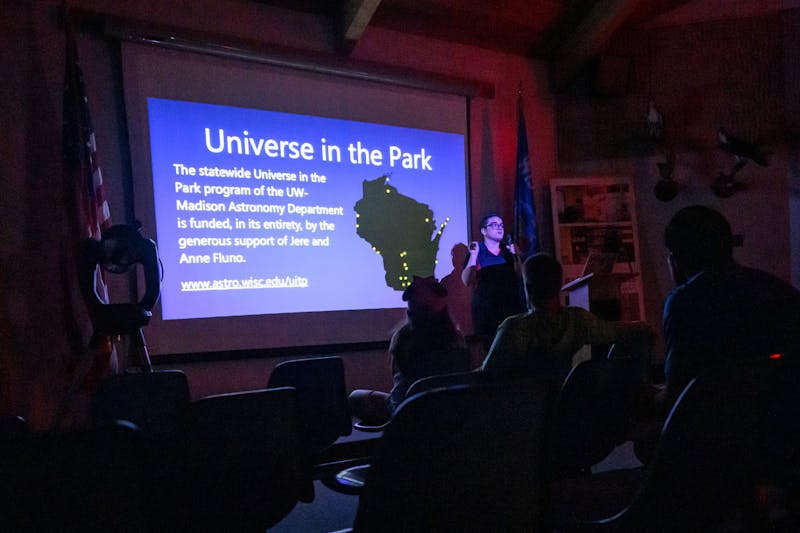
The UW Space Place is one of three major outreach programs created by the astronomy department: the other two are the Washburn Observatory on campus and Universe in the Park, an educational program held at state parks.
Since Universe in the Park has largely private funding and the observatory has been a campus building since 1881, Lattis said these programs didn’t suffer fallout from the budget cuts.
Schoolchildren made up the majority of the thousands of annual visitors who frequented Space Place.
“We had a set of space science and astronomy workshops that school teachers like to fit into their science curriculum and [science] classes and things like that,” Lattis said. “Many thousands of schoolchildren over the years have visited Space Place and hopefully been inspired to think about astronomy, to learn more about it, and of course, that’s going to be gone.”
Aside from students and teachers, the Madison Astronomical Society (MAS), who frequently hosted meetings at UW Space Place, were also affected by news of its closure. The MAS is an organization focusing on astronomical observation and engages in public outreach, usually in partnership with UW Space Place.
“Space Place’s demise marks the end of a long partnership. It’s nearly 30 years in real terms, but in more basic ways, our group has partnered with the astronomy department at the UW since the club’s founding in 1935,” John Rummel, long-time member and former president of the MAS, told the Cardinal.
Enjoy what you’re reading? Get content from The Daily Cardinal delivered to your inbox
Along with other events, the UW Space Place and MAS collaborated on a yearly event called Moon Over Monona Terrace, “a huge star party once or twice a year in downtown Madison on the rooftop gardens of the Convention Center,” Rummel said.
“Those never would have happened without Space Place,” Rummel said. “That type of focus on astronomy and space science will be hard to replace.”
UW Space Place’s closure coincides with broader discussions around budget cuts for NASA and the National Science Foundation by the Trump administration. Both organizations provide significant grant funds to UW-Madison. The National Science Foundation made up 13% of UW-Madison’s 2023-24 federal research awards, only beaten out by the U.S. Department of Health and Human Services.
Congress passed a $24.4 billion budget for NASA in January 2026, rejecting President Trump’s FY2026 budget, which would’ve cut $6 billion from NASA’s budget for the year. The National Science Foundation also received a nearly $9 billion budget from the bill, as opposed to the president’s proposed $3.9 billion budget.
The Daily Cardinal has been covering the University and Madison community since 1892. Please consider giving today.