
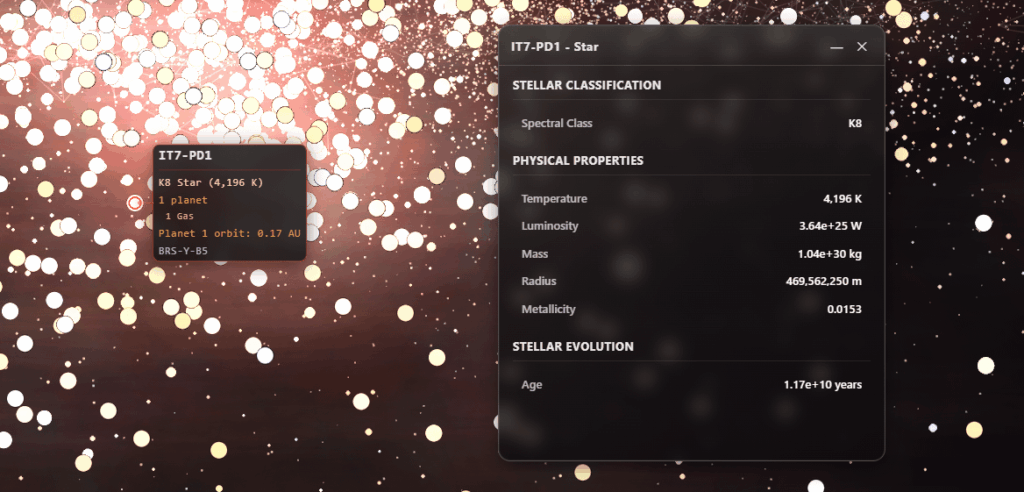
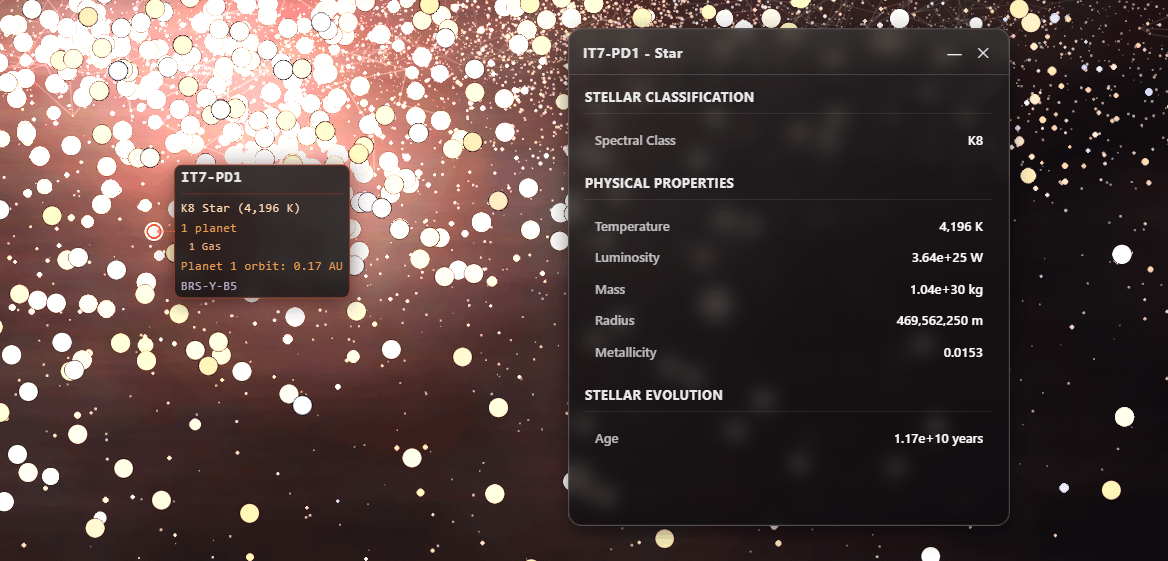
I’m building a large-scale map for a fictional game universe (~24,500 stars), but the underlying stellar data is real: spectral class, temperature, luminosity, mass, age, and planetary orbital distances are all present and surfaced in the UI.
My goal isn’t strict realism, but to make the map feel astronomically grounded rather than arbitrary. To that end I’ve used realistic stellar colour–temperature mappings and glow effects, and I’m surfacing orbital distances in AU alongside star properties.
Where I’ve struggled is visual language versus intuition. For example, blue stars are physically hotter than red ones, but players intuitively associate “warm colours” with heat. Orbital environment temperature is also a gameplay concept, so I’ve colour-coded orbits from hot to cold in a way that conflicts with stellar colour semantics.
The game itself exposes an external temperature value for orbits that appears to be derived from stellar and orbital data, but the exact equation isn’t documented. (I'd love to be able to work it out!) Given luminosity, distance, and stellar class, I’m curious which visual cues here feel reasonable, and which ones risk teaching the wrong mental model.
I’d really appreciate feedback from an astronomy perspective on how you’d balance physical correctness against legibility in a visualization like this.
To be clear, I’m not aiming for scientific accuracy in outcomes, only in the visual cues used to communicate scale and temperature.
by Diabolacal
2 Comments
If you are trying to convert a stellar temperature to a particular color for display, then the following site might have the information you need:
[http://www.vendian.org/mncharity/dir3/starcolor/](http://www.vendian.org/mncharity/dir3/starcolor/)
I think that type of people who play space games are likely to know that red stars are cooler than blue ones, wouldn’t worry about that too much. You could probably exaggerate the color a little bit, since actual realistic colors just range from warm white to cool white.
Visual gauges might help too, especially on temperature and luminosity. Show where the star sits in the normal range for main sequence, from like 2000K to 200,000K (you might want the scale to be logarithmic). Something similar with radius and metallicity may work.
Also, giving a reference point (usually the sun) is common way to give a sense of scale in space games. Seeing a star is 40 solar masses will be more Intuitive for most people than 8×10^(31) kg.