
It’s been said that science is not truth, but rather finding the truth… always in flux as we learn more about the universe. Many scientists dream of the day (and put in the hard work toward) that next big discovery… but what about a rediscovery?
Historian Ivan Malara at the University of Milan was busy in January poring over a 16th-century copy of a 2nd-century work — one that dictated our literal worldview for dozens of generations.
The Almagest got quite a few things right — the Earth being a sphere, for one thing — but it also held the notion that the Earth was the center of the universe. That geocentric model went unchallenged for a good 1200 years, until Copernicus placed the Sun at the center of our system. Other scientists eventually came to the same conclusion, including Galileo Galilei.
Malara knew young Galileo was heavily influenced by the Almagest, teaching its collective knowledge to others, so he set out to find copies.
“My research on Galileo and the Almagest began three, almost four years ago,” Malara recalls. “I started in Vienna, in Europe, and then I decided to check out copies of the Almagest, the earliest printed editions of the Almagest that were held in Florence.”
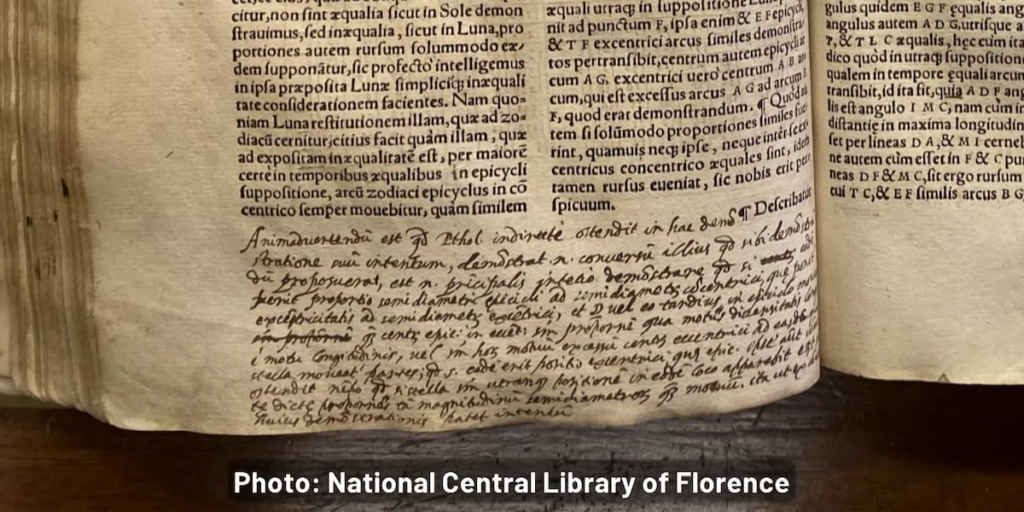
It was here where Malara noticed extensive handwritten notes in one of the copies, first beginning with a psalm, then extending across multiple margins — and his excitement grew and grew with each turn of the page. The historian came to recognize the handwriting as that of Galileo Galilei himself, written in the very text he would later subvert: “Honestly, I didn’t expect to find Galileo’s copy of the Almagest… I almost had a heart attack!”
After consulting with colleagues who confirmed these notes were the real deal, it opened a new window into Galileo’s evolution from brilliant mathematician to scientific revolutionary. “It was not just an ideological choice or even a philosophical choice,” Malara offers. “It grew out of a deep and highly skilled understanding of the ancient astronomy, the ancient scientific tradition.”
While we may hold a vision of Galileo as the man who challenged the church and paid the price — having his books banned and house arrest placed on him for the rest of his days — he was a man of faith, and the very psalm he scribbled in the Almagest may paint a different portrait for some. “If you contextualize, if you put this biblical verse in context, then you realize that back then it was not so unusual to think of the Almagest as a work that could help the reader understand the beauty and the goodness of God’s creation.”
For his part, Malara hopes this discovery can help gain insight into just how Galileo came to reject and correct established knowledge with his mathematical know-how: “This can tell us something about how he became a Copernican. This is the huge million-dollar question in the history of science, because we still don’t know it.”
Latest Local News | First Alert Weather | Crime | National | 13abc Originals
Copyright 2026 WTVG. All rights reserved.