

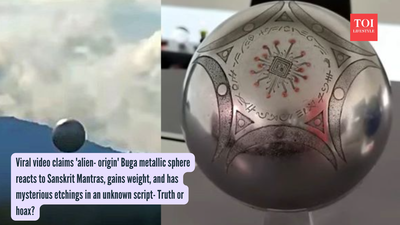
 A mysterious metallic sphere, dubbed the Buga Sphere, was discovered in Colombia, exhibiting unusual flight patterns and a strange reaction to Sanskrit mantras. Preliminary analysis revealed a complex internal structure, and the object reportedly increased in weight over time. While some interpret these findings as evidence of alien technology, others remain skeptical, awaiting further scientific verification. The existence of aliens has always been a mind boggling question that human beings have always been curious about.Whenever a video alleging UFO sightings goes viral on social media, we instantly ask, are aliens real?Well, we don’t know either surely!Previously, the skies over Buga, Colombia, filled with more than just curiosity, they led to a global debate about whether an alien object might be “listening” to ancient Sanskrit chants.A mysterious metallic sphere, later called the Buga Sphere, was first seen zig‑zagging in an odd, non‑aircraft‑like pattern before falling to the ground and drawing immediate scientific attention.Infact, a viral video even claimed that the object is said to react specifically when Sanskrit mantras are played, emitting electromagnetic surges and vibrations that some interpret as intelligent, rather than accidental.
‘alien- origin’ Buga metallic sphere (Photo: @maniaUFO/ X)
What is the Buga Sphere?
The Buga Sphere is a smooth, metallic orb first spotted in the skies over Buga, Colombia, in early March 2025, moving in a strange, zig‑zag pattern that did not match any known aircraft. It soon fell to the ground, where it was retrieved and sent for study, eventually landing in the hands of researchers at Mexico’s National Autonomous University.Preliminary analysis by the Mexican team found three layers of metal‑like material surrounding a small, dense core, along with a network of fibre‑optic‑like “wires” and 18 microspheres arranged around the nucleus.As described by Dr. Carlos Muñoz and engineer Rodolfo Garrido during a UNAM‑hosted press conference organised by Jaime Maussan, microscopic scans of the object showed a network of complex, fibre‑optic‑like wires inside it, suggesting that it could transmit and receive signals. Oddly, it also contains a central “nucleus,” which they call a “chip,” surrounded by 18 microspheres and three layers of a metal‑like material.The object also created unusual effects on the environment. The area where it landed lost all grass and soil colour, with no sign of regrowth even months later. Scientists did not detect any radiation, but according to Mail Online, they believe “an invisible energy” might have removed all moisture from the spot. Rodolfo Garrido, an engineer with the research team, told Maussan Televisión that a “strong, decaying ionised field” could be the reason.
Buga sphere gained weight!
Another strangely surprising detail is that the sphere has grown heavier over time. “Its weight changed to 16, 20, and then 22 pounds,” Garrido explained. One theory circulating among researchers is that the object may use “futuristic gravitational forces” to reduce its weight during flight.
Alleged Sanskrit‑mantra reactions
According to viral videos widely shared on social media, scientists exposed the Buga Sphere to different sounds, including Western music, random frequencies, and finally Sanskrit mantras, and claimed it reacted only to the latter.Commentators covering the story say that when Vedic chants such as selected mantras were played, the object showed “electromagnetic surges and vibrational responses,” while remaining inert under other conditions.
Alien tech or just another hoax?
Even if the Sanskrit‑mantra reaction remains unverified by mainstream science, the Buga Sphere has become a magnet for interpretation. For some, it is proof of alien technology; for others, it is a mystery still waiting for rigorous, peer‑reviewed study.Well, not everyone agrees. As a Facebook‑based fact‑checking post on the phenomenon puts it: “There’s no verified scientific evidence for a UFO over Colombia responding to Sanskrit hymns with light,” and critics online have called the clip “silly” science.