
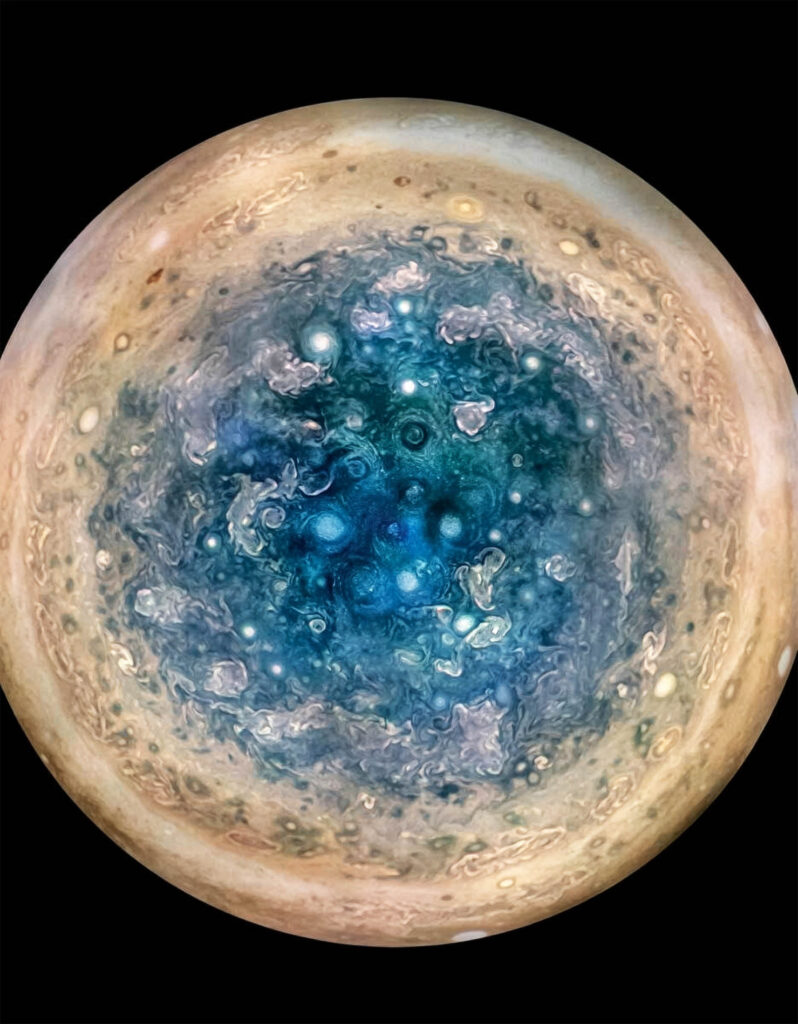
A new study has redefined gas giant Jupiter’s dimensions. The study found that the planet is about 5 miles (8 kilometers) narrower at its equator and 15 miles (24 kilometers) flatter from pole to pole than previously thought.
The revised size sharpens maps of the giant planet and gives scientists a cleaner way to connect its clouds, winds, gravity, and hidden interior.
Measuring Jupiter with radio waves

Juno caught the key evidence in radio signals that bent as the spacecraft passed behind Jupiter, from Earth’s view.
By tracing that bending through the planet’s atmosphere, Dr. Eli Galanti at Weizmann Institute of Science tied each signal to a sharper outline of Jupiter’s body.
Older spacecraft records had left the planet’s dimensions slightly inflated, partly because they did not account for its powerful winds.
The updated outline now sets the reference points scientists need before they connect Jupiter’s atmosphere to what lies far below.
Why Jupiter’s shape matters
A gas giant – a planet made mostly of hydrogen and helium – has no solid surface, so scientists choose a pressure level to mark its size.
Near the atmospheric pressure level that scientists use as Jupiter’s official boundary, the revised measurements slightly shrink the planet’s long-accepted dimensions.
That narrower profile changes the baseline used to interpret Jupiter’s gravity, temperatures, and deep internal structure.
Even small corrections matter at Jupiter’s scale, because tiny changes in radius ripple through nearly every model used to explain the planet.
Old numbers lingered
For decades, Jupiter’s standard dimensions rested on six radio occultation measurements – signal-bending tests – from NASA’s Voyager and Pioneer spacecraft.
Earlier spacecraft gave planetary scientists a foundation, but their data came from only a few paths through Jupiter’s atmosphere.
“Those missions provided a foundation, but now we got the rare opportunity to spearhead the analysis of as many as 26 new measurements made by NASA’s Juno spacecraft,” said Galanti.
The new measurements also resolved mismatches that had persisted between spacecraft observations and models of Jupiter’s atmosphere and interior.
Winds changed Jupiter’s shape
Fast east-west winds also reshape Jupiter, because moving air changes the forces acting on the planet’s outer layers.
Earlier estimates treated Jupiter mostly as a rotating body without adding the extra shape changes that are driven by those winds.
After the team included zonal winds – broad east-west streams in a planet’s atmosphere – the old mismatch eased.
That result means Jupiter’s upper winds stay fairly similar with height, rather than changing sharply between the levels that Juno sampled.
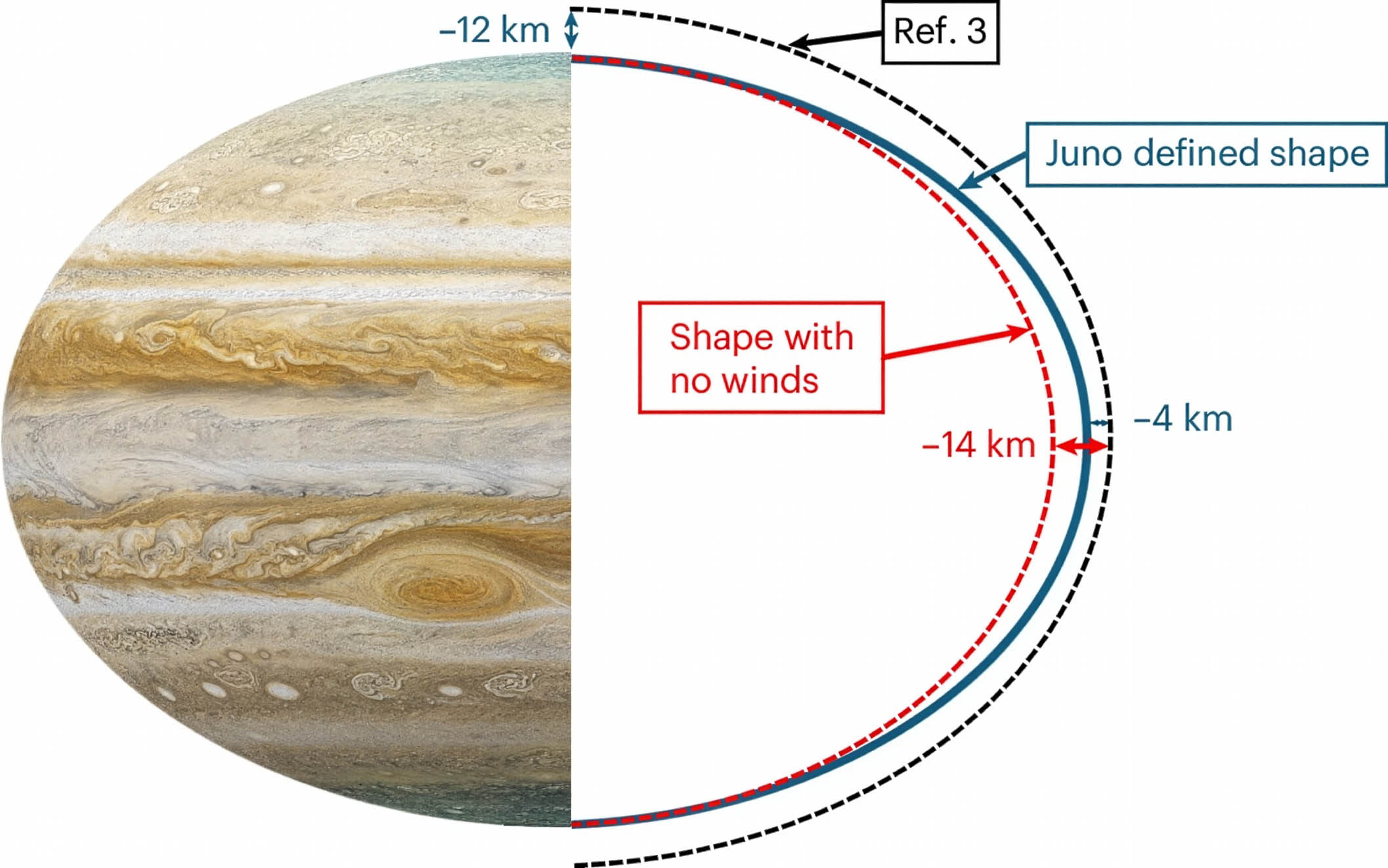 The shape of Jupiter redefined by Juno. Right: 1-bar shapes (not to scale), showing the L81 shape based on the V1E occultation, neglecting winds3 (dashed black line); the full shape from this study (blue line); and the corresponding no-wind shape (dashed red line). Left: an image of Jupiter. Credit: image of Jupiter, NASA / JPL-Caltech / Nature Astronomy. Click image to enlarge.A smaller reference
Near the level used for planetary maps, the equatorial radius fell by 2.5 miles (4 kilometers) in the reference value.
Pole to pole, the update removed about 15 miles (24 kilometers) from the diameter once used in standard references.
Mean radius changed by about 5 miles (8 kilometers), which matters when researchers compare Jupiter with giant planets around other stars.
Small corrections gain power because gravity, temperature, pressure, and wind all connect through the same planetary shape.
Inside the giant
Computer models of Jupiter’s interior depend on the chosen radius, because a smaller outer boundary makes Jupiter slightly denser in calculations.
That denser setup lets models allow a cooler atmosphere and more heavy material mixed into the outer layers.
The change helps reconcile gravity readings from Juno with temperature clues from NASA’s Galileo probe – a capsule that entered Jupiter’s atmosphere – and Voyager observations.
Storms add depth
Jupiter’s polar storms strengthen the same lesson, because their motion reveals how deeply weather can reach.
A related study of polar cyclones – huge spinning storms near a planet’s poles – used Juno observations to link westward drift with storm depth.
Slow drift suggests vertical structure, since deeper or shallower storms move differently under Jupiter’s rotation.
That boundary helps researchers avoid mistaking weather-driven shape changes for signs of deep structure when they build interior models.
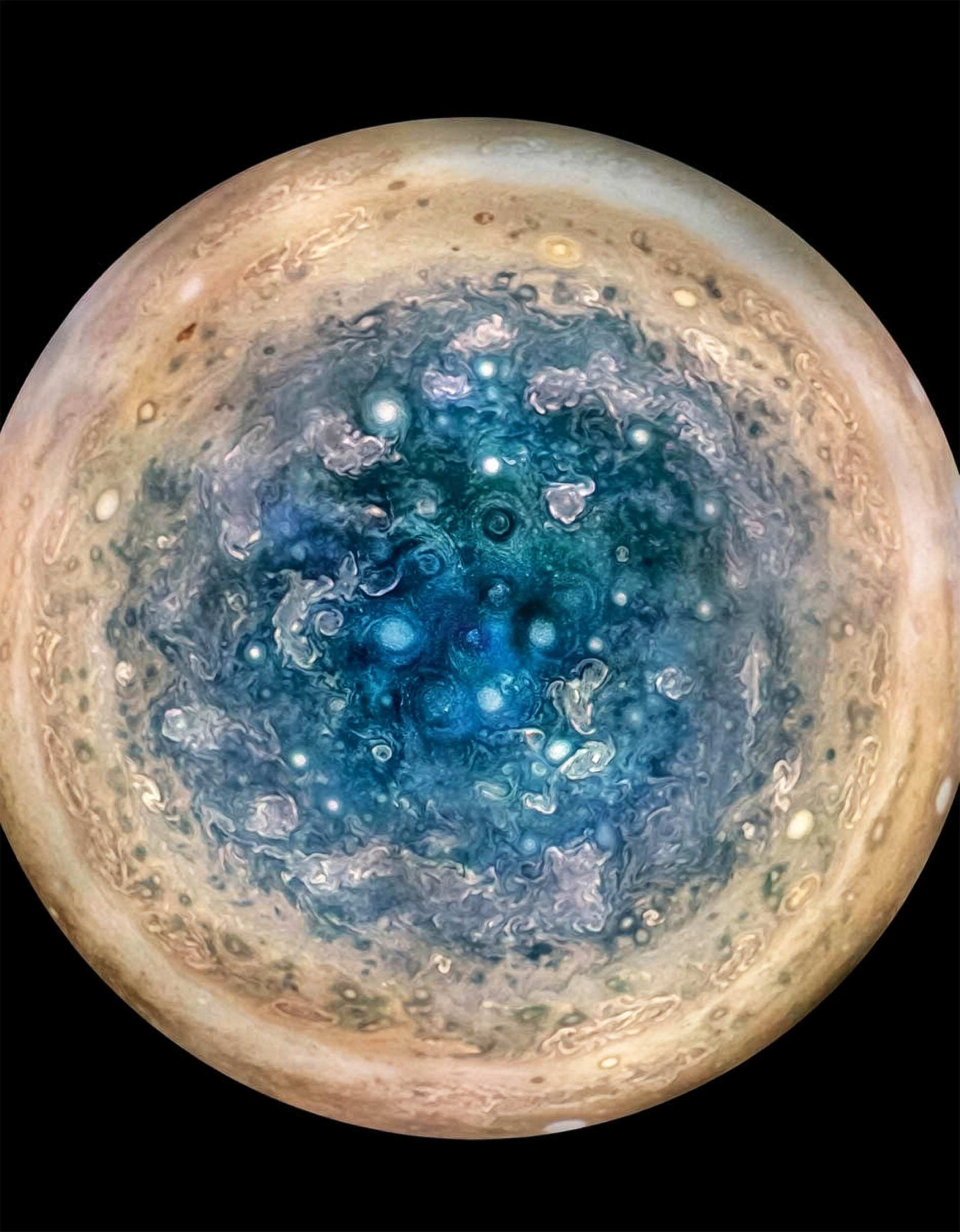 Jupiter’s south pole as seen by NASA’s Juno spacecraft at a close pass. Photo courtesy of NASA. Click image to enlarge.Future measurements await
Another spacecraft will test these ideas as Jupiter research moves from shape to deeper atmospheric layers.
The Juice mission – Europe’s Jupiter Icy Moons Explorer – was launched in 2023 to study Jupiter and three moons thought to hold buried oceans.
A Weizmann-designed instrument will look deeper into Jupiter’s atmosphere by tracking very stable radio signals during future passes.
Broader coverage could expose whether the new reference shape holds at latitudes that Juno did not sample well or at deeper levels.
Limits still matter
Precision does not mean every part of Jupiter is now equally measured or equally well understood.
Juno’s radio paths covered many low and middle latitudes, while high southern latitudes and the equator remained less sampled.
No Juno radio measurement reached the 1-bar level, so researchers linked that reference depth to older data.
Those gaps make the new shape much stronger than before, but not final in every possible detail. Future missions will need to test the details.
Jupiter’s shape redefined
A slimmer Jupiter now connects atmospheric winds, spacecraft signals, and interior models in one cleaner planetary reference.
Future radio and microwave measurements can refine that reference further, especially where Juno obtained only sparse coverage.
The study is published in Nature Astronomy.
—–
Like what you read? Subscribe to our newsletter for engaging articles, exclusive content, and the latest updates.
Check us out on EarthSnap, a free app brought to you by Eric Ralls and Earth.com.
—–