
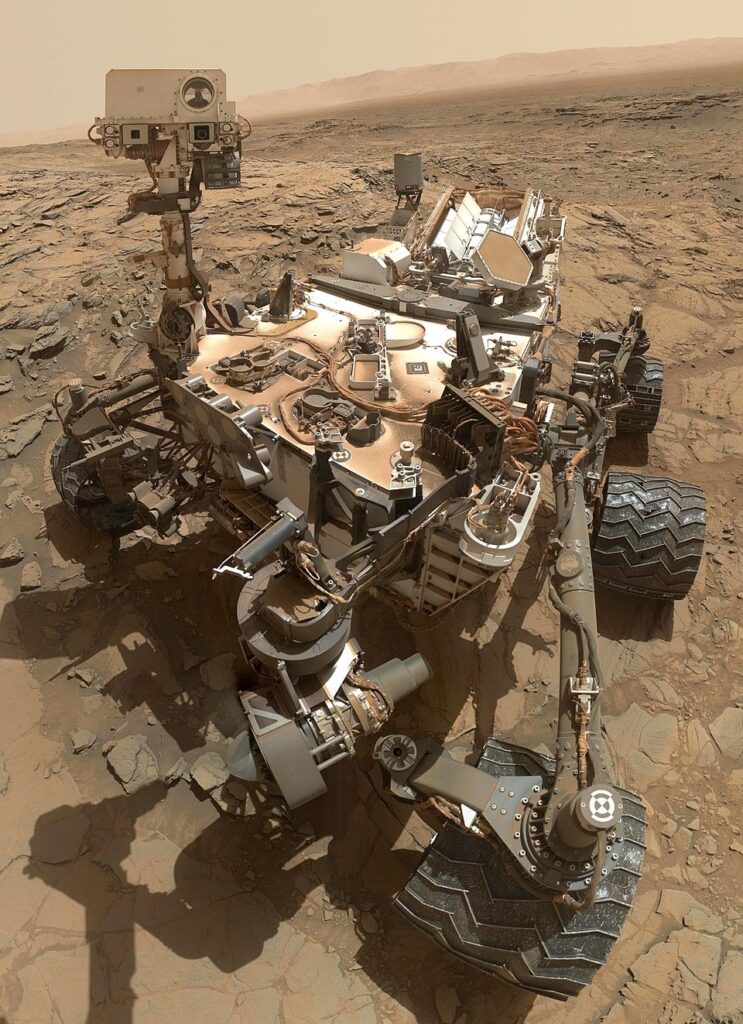
I once got a drill bit jammed in concrete and the language that followed was, let’s say, colourful…and that was with the offending masonry right in front of me. That, in essence, is what happened to NASA’s Curiosity rover on the 25th of April this year and the solution required some impressive problem solving from 300 million kilometres away. At least I could give mine a firm wobble and a stern look of disappointment. Curiosity’s team had to think rather harder than that.
Curiosity was doing what it does best and drilling into a Martian rock to collect a sample for analysis. The target was a flat disc of rock nicknamed “Atacama,” it was modest enough only about 45 centimetres across, 15 centimetres thick, and weighing around 13 kilograms. It could’t even really be classed as a boulder. But when the rover retracted its arm after drilling, Atacama came with it, wedged tight against the fixed sleeve surrounding the drill bit and dangling from the end of the robotic arm.
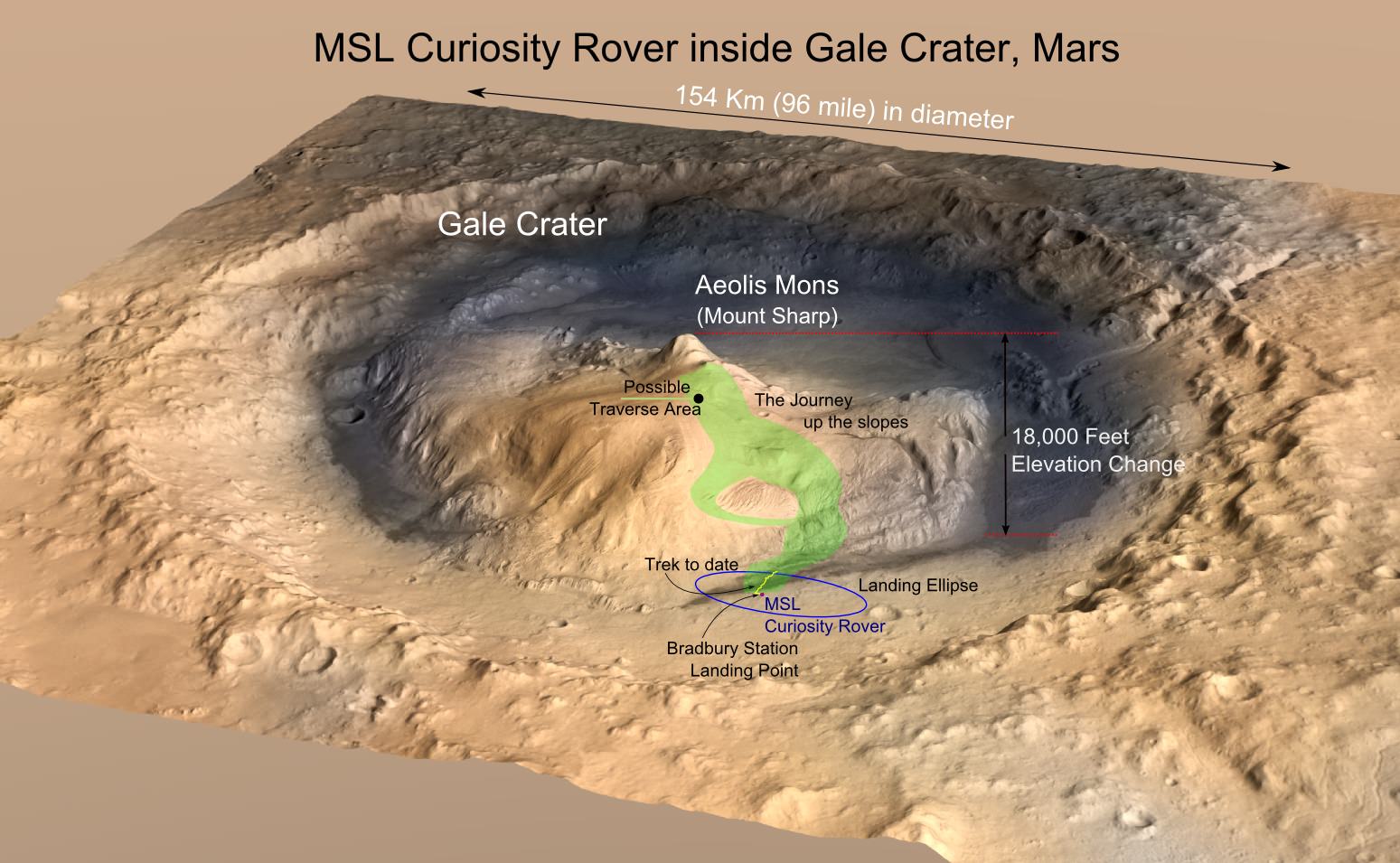 Aeolis Mons – also known as Mount Sharp – inside the Gale Crater (Credit : NASA/JPL)
Nothing like this had ever happened before. Drilling had occasionally cracked or shifted the upper layers of Martian rocks, but an entire rock stuck to the drill? That was new territory.
The team at NASA’s Jet Propulsion Laboratory didn’t panic. They did what scientists do they thought it through. Their first attempt was simple… vibrate the drill and hope the rock shook loose. It didn’t. Four days later they tried again, reorienting the arm and running the vibrations once more. This time the cameras caught sand trickling from Atacama as the vibrations did their work. But the rock held on.
It took a third attempt on the 1st of May to finally crack the problem – literally. Engineers tilted the drill further, then combined rotation, vibration, and spinning of the drill bit in a carefully planned sequence. They had prepared for multiple rounds of this but they only needed one. Atacama dropped, hit the Martian surface, and broke apart on impact.
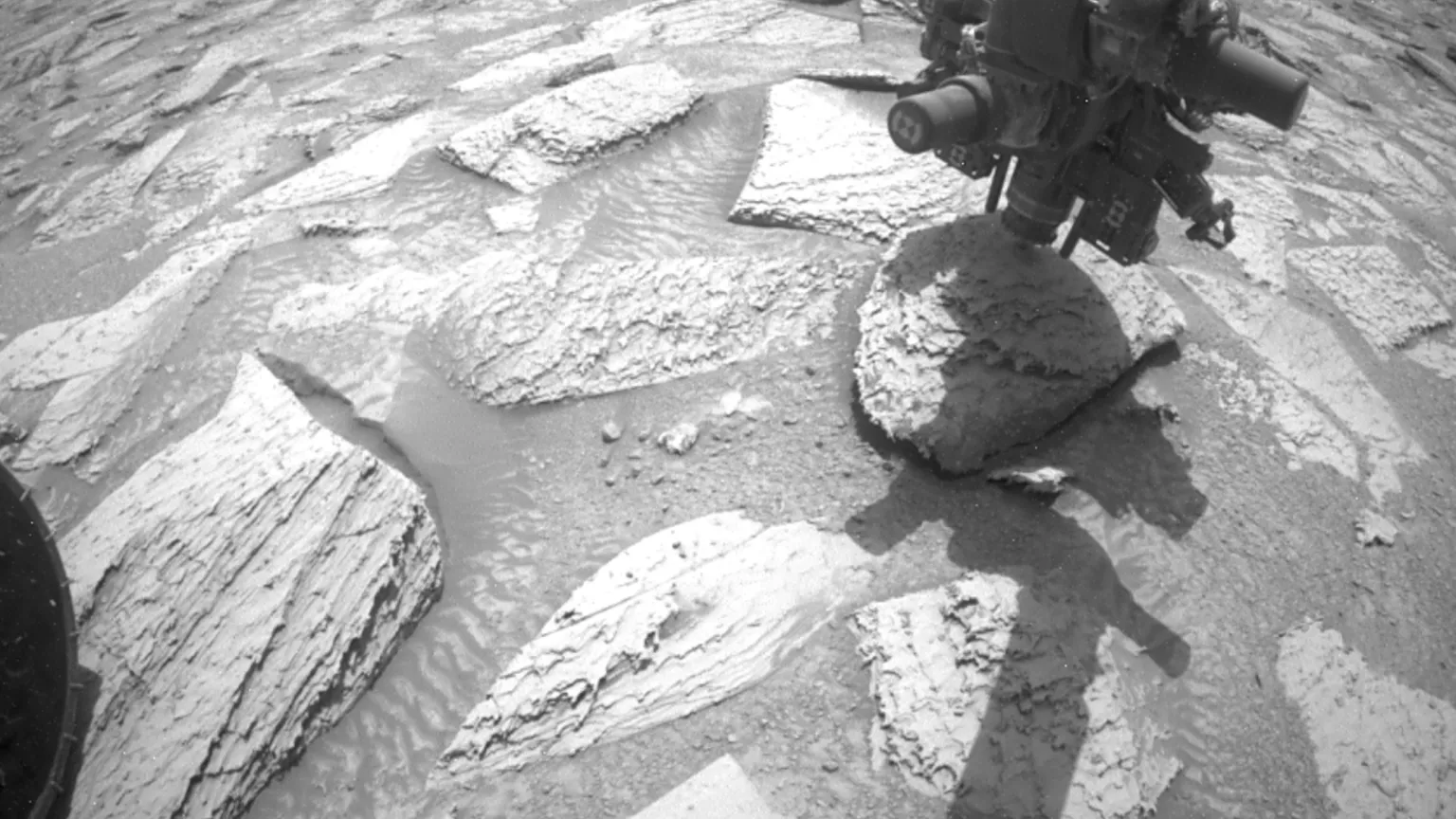 It took multiple attempts to free the drill on Mars Curiosity rover (Credit : NASA)
What makes this story remarkable isn’t just the happy ending, it’s the sheer complexity of the challenge. Every command sent to Curiosity takes minutes to arrive. There’s no joystick, no instant correction, no nipping out to have a look and in the case of a stuck drill in a rock, no wobbling to get it free. Every manoeuvre is planned meticulously, tested, and then trusted to execute flawlessly across the void of space.
Curiosity has been roving the Martian surface since 2012, and moments like this are a reminder that every day it operates is an achievement and it seems that the red planet doesn’t make things easy. The fact that a team of engineers on Earth can coax a robot on another planet out of an unprecedented jam with nothing but patience, physics, and brilliant planning should fill all of us with a quiet sense of wonder.