
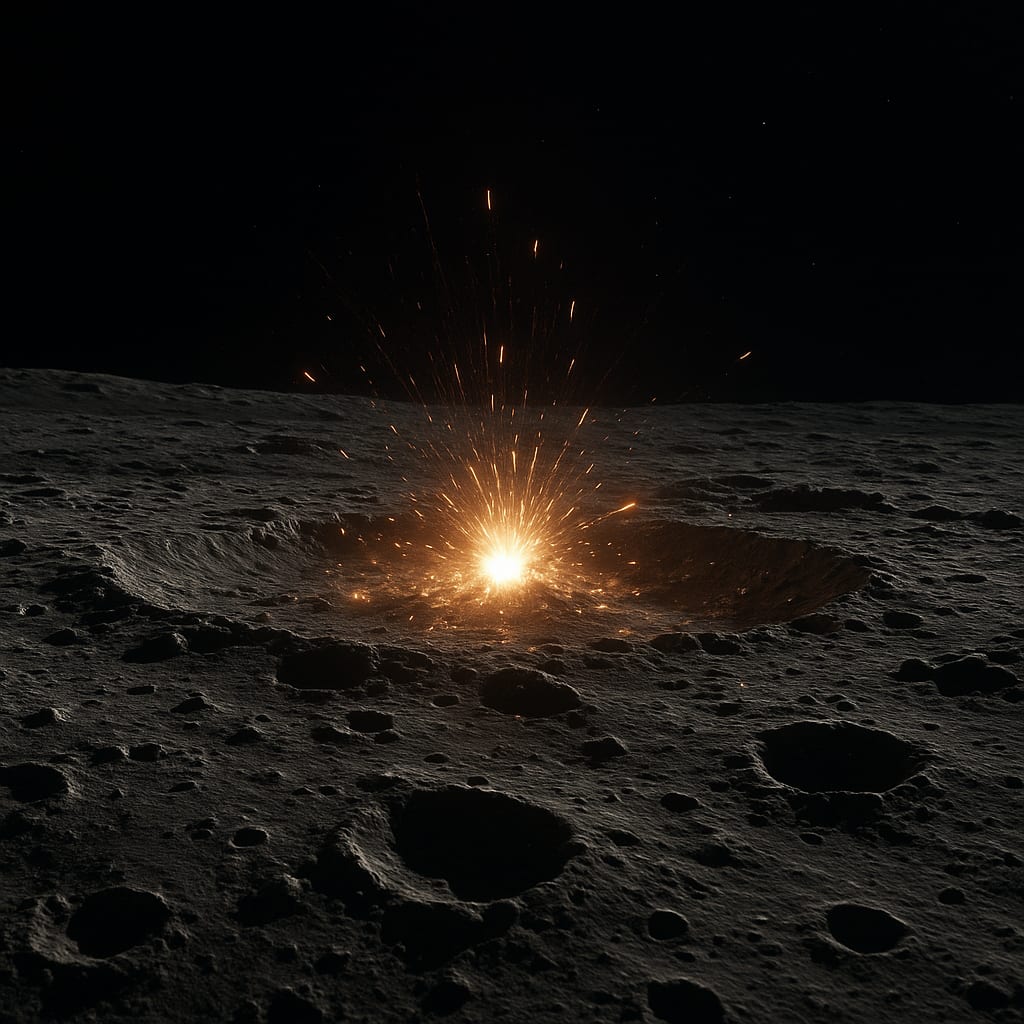
For centuries, humanity has looked at the Moon as a serene, unchanging celestial neighbor. A silent sentinel in the night sky, its cratered face telling a story of ancient bombardment from the early days of the solar system. However, modern science has revealed that the Moon is far from silent or static. In fact, it is being struck by space rocks with a frequency that is both startling and scientifically fascinating. These events, known as “lunar impact flashes,” are now a critical focus for NASA as we prepare to return humans to the lunar surface through the Artemis mission.
What Are Lunar Impact Flashes?
To understand a lunar impact flash, one must first appreciate the fundamental difference between the Earth and the Moon: the atmosphere. When a meteoroid—a small piece of space debris—enters Earth’s atmosphere, it encounters friction. This friction heats the rock until it glows, creating the beautiful “shooting stars” we see from our backyards. Most of these rocks burn up completely miles above the ground.
The Moon, however, has no such shield. It possesses an extremely thin exosphere, but nothing substantial enough to slow down a speeding meteoroid. When a rock the size of a marble or even a pebble hits the Moon, it does so at speeds often exceeding 45,000 miles per hour (20 kilometers per second). At these hypervelocity speeds, the kinetic energy of the impactor is so immense that it doesn’t just make a hole; it creates a brief, intense explosion. A significant portion of that energy is converted into heat and light, resulting in a flash that can be seen from Earth with the right equipment.
NASA’s Eye on the Moon: The Monitoring Program
Since 2005, NASA’s Lunar Impact Monitoring Program, based at the Marshall Space Flight Center in Huntsville, Alabama, has been diligently watching the Moon. Using a series of ground-based telescopes, researchers observe the “dark” portion of the Moon—the side currently in shadow but still visible from Earth thanks to “Earthshine” (sunlight reflected off the Earth onto the Moon).
By watching the unlit portion of the lunar disk, astronomers can detect even relatively faint flashes that would otherwise be drowned out by the Sun’s glare. Over the nearly two decades of the program, NASA has recorded over 400 such impacts. These aren’t just minor blips; in 2013, the program recorded a massive flash caused by a 40-kilogram (88-pound) rock hitting the Mare Imbrium. That flash was so bright it could have been seen by anyone looking at the Moon with the naked eye at the exact moment of impact.
The Science Behind the Sparkle
What exactly are we seeing when we spot a flash? It’s not “fire” in the traditional sense, as there is no oxygen on the Moon to support combustion. Instead, it is a plume of molten rock and vaporized lunar soil (regolith). The impact creates a crater, and the material ejected from that crater is heated to thousands of degrees, glowing brilliantly for a fraction of a second—usually less than one-tenth of a second.
By analyzing the brightness and duration of these flashes, scientists can estimate the size and mass of the meteoroids, as well as the energy of the impact. This data allows researchers to build a statistical model of how often the Moon is hit and by what size of objects.
Why This Matters for the Artemis Mission
NASA’s Artemis mission isn’t just about “flags and footprints.” The goal is to establish a sustainable human presence on the Moon, including the Lunar Gateway station in orbit and a base camp at the lunar South Pole. When you are building a “home” on a world without an atmosphere, understanding the local “weather”—specifically the rain of meteoroids—is a matter of life and death.
The data from the Lunar Impact Monitoring Program is directly influencing the design of lunar habitats and spacesuits. If we know that a certain area of the Moon is frequently pelted by small but high-velocity debris, we can engineer shielding that is both lightweight and robust enough to protect astronauts. Furthermore, these observations help NASA predict “meteor showers” on the Moon, which occur when the Moon passes through the debris trail of a comet, much like Earth does. During these times, extra precautions may be needed for lunar activities.
A New Era of Lunar Science
As we transition from observing the Moon from Earth to actually living on its surface, our methods of monitoring will also evolve. Future lunar bases may include their own seismic sensors to “feel” the vibrations of nearby impacts, providing even more precise data than optical telescopes ever could. We are moving from being distant observers to becoming active participants in the lunar environment.
The discovery and ongoing study of lunar impact flashes remind us that the solar system is a dynamic and sometimes violent place. But they also demonstrate humanity’s incredible ability to turn a potential hazard into a field of scientific discovery. As the Artemis astronauts look up at the black lunar sky, they will do so with the knowledge provided by years of patient observation from Earth, ensuring that while the sky may be falling, we are more than ready to meet it.