
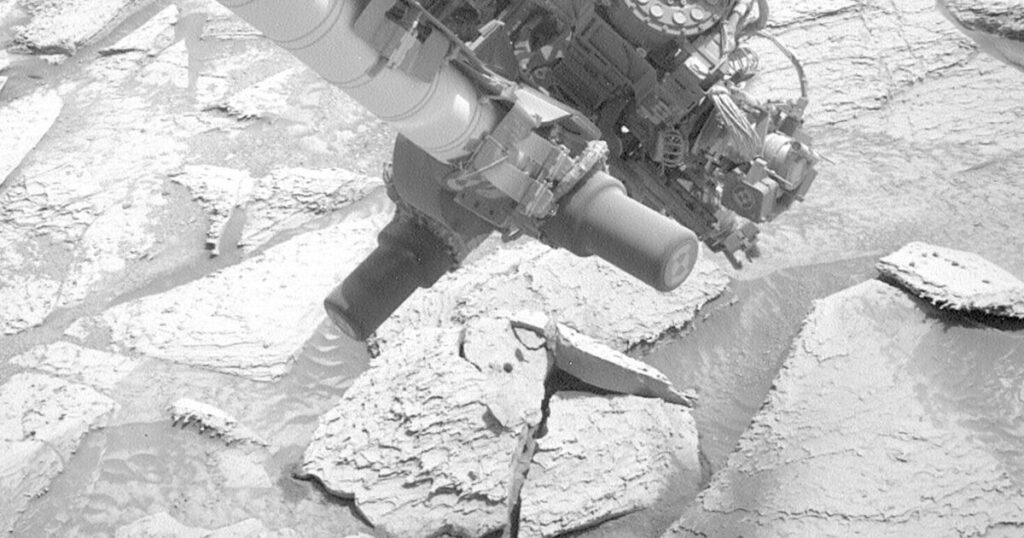

The rock is finally shaken off and shatters on the Mars surface. (NASA / JPL-Caltech via SWNS)
By Talker
By Dean Murray
A stone in your shoe is a chore on Earth, but a Martian boulder stuck on your robot on the Red Planet makes for an out-of-this-world problem.
NASA‘s space scientists had a challenge when a large rock remained on the drill of the Curiosity Mars rover after an exploratory incision.
It took a week of waving the arm on which the drill was mounted for the rogue rock to finally drop back to the Martian surface.
NASA said: “On April 25, 2026, Curiosity drilled a sample from a rock nicknamed ‘Atacama,’ which is an estimated 1.5 feet in diameter at its base, 6 inches thick and weighs roughly 28.6 pounds (13 kilograms).
“When the rover retracted its arm, the entire rock lifted out of the ground, suspended by the fixed sleeve that surrounds the rotating drill bit.”
The rock on the Martian surface before Curiosity drills it. (NASA / JPL-Caltech via SWNS)
By Talker
The space agency said that drilling has fractured or separated the upper layers of rocks in the past, but a rock has never remained attached to the drill sleeve.
The team initially tried vibrating the drill to shake off the rock, but saw no change.
An incredible series of images documents the rover’s predicament, first as it gets the rock stuck to the drill on the end of its robotic arm.
We then see Curiosity waving its arm and running the drill a few times, before the rock finally detaches and shatters on the ground.
NASA said: “Finally, on May 1, Curiosity’s team tried again, tilting the drill more, rotating and vibrating the drill, and spinning the drill bit. The team planned to perform these actions multiple times but the rock came off on the first round, fracturing as it hit the ground.”
The rover’s mission is to collect and analyze rock samples on Mars to help scientists understand the planet’s geology and history.