
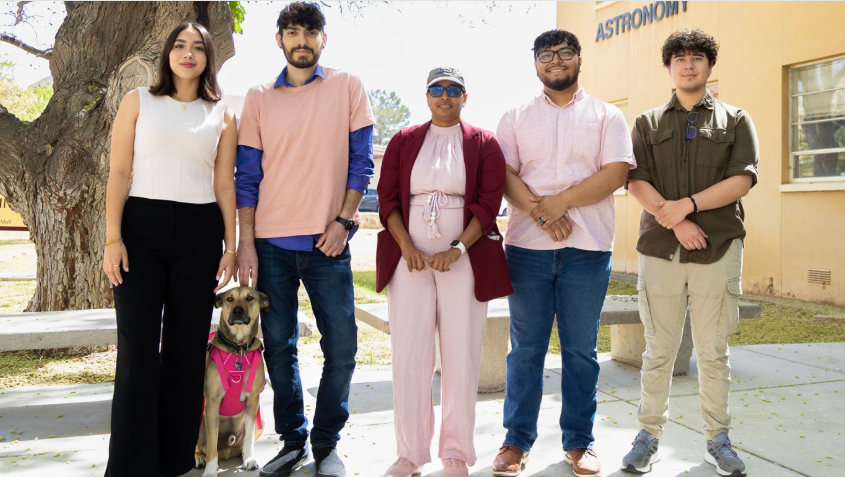
Juie Shetye. an assistant professor at New Mexico State University, has received an award of $640,000 to support her research on the Sun with a team of undergraduate and graduate students, according to an article on the newsroom.nmsu.edu website.The highly competitive CAREER Award is the National Science Foundation’s most prestigious honor for junior faculty members success in research combined with education.Among other findings, Shetye, whose research includes space weather, has formulated an algorithm that can predict when solar flares are likely to happen, so that humans can be warned. When two total solar eclipses were visible in the U.S. — one in October 2023 and another in April 2024 — Shetye had two teams of students study atmospheric gravity waves and share the science with local residents.Last December, Shetye and a group ofher students went to the American Geophysical Union annual meeting, the largest conference on Earth and space science in the world, which was attended by more than 25,000 people from more than 100 countries. The astronomy department students with whom she came presented their research at the event.Shetye is currently teaching a course for undergraduates about the history of solar observations in the Southwest. With funding left over from previous grants, she may be able to extend her student research beyond five years.
LAS CRUCES, N.M. —
Juie Shetye. an assistant professor at New Mexico State University, has received an award of $640,000 to support her research on the Sun with a team of undergraduate and graduate students, according to an article on the newsroom.nmsu.edu website.
The highly competitive CAREER Award is the National Science Foundation’s most prestigious honor for junior faculty members success in research combined with education.
Among other findings, Shetye, whose research includes space weather, has formulated an algorithm that can predict when solar flares are likely to happen, so that humans can be warned.
When two total solar eclipses were visible in the U.S. — one in October 2023 and another in April 2024 — Shetye had two teams of students study atmospheric gravity waves and share the science with local residents.
Last December, Shetye and a group ofher students went to the American Geophysical Union annual meeting, the largest conference on Earth and space science in the world, which was attended by more than 25,000 people from more than 100 countries. The astronomy department students with whom she came presented their research at the event.
Shetye is currently teaching a course for undergraduates about the history of solar observations in the Southwest. With funding left over from previous grants, she may be able to extend her student research beyond five years.