
One of the galaxies closest to us is approaching the Milky Way for the first time in history—according to the authors of a new study published in late April 2026. Their computer simulation of the gas halos of both galaxies supports the “first-pass” theory and contradicts an alternative hypothesis suggesting that this encounter already took place billions of years ago.
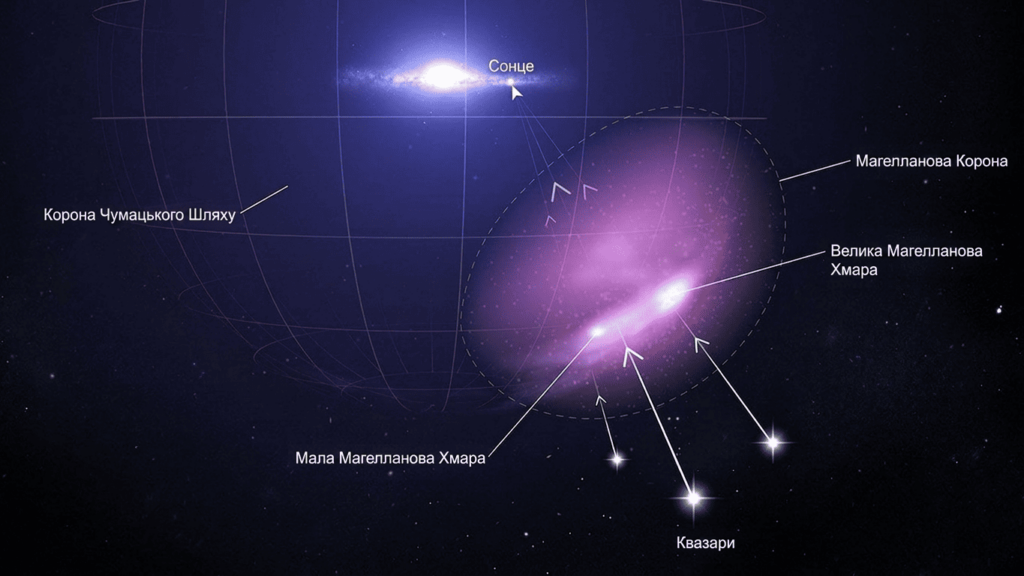
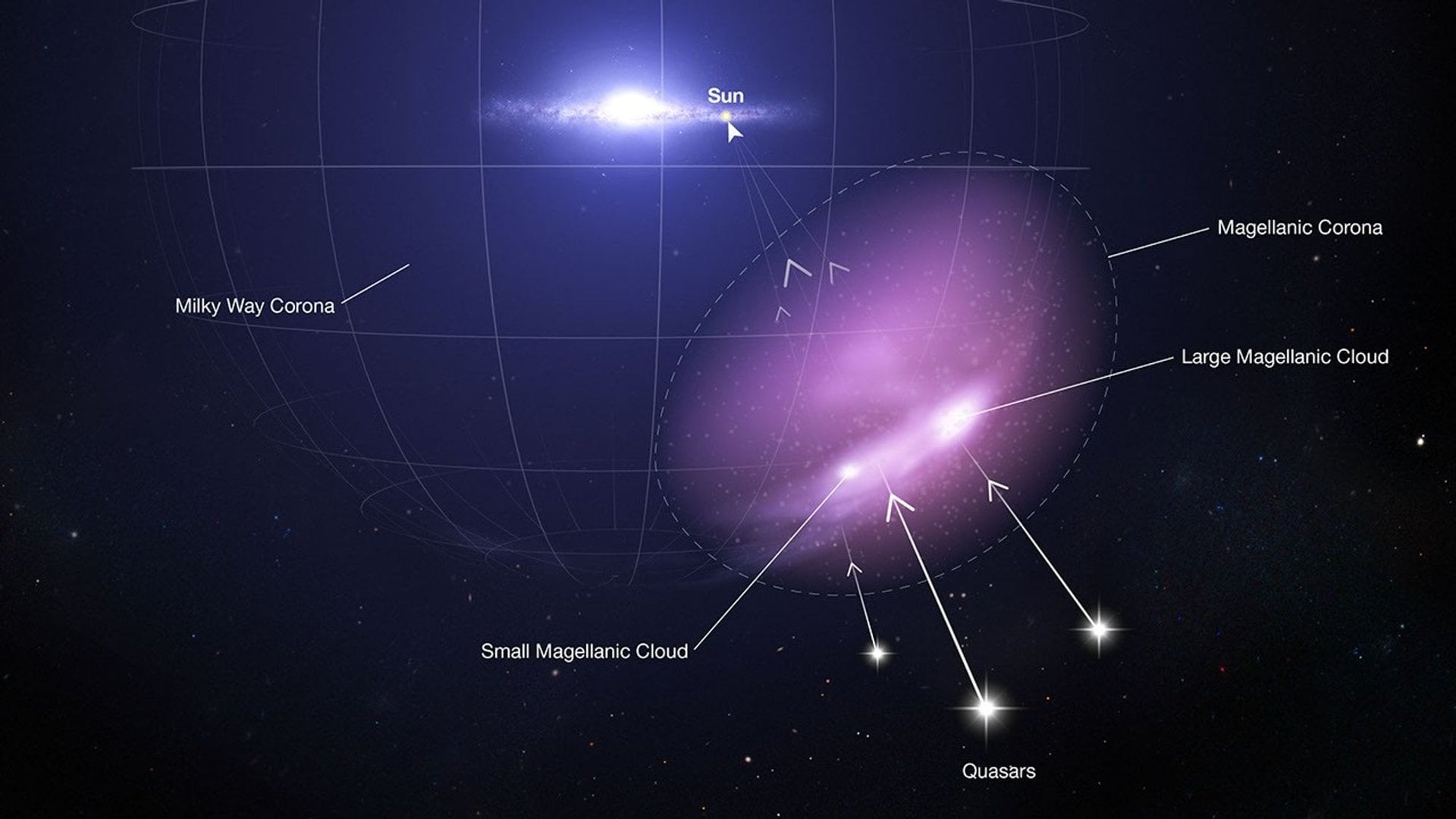 Illustration of the study of the Magellanic Clouds using light from quasars. The presence of this gaseous envelope confirms that the Large Magellanic Cloud is approaching our Galaxy for the first time. Source: NASA, ESA, Leah Hustak (STScI)
Decades-long dispute
The Large Magellanic Cloud is the Milky Way’s largest satellite galaxy, located approximately 160,000 light-years away. Astrophysicists have long debated whether this is its first pass near our galaxy, or whether it has “visited” us before. This is no simple matter, as the large-scale approach of such a galaxy has a significant impact on the evolution of the Milky Way.
In 2024, physicist Eugene Vasiliev published a paper in which he advocated the “second passage” theory: if the Milky Way’s dark matter halo is anisotropic—that is, if dark matter particles move predominantly in certain directions rather than chaotically—then the Cloud’s current position and velocity fit perfectly into a scenario where the first passage occurred 6–8 billion years ago.
How the simulation resolved the dispute
Scott Lucchini, Jiwon Jesse Han, Sapna Mishra, and Andrew J. Fox, along with their co-authors, approached the problem from an unexpected angle—through the lens of gas hydrodynamics.
Using the GIZMO simulation package, the researchers built a model in which rigid analytical models of dark matter in both galaxies were combined with “dynamic” gas particles that simulate the intergalactic medium. They then used the Trident package to generate simulated spectroscopic data—the kind a real telescope would have obtained while observing the gas in that region.
What the comparison with actual observations revealed
The simulated data were compared with actual ultraviolet observations—specifically, with spectral signatures of ionized carbon and hydrogen against the backdrop of distant quasars located beyond the Cloud. The result was telling: the “first-pass” simulation accurately reproduced both the gas velocity and its spatial distribution.
The “second passage” model could not account for this—in that model, the Cloud would have taken too long to pass through the Milky Way’s gas and would therefore have lost its “corona,” the vast halo of warm ionized gas surrounding the galaxy. The actual corona of the Large Magellanic Cloud, on the other hand, is well preserved.
Dispute still unresolved
The researchers acknowledge several simplifications in their model: the Small Magellanic Cloud was not included in the simulation, even though it accounts for the vast majority of the neutral gas in the so-called Magellanic Streams—the gas tails trailing behind both galaxies.
In addition, the corona is described in the simulation as a single-layer thermal structure, whereas in reality it is much more complex. An independent group of researchers using the Hyper Suprime-Cam on the Subaru Telescope also recently detected stellar debris at a distance of about 30 kiloparsecs within the Milky Way’s halo—and these findings are more consistent with Vasiliev’s “second passage” theory.
The authors of the simulation have not yet had a chance to respond to this argument. NASA’s Aspera mission may finally settle the matter, as it will allow for direct investigation of the shape and distribution of the Magellanic gas.
According to universetoday.com