
While April is seen as the month for spring cleaning to be undertaken, effective tips can be used throughout the year.
Some people may use the opportunity for a refresh around the home, while others will keep to small changes.
Cleaning your kitchen will likely be part of this process, and a few cleaning experts have some advice for wiping down surfaces.
What mistake should you avoid when cleaning kitchen surfaces?
A mistake that people might make when wiping down kitchen surfaces or appliances like hobs is using too much cleaning spray.
Sharing some advice, home cleaning brand method shared: “When tackling a big spring reset, it’s easy to assume that using more cleaning products will automatically deliver better results.
“Yet in reality, overusing products can leave behind residue and even make surfaces harder to clean over time.”
To get around this issue, they said: “A lesser-known but highly effective hack is to avoid wiping straight away.
“Instead, spray a cooled stovetop or oven racks and leave the product to sit for around 60 seconds before reaching for a cloth.
“That short pause allows the formula to break down stubborn grease and residue, lifting dirt rather than smearing, making the whole process quicker, easier, and far more effective.
“You’ll thank yourself later!”
Andrew Wright, founder of Cookology, shared similar sentiments to this.
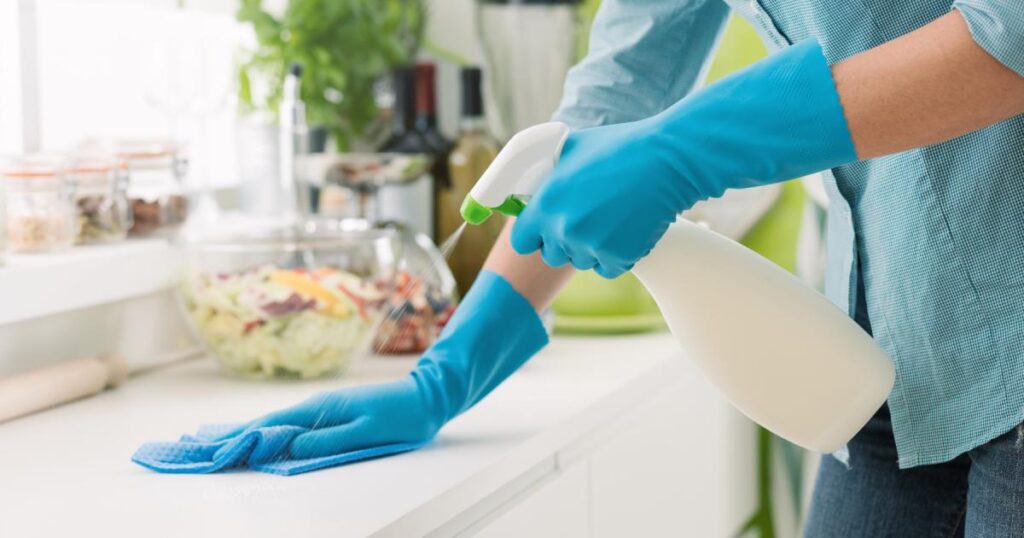
Waiting 60 seconds after using a cleaning spray can help break down stubborn grease and residue (Image: Getty Images)
He explained: “The secret to the professional-standard clean isn’t how many products you use on it, it’s actually just how long you let the one product work.
“Instead of spraying and wiping immediately, give the formula at least 60 seconds to sit.
“This will give the active ingredients to break down the stubborn grease and any burnt-on residue.
“If you let the sprays do the heavy lifting, you’ll find that the lighter application is far more effective, and your appliances will stay in showroom condition for so much longer.”
Meanwhile, Jag Sandhu, National Account Manager at ASKO, said: “One common mistake people make during a deep clean is overusing cleaning sprays, particularly on surfaces like hobs and oven racks.
“While it might seem like more product equals a better result, excessive spray actually can leave behind a sticky residue.
“Over time, this buildup can make surfaces feel tacky and attract even more dirt and grease, making them harder to clean in the long run.
“In some cases, layering different products can create a film that’s difficult to remove.”
What type of cleaning spray should you use?
Jamie Grainger, Commercial Director of UK cleaning and hygiene specialists PPS, has shared that using the right spray for the right job can help enormously.
He explained: “In commercial and domestic settings alike, different types of soiling require different chemical approaches.
“Degreasers, enzymatic cleaners and descalers, for example, are all formulated to target very specific contaminants.
“Using the wrong product does not just reduce effectiveness.
“It can also increase cleaning time, product usage and, in some cases, risk damage to surfaces.”
Recommended reading:
Taking a more “considered approach” in matching the spray to the task can be beneficial.
Jamie continued: “This might mean investing in a more specialised solution, but in practice it delivers better results, improves efficiency and often proves more cost-effective over time.
“It also helps to protect surfaces and extend the lifespan of equipment, which is particularly important in kitchens and high-use environments.”
Do you leave cleaning solutions for a minute before wiping down kitchen surfaces? Let us know in the comments.