
When you look up at the night sky, you may sometimes see a star flare up with a brightness thousands of times greater than its usual luminosity. At first glance, it might seem like a typical supernova—the final, catastrophic chapter in a star’s life. But there are exceptions when a star continues to exist after such a cataclysm. Astronomers affectionately refer to this phenomenon as “pseudo-supernovae.”
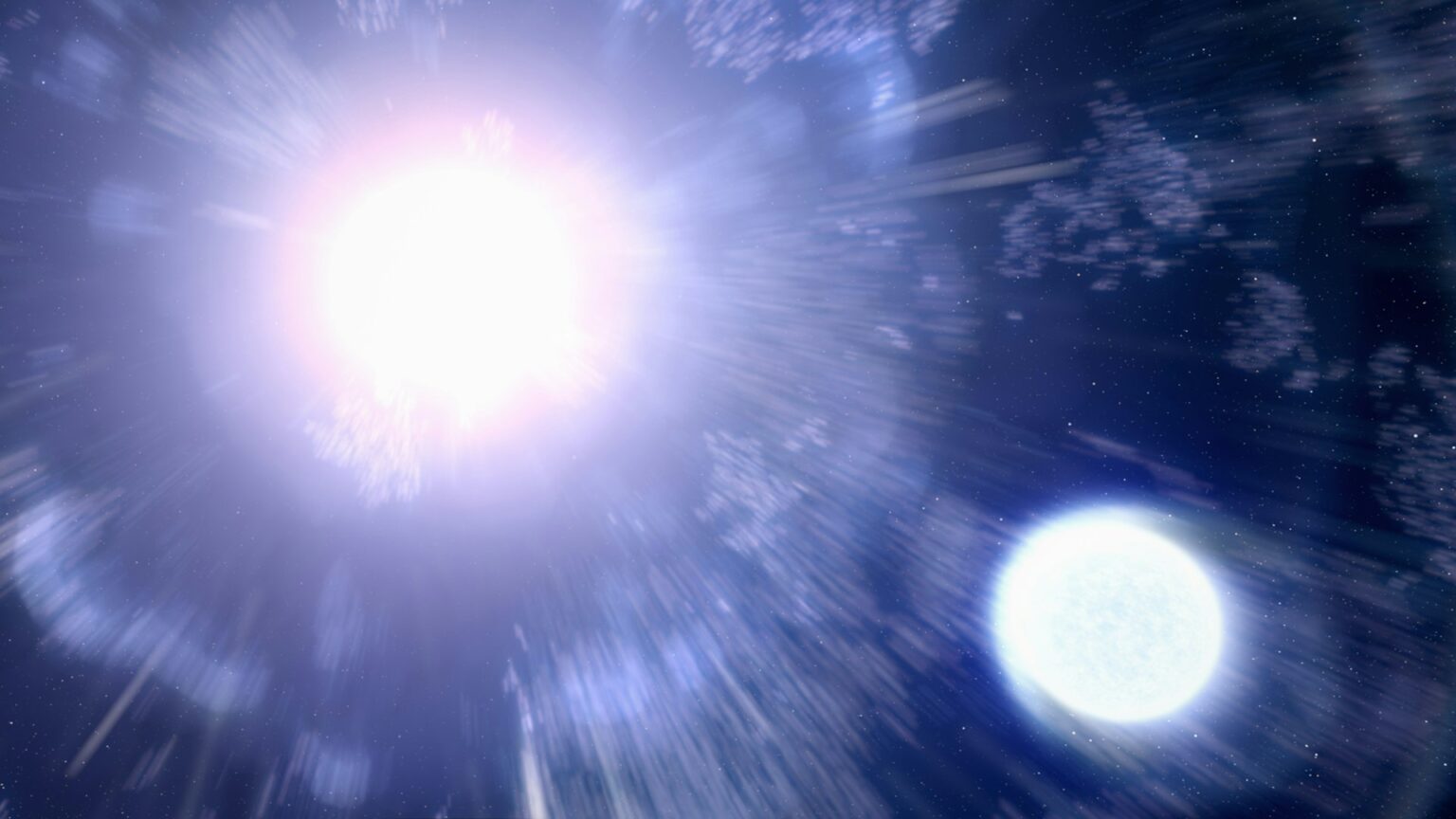 Illustration of a supernova explosion. Source: Unsplash
These are extremely massive stars that, from time to time, experience titanic outbursts of “rage,” ejecting colossal amounts of their own matter into outer space. This process is known among scientists as explosive mass loss, and its true nature has remained one of the greatest and most complex mysteries of modern astrophysics.
Mystery of computer simulations
Studying such cosmic “impostors” is like trying to weigh the ash of a raging volcano without getting close to its crater. Modern infrared or radio observations capture only the current state of affairs, whereas stars lose matter intermittently rather than in a steady stream.
For decades, scientists have been developing complex computer models of stellar evolution. But when it came to truly massive stars, these algorithms failed: the simulations were unable to correctly complete the life cycle of a massive star precisely because of the unpredictable explosive loss of mass.
It is believed that light pressure pushes matter beyond the so-called Eddington limit, but scientists were missing a key detail—the free efficiency parameter. This mysterious regulator of burst power has hindered our understanding of the evolution of giants.
Galactic Census
To break the deadlock, a team of astrophysicists led by Shelley J. Cheng of the Harvard-Smithsonian Center for Astrophysics adopted a radically new approach. Instead of “detecting” flares from individual stars, they conducted a large-scale survey of red supergiants in the Local Group—the galaxies that are the immediate neighbors of our Milky Way.
Using data from powerful wide-field surveys, researchers have created a detailed map of these swollen stars in the late stages of their evolution. Using the MESA software package, scientists created artificial stellar populations with varying initial masses and ages, adjusting that very unknown efficiency parameter. They then carefully compared their virtual stars with actual observations in the Magellanic Clouds and the Andromeda Galaxy (M31).
Metals as catalysts for stellar explosions
The result was impressive: the efficiency metric wasn’t just a random number. It demonstrated a clear positive correlation with metallicity—the amount of heavy elements incorporated into the star’s structure.
The more heavy metals a star contains, the more violent its eruptions become. It’s a bit like adding more baking soda to a school volcano experiment: the more reagent you add, the more powerful the reaction. When these calibrated data were incorporated, the models revealed an interesting evolutionary paradox. Stars with masses greater than 20 times that of the Sun lose matter so rapidly during their outbursts that they skip the red supergiant stage entirely, following a completely different path.
Future of space exploration
Although the link between mass loss and metallicity seems convincing, the universe always holds more secrets. To definitively confirm the universality of this trend, astronomers need to expand their search to include a larger number of galaxies. Scientists have yet to determine the key question: Are heavy elements the direct trigger of the explosion, or do they merely affect the volume of material ejected?
In the future, with the deployment and commissioning of powerful instruments such as the Extremely Large Telescope, humanity will be able to peer even deeper into the heart of these turbulent processes. The saga of giant “erupting” stars continues, and every new model developed brings us closer to understanding their incredibly complex nature.
We previously reported on how a new supernova remnant turned out to be the faintest in the radio spectrum.
According to Space