
(Iowa Capital Dispatch) – In order for scientists to know how equipment will fare in space, they must test tools in a variety of manners — vibrations, thermal changes, if materials will warp when put under stress. Something as small as metal debris touching a circuit board inside a satellite instrument could spell disaster for the equipment as a whole, or at least set back the project timeline while things are taken apart and reworked.
At the University of Iowa, the success of a project that brought the largest grant in its history to the institution and support from within and outside the university have led to the creation of laboratories keeping the UI on the cutting edge of space technology development and ahead of the competition.
Casey DeRoo, associate professor and director of research and operations in physics and astronomy, said these facilities and what they can do will open doors for internal and external partnerships, research and opportunities for students who want to make their own mark on the study of the stars. Construction finished this month, Departmental Executive Officer Greg Howes said, and staff and students are already utilizing the space for their work.
“Being frank, there aren’t that many physicists in the world,” DeRoo said. “But what we are interested in is making sure that those physics students that do come here have access to a quality education that gives them the capabilities and the opportunities to go on and say, ‘I have this degree of professional experience,’ which is really, really hard to do if you don’t have access to labs like this.”
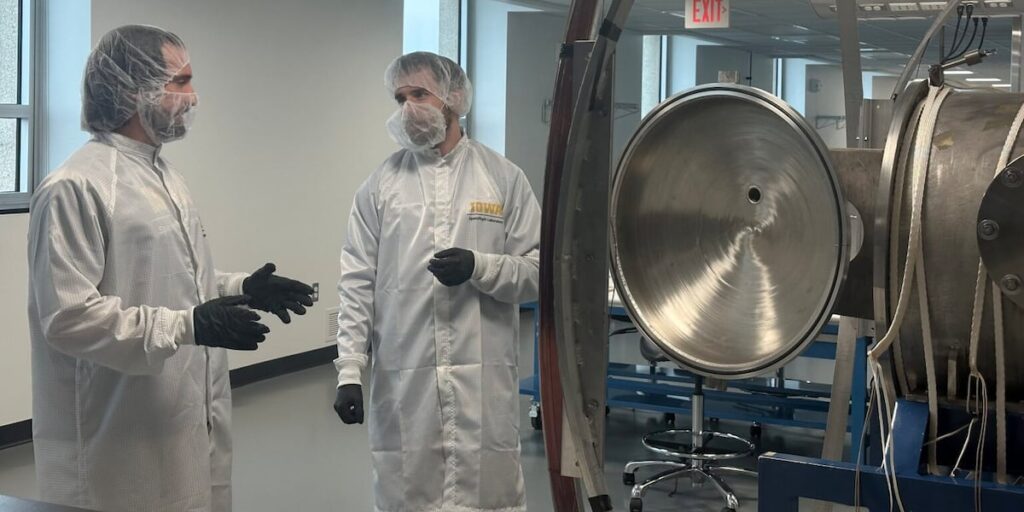
Iowa Spaceflight Laboratories take up much of the seventh floor of Van Allen Hall, including the office of the building’s namesake, and hold equipment to take a concept and turn it into a tool for testing. The laboratories also operate as service centers, allowing the university to keep on additional staff and other projects and groups to utilize equipment when necessary.
Last July, two satellites carrying instruments developed and tested by University of Iowa researchers launched into Earth’s orbit to study the interactions between the planet’s magnetic sphere and solar wind coming from the sun. Tandem Reconnection and Cusp Electrodynamics Reconnaissance Satellites, or TRACERS, was funded by NASA to the tune of more than $171 million, the largest external project in the UI’s history.
Those satellites, and their instruments, are still operating today, said TRACERS Principal Investigator and UI physics and astronomy associate professor David Miles, and scientific journal articles written from gathered data should be published soon. Researchers are also working on new ideas for how to use the instruments and their measurements.
Sitting in the new spaceflight laboratories is a third TRACER spacecraft, one Miles said wasn’t meant for launch and will never actually see space.
Where James Van Allen used to work at the UI has been transformed into the lab’s new prototyping space, and other rooms have been equipped to support different projects and tests. Clean rooms allow engineers, working with various researchers on different projects in the space, to control the humidity and temperature as they assemble instruments.
The renovations and equipment purchases were supported with $7.2 million from the UI and $670,000 from the Roy J. Carver Charitable Trust. NASA funding has also supported the lab, DeRoo said.
“The idea is, really, to be able to be a one-stop shop to come from concepts to design to implementation, and actually, ultimately to delivery,” DeRoo said.
As the spaceflight lab is set up as different service centers, DeRoo said they can support external as well as internal stakeholders, whether from academia or industry.
Work is already being done in the new laboratories, from faculty, engineers and students. A group of graduate students, including UI third-year Ph.D. student Brendan Powers, is creating instruments to gather data above the TRACERS crafts as they pass a certain point in orbit, he said. Researchers also mentioned upcoming work that will include hundreds of circuit boards, all made in-house.
Each part of the instrumentation process that can be completed at the UI rather than somewhere else is an advantage the university has, DeRoo said, of time, cost and what they can offer to grant providers and potential project partners.
Rich Dvorsky, interim research administrator for the spaceflight lab, said in the past he would need to travel to Maryland for months in order to conduct thermal tests on instruments, but now other researchers are bringing their equipment to the UI for testing on projects they’re collaborating on.
Having equipment in-house also allows teams to respond quickly when one aspect of a project goes wrong or doesn’t hold up as expected, DeRoo said. That helped during the TRACERS project preparation when they were able to design and create new brackets within weeks.
One unique aspect of the UI physics and astronomy program is the fact it is one of few places where undergraduate students can come in and get hands-on experiences with “real space hardware,” DeRoo said. With current and future projects coming through the lab, students will have even more up-close learning opportunities.
Faculty are also an important part of the program and a sign of its health, DeRoo said, as many faculty members are in the early or middle stages of their careers and the UI is committed to hiring more faculty.
“The way I would think about this investment as a whole, it really does mean that we are able to deliver not just now and on our current history, but in our future,” DeRoo said.
Want to get the latest news and weather from Siouxland’s News Source? Follow these links to download our KTIV News app and our First Alert Weather app.
Copyright 2026 Iowa Capital Dispatch. All rights reserved.