
On the full moon on the first night of the month, New Yorkers will gather to celebrate Earth’s lunar neighbor at a Brooklyn graveyard.
The macabre affair kicks off a busy month of celestial events, including a meteor shower running for much of the month as well as the return of Manhattanhenge, when the sunsets line up with the city’s street grid. The month ends as it begins – with another full moon.
“ May is exciting,” said Jackie Faherty, astrophysicist at the American Museum of Natural History. “May has a lot of action going on.”
Once in a blue moon
Green-Wood Cemetery’s May 1 MoonFest includes scientists and historians who will discuss the effect the moon has had on the Earth from 238,000 miles away. The soiree is inspired by one of the graveyard’s permanent residents — John Draper — who took one of the earliest photographs of the moon in 1840.
Telescopes will be pointed at the full moon for an up-close view of craters and the lunar surface. There’s also a chance to see distant stars and planets. The party runs from 7 p.m. to 11 p.m at the main entrance.
“ We go out and summon all the ghouls and goblins and everybody, and we look at the moon,” said Bart Fried, a member of the Amateur Astronomers Association, the organization co-hosting the Moon Fest. “You see the whole full moon, which is always fun.”
The full moon returns on May 31. The second full moon in a month is known as a blue moon — a rare occurrence that happens just once every two to three years. It’s not actually blue.
Eta Aquarids meteor shower
The Eta Aquarids meteor shower started last month and runs until May 21. The meteors, often commonly called shooting stars, are the debris left behind by comets. In this case, the shower is the byproduct of Halley’s Comet. Each time the comet passes Earth, it leaves behind debris made of ice and rock. When this cosmic dust collides with the Earth’s atmosphere, it disintegrates and becomes fiery and colorful sparks. While the Eta Aquarids meteor shower is an annual event, the parent comet won’t return until 2061 on its 76-year trip around the sun.
The meteors travel at nearly 150,000 mph and leave trailing streaks of light that last several seconds, and sometimes even minutes. The shooting stars appear from the constellation Aquarius, hence the name.
“ These are fast meteors and some really glowing trails behind them,” Fried said. “Although New York City is not an ideal location because of the moon, you can still catch some meteors.”
Manhattanhenge returns
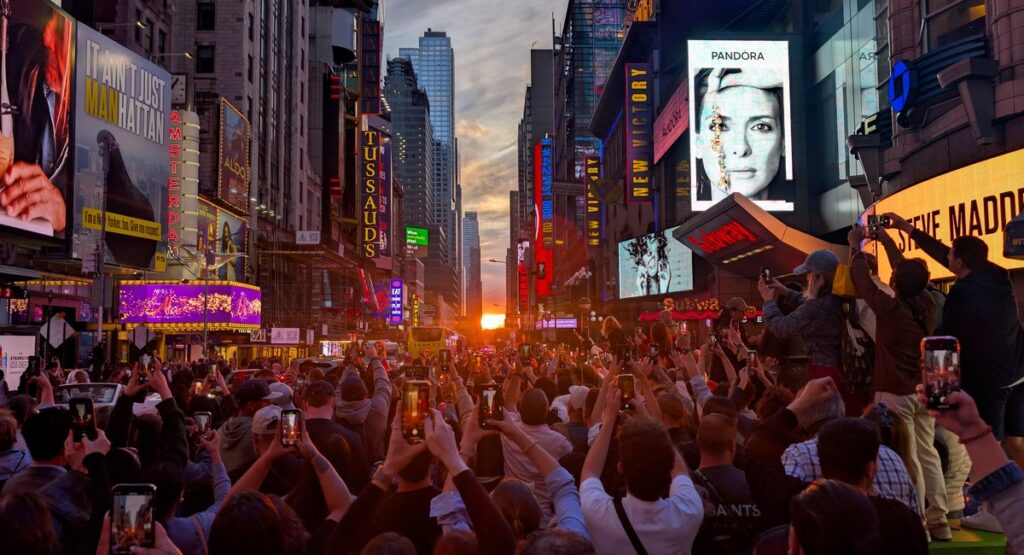
Manhattanhenge happens when the sun aligns with the city’s street grid, resulting in sunsets that look like they are descending into the canyon of skyscraper-lined streets.
On May 28 at 8:14 p.m., the sun’s midpoint will line up with the city’s street grid. The next evening, one minute earlier, the bottom of the sun will align with the grid.
For the best way to view Manhattanhenge, head to a crosstown street — 14th, 23rd, 34th, 42nd and 72nd streets are ideal — and look west. Tudor City is one of the most popular observation points, as are the Brooklyn waterfront as well as Hunters Point and Gantry Plaza State Park in Queens. Rooftops, the High Line and the Hudson River waterfront are unfortunately not very good vantage points.
City sunsets will have a similar Manhattanhenge quality through mid-July, albeit without the precision. The perfect lineup returns on July 11 and 12.
“June is a gorgeous, sunset month because they’re what I call Manhattanhenge effect sunsets,’ Faherty said.
A planetary conjunction
Venus and Jupiter will be the brightest planets during May. Both planets are easily visible at sunset, and are often mistaken for bright stars. Unlike stars, however, planets do not twinkle.
An easy way to spot Venus and Jupiter is to look for the moon on May 18, when both planets will be right next to the moon at sunset.
“ As the sun is setting, you need to look towards the west and you will see Venus and Jupiter and then the little sliver of a moon will be very close,” Faherty said.
The moon will be in its waxing crescent phase, which means the sky will also be dark and perfect for stargazing.