
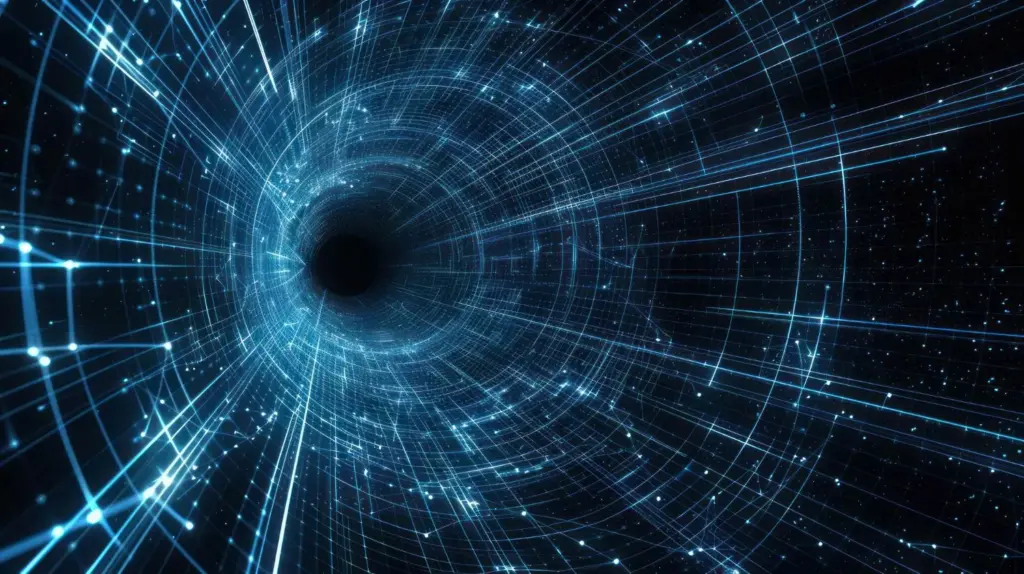
Spacetime, the invisible fabric stitching the universe together, could actually be far more complex than previously believed.
Long ago, Einstein gave us a set of equations describing how stars and galaxies bend and curve spacetime. Over the decades, physicists came to think of this framework as a depiction of a smooth, fluid sheet that rippled with gravitational waves and bowed down into black holes.
But instead of a calm sheet, imagine every bit of spacetime is a restless ocean. Beneath, invisible fibers tie and untie in knots to hold patterns taut, while the water crashes. So new research is painting a picture in which spacetime can develop in complicated, nonlinear ways while much of its geometry resists disintegration.
New research suggests that Einstein’s equations do not only describe a smooth cosmic canvas. They also allow for knotted structures that can last and change, much like magnetic field lines trapped in plasma.
Black holes ring: Physics to pay close attention
Using a version of general relativity that accounts for the nonlinear electrodynamics of continuous media, scientists have found connections in the gravitational field. These connections appear as two-dimensional surfaces woven with field lines, and their connectivity stays intact even as spacetime moves and bends.
This “gravitational frozen-in” effect arises from an Ohm-type condition applied to the gravitational field. In simple terms, spacetime acts like a perfect conductor, locking in its field lines so they cannot break or reconnect at will.
The most striking part of the framework is that it shows conserved quantities that are similar to more familiar electromagnetic phenomena:
A gravitational magnetic flux that stays constant, no matter how spacetime bends.
A gravitational helicity, an indicator of the knottedness of field lines, provides a topological signature of spacetime’s unseen dance.
Gravity can accelerate the homogenization of space-time
Taken together, these results impose powerful topological constraints on how spacetime can evolve. According to them, deep beneath the chaos of black holes and cosmic strings and gravitational waves lurks an organizing principle, a geometric skeleton guiding the nonlinear dynamics of the universe.
Instead, spacetime is not just a passive stage; it is an active medium with its own rules of connection. The discovery could lead to new lines of inquiry. This includes exploring the origin of the universe, examining its tangled interiors within black holes, and understanding cosmic evolution up to the present day.
Journal Reference:
Felipe A. Asenjo, Maricarmen A. Winkler, and Luca Comisso. Frozen-In Gravitational Fields. Physical Review Letters. DOI: 10.1103/6c4q-kx6f