

Pluto has always been a crowd favorite, especially in the United States. That’s because it’s the only planet discovered by an American. In 1930, Clyde Tombaugh made this historic discovery while studying photographs from the Lowell Observatory. That is why the International Astronomical Union’s (IAU) decision in 2006 to reclassify it as a “dwarf planet” sparked a storm of controversy.
 NASA Administrator Jared Isaacman raised the issue of Pluto’s status during the review of NASA’s budget request for fiscal year 2027. Photo: NASA
Today, this issue is back on the agenda, and not without political undertones. Donald Trump has long been advocating for the “rehabilitation” of Pluto, even suggesting that it be done by presidential decree—which, of course, is absurd. Jared Isaacman, the billionaire astronaut and current NASA administrator, also joined the effort. At a U.S. Senate hearing held on April 28, he openly stated that he supported the idea of restoring Pluto’s former status as a planet so that Clyde Tombaugh, its discoverer, could receive the recognition he deserved. NASA is already preparing documents to launch a new discussion within the scientific community, although the final decision still rests with the IAU .
Born from cosmic dust
To understand why Pluto was removed from its status, we need to look back at the history of our Solar System’s formation. Billions of years ago, it was nothing more than a gigantic cloud of gas and dust. When gravity compressed the center of the cloud, nuclear fusion ignited and the Sun was born. The remaining material formed a rotating disk.
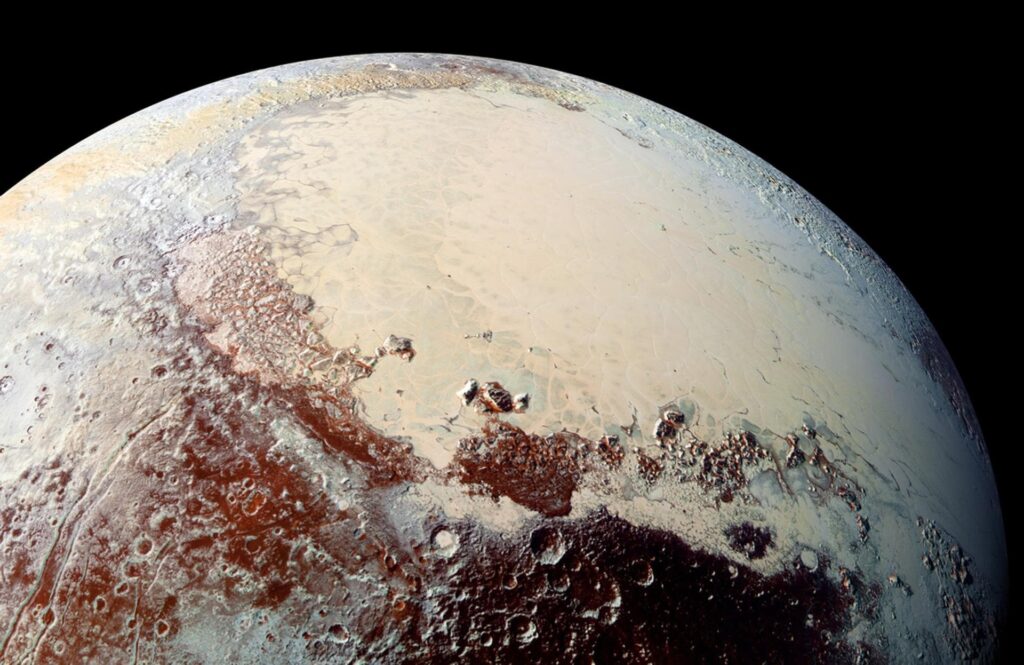 The Sputnik Planitia region on Pluto. Source: NASA / Johns Hopkins University Applied Physics Laboratory / Southwest Research Institute
Over time, the dust in this disk clumped together. Some of these clumps became massive enough that, under the influence of their own gravity, they took on a spherical shape and cleared their orbital path of space debris. We call them planets. But on the outskirts of the Solar System, in the Kuiper Belt and the Oort Cloud, there are billions of smaller objects. For a long time, Pluto seemed to us to be just a “strange planet” with an elongated and tilted orbit, until we realized it wasn’t alone out there.
Why was Pluto “demoted”?
A true revolution in astronomy took place in 2005, when scientists discovered Eris—an object more massive than Pluto, located at a similar distance from the Sun. It has become clear: Pluto is not unique. It is just one of many members of an entirely new class of celestial bodies.
At that time, the International Astronomical Union introduced new rules. To be classified as a planet, a celestial body must:
Orbit the Sun.
Have sufficient mass to assume a spherical shape.
Clear its orbit of other objects.
Pluto does not meet the third criterion, as it shares its space in the Kuiper Belt with many other icy bodies. It is this criterion that is currently the most controversial. Supporters of Pluto rightly point out that Earth and Jupiter also share their orbits with thousands of asteroids, so the criterion of “clearing an orbit” is vague.
Beauty of the unknown world
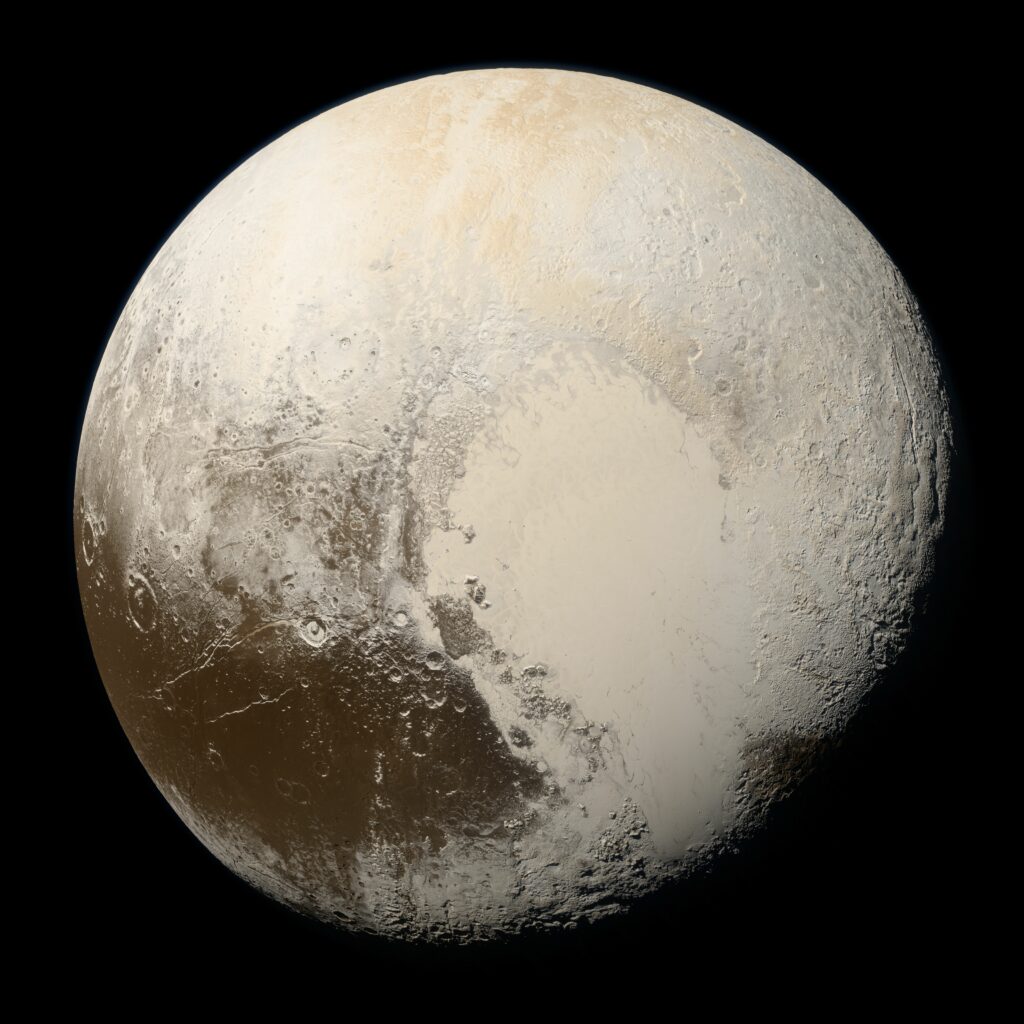 Pluto was photographed by the New Horizons probe. The Sputnik Planitia region is visible in the lower right part of the planet. Source: NASA
Despite its reclassification, Pluto has not lost any of its appeal. In 2015, the New Horizons spacecraft flew past it and sent back stunning images. Instead of a lifeless block of ice, we saw a geologically active world with towering mountains, nitrogen glaciers, and the famous heart-shaped plain, which was named Tombaugh Regio in honor of its discoverer.
Astrophysics isn’t concerned with fitting into school textbooks, and the new classification of dwarf planets actually better describes the evolution of our Solar System. But will the situation change now that the head of NASA, along with Donald Trump, is so openly striving to restore planetary status to this distant, mysterious, and incredibly beautiful world? Pluto is Pluto, and it doesn’t matter what label they attach to it.
We previously shared five facts about Pluto which may surprise you.
According to Space