
NASA has two car-sized vehicles on the ground exploring areas of Mars’s surface that are billions of years old.
But the similarities of the landscapes through which both the Curiosity and Perseverance rovers are traveling couldn’t be more different.
While Curiosity reaches younger terrain 15 years into its mission in the foothills of a Martian mountain, its Perseverance cousin is venturing atop a crater rim into some of the most ancient landscapes in our whole solar system, according to the U.S. space agency.
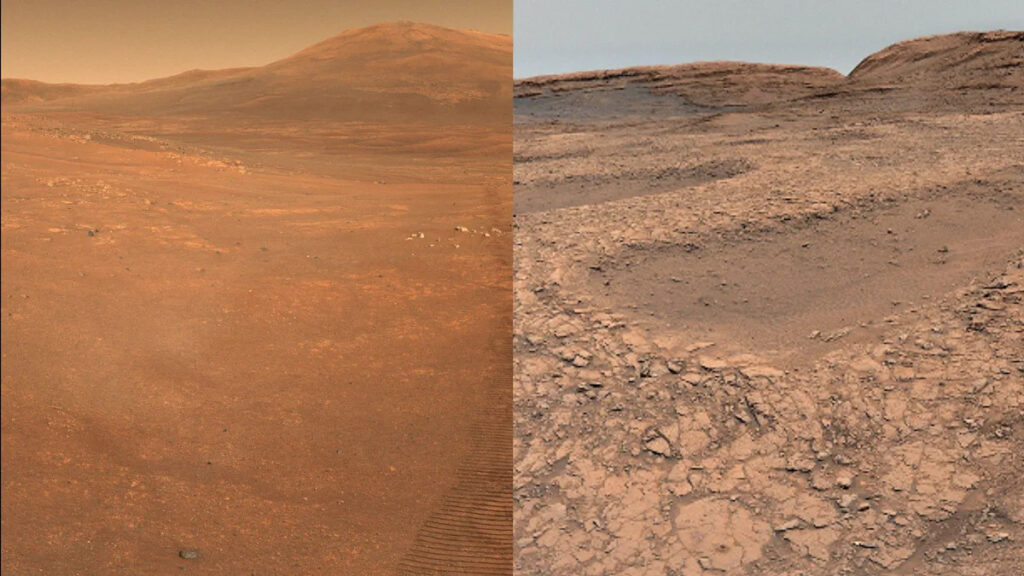
To showcase the distinct regions each rover is exploring, NASA recently shared dueling panoramas composed from hundreds of photos taken between the end of 2025 and the beginning of 2026.
In honor of Earth Day, see these photos of our planet from space
1 of 12
The crew of Artemis II captured a breathtaking image of a celestial event known as an “Earthset,” in which the Earth dropped below the lunar horizon. The image is reminiscent of the iconic “Earthrise” photo that NASA astronaut Bill Anders captured in 1968 during the Apollo 8 mission that showed our planet rising on the lunar horizon.
Here’s a side-by-side look at the landscapes through which NASA’s Mars rovers are venturing as the agency prepares for the first astronauts to venture to the surface amid its Artemis moon program.
NASA’s Mars rovers capture 2 sides of red planet. See photo
NASA has two car-sized robots – Perseverance and Curiosity – that have spent years exploring the Martian surface for signs that the planet was once habitable.
But each are exploring very different areas of Mars 2,300 miles apart – the distance from Los Angeles to Washington, D.C. – to find new clues that will help scientists on Earth solve mysteries about the red planet’s history.
To give you an idea of just how disparate each landscape is that the rovers are exploring, NASA on April 27 shared panoramic photos from Curiosity and Perseverance.
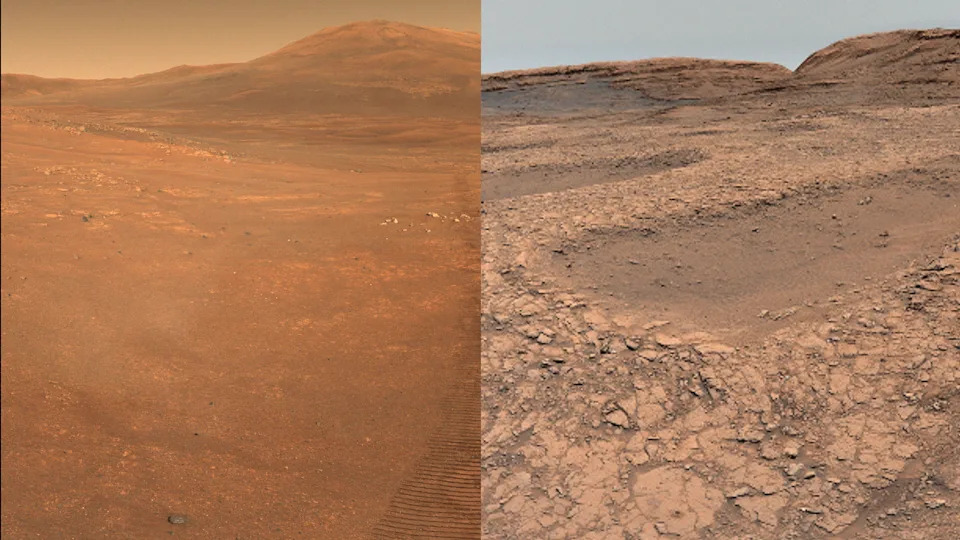
A side-by-side image shows two areas of Mars taken by NASA’s two rovers on the planet about 2,300 miles apart. On the left is a panorama taken by the Perseverance rover as it travels on the rim of the Jezero Crater. On the right is an image from the Curiosity rover as it roams the Gale Crater.
Curiosity’s 360-degree panorama was stitched together from 1,031 images taken between Nov. 9 and Dec. 7, 2025, NASA said in a press release. The mosaic offers a detailed portrait of a region brimming with ancient ridges known as boxwork formations that resemble spiderwebs.
Perseverance’s panorama, meanwhile, focuses on a place nicknamed “Lac de Charmes” outside the rim of the Jezero Crater. Composed of 980 images taken between Dec. 18, 2025, and Jan. 25, 2026, the mosaic details the crater’s rim and ancient rocks around it, according to NASA.
What is NASA’s Perseverance rover on Mars?
After launching in 2020, Perseverance made a 200-day, 300-million-mile journey to reach Mars‘ Jezero Crater in February 2021. Believed to have formed 3.9 billion years ago from a massive impact, the Jezero Crater shows evidence of having once been filled with water.
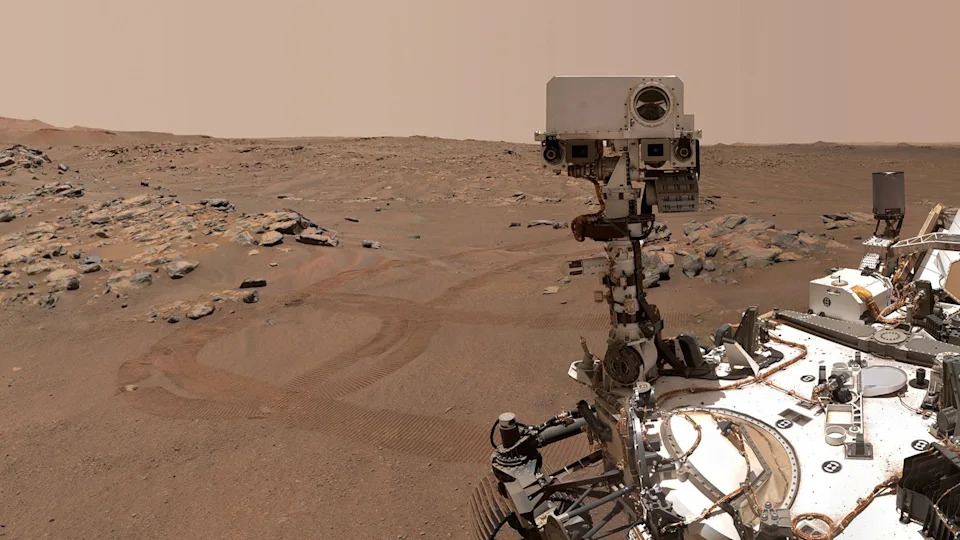
NASA’s Perseverance Mars rover is seen in a “selfie” that it took over on Sept. 10, 2021. Perseverance rover, along with Curiosity, is one of the agency’s two car-sized robots exploring the Martian surface for signs that the planet was once habitable. And in September, NASA officials confirmed that one of the rovers’ finds contained a potential biosignature.
At the end of 2024, after years in the trenches of Jezero, Perseverance summited the steep Martian crater to begin the next leg of its journey on the rim.
Exploring in and around the crater, Perseverance is searching for signs of ancient microbial life and other remnants of Mars’ earliest years billions of years ago. The rover has also studied phenomenon like “dust devils.”
And in September 2025, NASA announced that a discovery from the rover – a potential biosignature in a rock sample – was the closest scientists had ever come to finding actual signs of past life on the planet.
What is NASA’s Curiosity rover?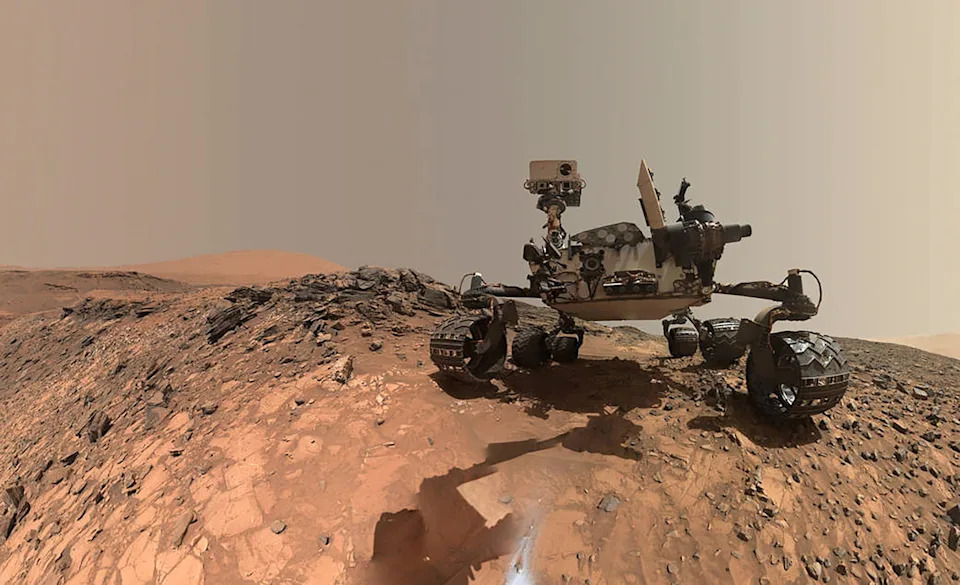
NASA’s Curiosity Mars rover is seen at the site from which it reached down to drill into a rock target called ‘Buckskin’ on lower Mount Sharp in this low-angle self-portrait taken August 5, 2015 and released August 19, 2015. The selfie combines several component images taken by Curiosity’s Mars Hand Lens Imager (MAHLI).
East of Perseverance, the Curiosity rover began its voyage to Mars in November 2011, landing in August 2012 in the Gale Crater on the boundary between Mars’ cratered southern highlands and its smooth, northern plains. While exploring the crater, believed to have formed 3.7 billion years ago, Curiosity has collected 42 powderized rock samples with the drill on the end of its robotic arm.
As it climbs the 3-mile-high Mount Sharp, Curiosity is searching for evidence that Mars was ever hospitable to life. To that end, the rover has been behind a slew of recent discoveries, including observations of never-before-seen organic compounds.
10 days, 10 photos. Here are the most stunning images from Artemis II
1 of 10
The Artemis II mission launches April 1 from the Kennedy Space Center in Cape Canaveral, Florida. The four-person crew aboard the Orion spacecraft hitched a ride to orbit atop NASA’s giant 322-foot Space Launch System rocket. Launching atop 8.8 million pounds of thrust, the SLS is the most powerful rocket NASA ever launched, about 17% more powerful than the iconic Saturn V rocket used during the Apollo era.
Could there have been life on Mars?
Mars may now be a barren, dusty landscape, but evidence suggests it may once have harbored life in some form.
For that reason, scientists regard the red planet as one of the best places in our solar system for humanity to look for signs that we at least at one point were not alone, according to NASA. That information will in turn reveal more information about Earth’s own place in the universe and how our vibrant planet came to be.
To that end, the Curiosity and Perseverance rovers, controlled remotely from Earth, have slowly navigated the rocky terrain to scoop up and collect intriguing samples that could help prove that theory.
What they’ve found, NASA says, has helped scientists in their objective to reconstruct how Mars formed and why it went from being wet to being dry.
Eric Lagatta is the Space Connect reporter for the USA TODAY Network. Reach him at elagatta@usatodayco.com
This article originally appeared on USA TODAY: NASA’s Curiosity, Perseverance rovers reveal different Mars landscapes