
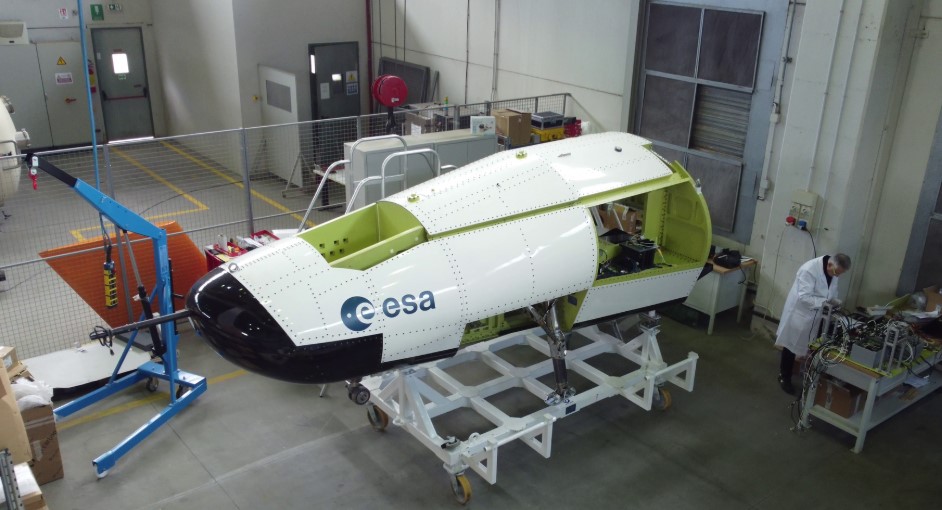
On 29th April, ESA announced updates about Space Rider, the agency’s reusable spacecraft. The recent focus has been on how the spacecraft’s skin handles extreme heat during reentry.
Thermal protection testing has pushed Space Rider’s heat-shield materials to very high temperatures. Engineers heated the system up to 1600 °C to simulate the intense heating the vehicle will endure when returning from orbit. The tests took place at the Italian Aerospace Research Centre’s plasma wind tunnel in Capua, Italy. These conditions help confirm whether the reentry module can survive the fiery environment of atmospheric entry.
The craft uses a set of ceramic tiles to form its outer skin. There are 21 tiles, produced by ISiComp in collaboration with the Italian Aerospace Research Centre (CIRA) and Petroceramics. The tiles are designed to be lightweight yet durable, and they shield the spacecraft from extreme heat and mechanical stress. Earlier testing in February subjected the tiles to severe vibrations caused by the Vega-C rocket’s engines, using a 200 kN shaker to replicate launch conditions.
Space Rider’s reentry module has a distinctive control system that relies on two flaps for maneuvering. Rather than traditional wings, the vehicle generates lift from its own body during descent. Each flap weighs around 10 kg and measures about 90 by 70 cm. They help steer the 3000 kg module as it enters Earth’s atmosphere at hypersonic speeds. The flaps are built from the same ISiComp ceramic material and are attached with titanium alloy supports created through additive manufacturing. Avionics systems provide the control signals to operate the flaps during flight.
Testing for the flaps involved the world’s largest plasma wind tunnel at CIRA. The experiments used an arc jet to bombard the flaps with gas traveling at ten times the speed of sound, simulating in-flight conditions. Space Rider has demonstrated strong performance in these tests so far, including survival of a deliberately damaged tile scenario that models potential micrometeoroid impact.
Researchers note that additional thermal protection and guidance-system tests are still required before Space Rider can be formally qualified for spaceflight and for return from orbit. More tests will proceed to validate readiness for real missions.
 Published by James Hydzik
James Hydzik is a technology geek focused on the junction of engineering, writing, and coffee. He joined Orbital Today in 2020 to help make sense of the Johnson government’s decision to buy OneWeb. Since then, he has taken on interviewing and editor-in-chief roles. James learned the ropes of editing and writing with Financial Times magazines, The World Bank, PwC, and Ericsson. Thus far, interviewing New Space movers has put the biggest smile on his workaday face. The son of an Electrical Engineer, James understands the value of putting complex topics into clear language for those with a lay person’s understanding of the subject. James is a European transplant from the United States, and as ex-KA3LLL, he now holds European amateur radio licenses. His next radio project is a portable 10GHz EME (moonbounce) station, as it combines his childhood interests in antennas and space.