
The universe outside the confines of the “pale blue dot” we call home is unimaginably vast and ever-changing — yet big discoveries aren’t limited to big celestial objects lightyears away.
Dr. Dave Jewitt, astronomer at UCLA, has plenty of discoveries to his name already — including 4 dozen minor planets, and the first object aside from Pluto in the “Kuiper Belt”, a ring of icy bodies beyond Neptune’s orbit. He also has a background in studying rotating comets, which involves a delicate dance of physics.
“People have been looking at this idea that comets can change their own spin for a long time,” he explains. “Comets go around the sun in these very elliptical orbits, very egg-shaped orbits… and when they’re near the sun, the ice in the comet nucleus basically turns to a gas, it sublimates. It’s like melting, but it turns straight to a gas with no liquid.”
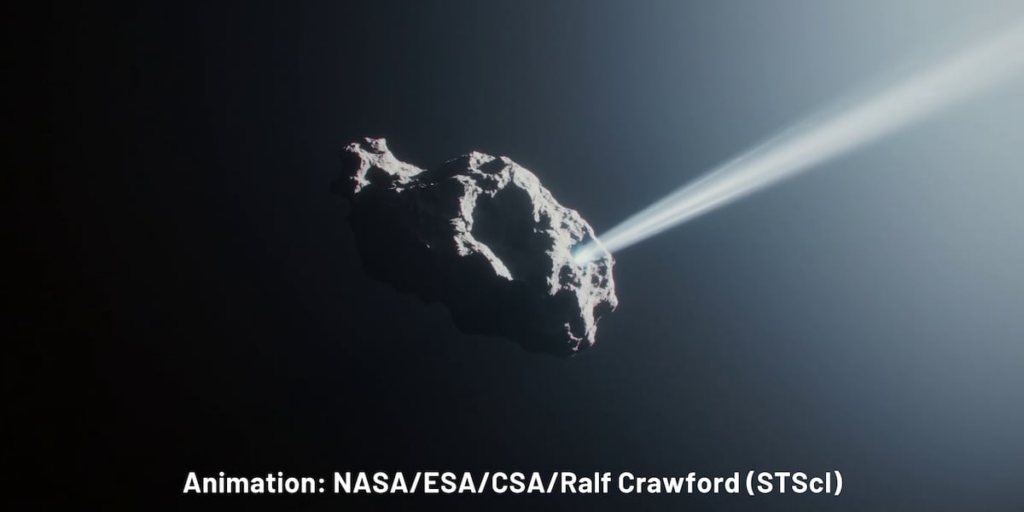
The escaping gas can sometimes form jets acting much like spacecraft thrusters, making the comet rotate in a certain direction and rate — usually quite slow. “It’s exerting a torque that changes the spin of the nucleus,” Dr. Jewitt compares, “in the same way that the force of the water changes the spin of a lawn sprinkler.”
Back in 2017, one particular comet dubbed “41P/Tuttle-Giacobini-Kresák”, came close to Earth and the Sun, offering a great chance for a sublimation case study. Its rotation rate slowed from once every 20 hours, to once every 46 hours, between March and May alone. More recently, Dr. Jewitt took a dive into the Hubble archive for more images, yielding an astronomical first: That comet had not only slowed its spin, but reversed it.
41P is only about a kilometer across, so any jet becomes that much more effective… in some cases, TOO effective. “Once they can change their own spin by outgassing, then their spin accelerates… and the only natural limit to the spin is breaking up,” Dr. Jewitt offers. “It’s not a very cohesive body… it’s more like a bunch of grapes, where the grapes are all kind of just touching each other, but not really stuck to each other with glue or anything like that. If you spin it fast, it’s going to fly apart, and we think that is what destroys the comets.”
Given its small size and accelerating spin, Dr. Jewitt only gives comet 41P a few more decades before it shears itself apart. This discovery may offer more new questions than solved answers, but that’s really where the scientific process shines: “You go out to answer one question and then 10 more appear… and it’s kind of a divergent thing, it’s not a convergent thing, which is really why it’s so much fun.”
Latest Local News | First Alert Weather | Crime | National | 13abc Originals
Copyright 2026 WTVG. All rights reserved.