
Agency
29/04/2026
39 views
0 likes
ESA’s Education Office is looking for highly motivated Master’s and Ph.D. students in engineering or science disciplines to participate in the fourth edition of the Earth Observation Satellite Systems Design Training Course. This edition of the training course will also include 15 participants from Africa, selected as part of the broader African Union–European Union strategic partnership. The African Space Agency (AfSA) and the European Space Agency (ESA) are jointly supporting initiatives aimed at strengthening collaboration in space activities. The course will take place across two weeks, the first onsite at ESA Academy’s Training and Learning Facility in ESEC-Galaxia, Transinne, Belgium, from 28 September to 2 October 2026, and the second online from 5 to 9 October 2026.
The Experience
Trainer explaining an exercise based on the Sentinel-3 Next Generation specification.
Earth observation (EO) satellites provide essential information to help guide our global society toward a more sustainable future. For instance, they enable monitoring of vegetation and waters to support the responsible use and preservation of limited resources; allow rapid assessment of damage caused by natural disasters such as floods and earthquakes to support effective response measures; offer insights into patterns of urban development; and deliver critical meteorological and environmental data that are fundamental for daily life and for understanding Earth system processes, including future climate evolution.
Earth observation satellite missions represent the largest component of ESA’s programme activities, with a significant share of the Agency’s annual budget dedicated to their definition, development and operation. ESA develops Earth research missions “end-to-end” from their conception to their exploitation. ESA also plays a leading role in the Copernicus Programme, the world’s largest civilian EO initiative developed in partnership with the European Commission and ensuring free-and-open access to high-quality Earth monitoring data for a wide range of environmental and security applications. ESA develops meteorological satellites in cooperation with the European Organisation for the Exploitation of Meteorological Satellites (EUMETSAT). Among ESA’s most recent research missions is BIOMASS, which provides critical data on global forest carbon stocks and plays a key role in improving our understanding of the carbon cycle, therefore supporting climate change mitigation strategies.
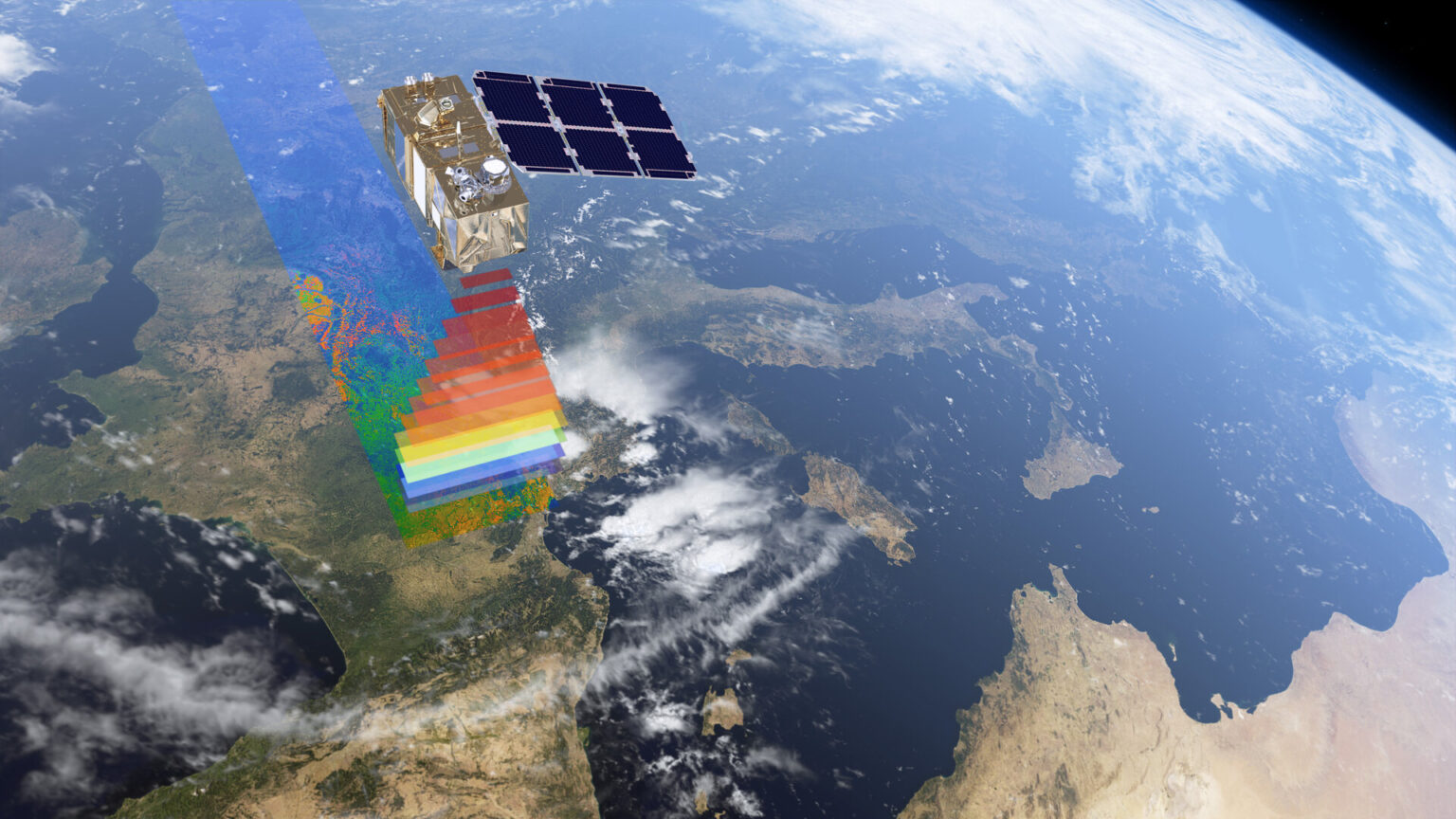
The Earth Observation Satellite Systems Design Training Course is a practice-oriented course in which students will become familiar with the end-to-end design process of an Earth observation satellite system. Beginning with the definition of mission objectives and corresponding requirements, the course will guide participants through key engineering decisions including orbit trade-offs, the design of optical and microwave payload instruments, overall satellite architecture, ground segment design and operations, as well as verification, testing, and in-orbit validation.
Students interacting with a trainer during the group project sessions.
Students will have the opportunity to apply their knowledge through a collaborative group project structured as a step-by-step Earth observation system design challenge. Each team will work through a sequence of hands-on exercises, progressively developing a realistic EO satellite system concept. Within each group, students will take responsibility for a specific engineering discipline, such as system engineering, microwave instrument design, optical instrument design, satellite design, or ground segment and operations. Trainers and experts will provide continuous guidance and feedback throughout the group sessions, helping students to consolidate their understanding and refine their designs.
The Earth Observation Satellite Systems Design Training Course has been developed by ESA’s Education Office in collaboration with ESA Earth observation system specialists and members of ARES, the Association of Retired ESA Staff. All trainers are seasoned experts who have led or contributed to flagship EO missions at ESA, bringing their top-level experience into an engaging and interactive learning environment, offering students direct insights into the real-life processes and challenges of working in the space sector.
Week 1 – Onsite Training preliminary schedule
Day
Lectures & Activities
Group Project Work
Monday
– Introduction to EO & EO Satellite Systems
– Use of EO Data in Science & Civil Services
– From User Needs to System Requirements
– Observation Fundamentals
GP1 – Orbit and Coverage Analysis
Tuesday
– Electromagnetic Theory & Antennas
– Radar Remote Sensing
– Microwave Radiometry
GP2 – Microwave Payload Design
Wednesday
– Basics of Space Optics
– Passive Optical Payloads
GP3 – Optical Payload Design
Thursday
– Space Lidars
– Satellite Observations of Climate Monitoring
– Satellite System Design & Payload Accommodation
– On-Ground Assembly, Integration & Verification
GP4 – System Architecture and Trade-offs
Friday
– Ground Segment & Operations Concepts
– Wrap-up and Conclusion
GP4 – System Architecture and Trade-offs (continued)
Week 2 – Online Training preliminary schedule
Day
Lectures & Interactive Sessions
Group Project Work
Monday
– Welcome back online – Risk Management & Technology Development
GP5 – Recap & Way Forward
Tuesday
– Launch & Early Orbit Phase – Questions & Answers
GP5 – System Design Finalisation (Part 1)
Wednesday
– Questions & Answers
GP5 – System Design Finalisation (Part 2)
Thursday
– Final Preparations
GP5 – System Design Finalisation (Part 3)
Friday
– Team Presentations – Course Wrap-up and Final Remarks
Final presentations and conclusion
To help students prepare and gain maximum value from the experience, preparatory material and recommended readings will be shared in advance, allowing participants to familiarise themselves with key concepts at their own pace.
Students participating in the Earth Observation Satellite Systems Design Training Course 2026 will be assessed based on their contributions to group work throughout the course and the quality of their final presentation. Upon successful completion, each student will receive a certificate of participation and a course transcript, which may be used to earn ECTS credit(s) from their respective universities.
Who can apply?
In order to participate, students must fulfil the following eligibility criteria at the time of application:
aged minimum 18 years old. ESA Academy and relevant partners will only appraise applications from students who have no or limited professional experience in relevant engineering or space-related topics;
be a citizen of an ESA Member State, Canada* or Associate Members;
be enrolled as a Master or PhD student in a university for the year 2026-2027;
be studying for a scientific or engineering degree and have a solid mathematics and physics background.
* Canadian students enrolled in a Canadian post-secondary institution may apply for additional support from the Canadian Space Agency through this Announcement of Opportunity (grant applications must be submitted at least 7 weeks before the course delivery and account creation 3 weeks before the deadline). This additional support is to cover costs that are not already covered by ESA for selected Canadian post-secondary students.
Selected students will be required to participate in the full two-week course, including the onsite training at ESA Academy’s facilities in ESEC-Galaxia and the online follow-up week. ESA will sponsor the onsite participation by covering accommodation and meals, and will contribute up to €350 towards travel expenses to Belgium.
ESA is committed to achieving diversity and creating an inclusive professional environment. To this end, we welcome proposals and applications from all eligible candidates irrespective of gender, sexual orientation, ethnicity, beliefs, age, disability, or other characteristics. ESA Academy strongly encourages inclusiveness within its programmes and within participating teams, which contributes to the enrichment of our programme.
Whenever possible, we seek to accommodate individuals with disabilities by providing the necessary support, either digitally or at the location of the training. In case of any questions or specific needs, please reach out to academy.training@esa.int to get assistance or advice during the application process.
How to apply
Apply through ESA Learn, the ESA Education and Community Platform;
Be sure to select your first, second, and third choice for your role in the group project from the following tasks:
System lead engineer
Microwave payload engineer
Optical payload engineer
Satellite engineer
Ground segment & Operations engineer
Please also make sure that you add some information about your preferences/choices in the application form as well as in the motivation letter.
Upload a motivation letter (PDF, maximum 1 page, no images);
Upload a CV (Europass format, PDF, maximum 2 pages, no images);
Upload a formal recommendation letter (PDF, maximum 1 page, including signature, no images) from a university professor or academic supervisor of current university (if it is not possible to receive the recommendation letter from your referee, please ask them to send a recommendation email to academy.training@esa.int before the application deadline);
Upload a copy of your Transcript of Grades from the two previous semesters, or, if not available, the previous graded academic year (PDF).
All answers and documents should be in English (Transcript of Grades can be submitted in the language of the hosting university, if unavailable in English).
The deadline for applications to participate in the Earth Observation Satellite System Design Training Course 2026 is 14 June 2026, 23:55 CEST.
We will announce the selected students by 29 June 2026.
For more information, please contact academy.training@esa.int.
Before you apply
Venue
The Earth Observation Satellite System Design Training Course 2026 will take place at ESA ESEC-Galaxia, located in Transinne, Belgium from Monday, 28 September to Friday, 2 October 2026 and online from Monday, 5 October to Friday, 9 October 2026.
Accommodation
For the first week of the training course, participants will stay at Mercure Hotel in Han-sur-Lesse.
The hotel will be provided and paid for by ESA.
Students will be assigned shared rooms with participants of the same gender.
Arrival and Departure
Arrival: Participants must arrive at Rochefort-Jemelle train station on Sunday, 27 September 2026.
Departure: Friday, 2 October 2026 from Rochefort-Jemelle after the course ends at 12:45 CEST.
Important: Selected students are required to attend the entire training course (onsite and online) from start to finish.
Transportation During the Training Course
A bus service will be provided and paid for participants by ESA:
Morning: Hotel → ESA ESEC-Galaxia
Evening: ESA ESEC-Galaxia → Hotel
Like