
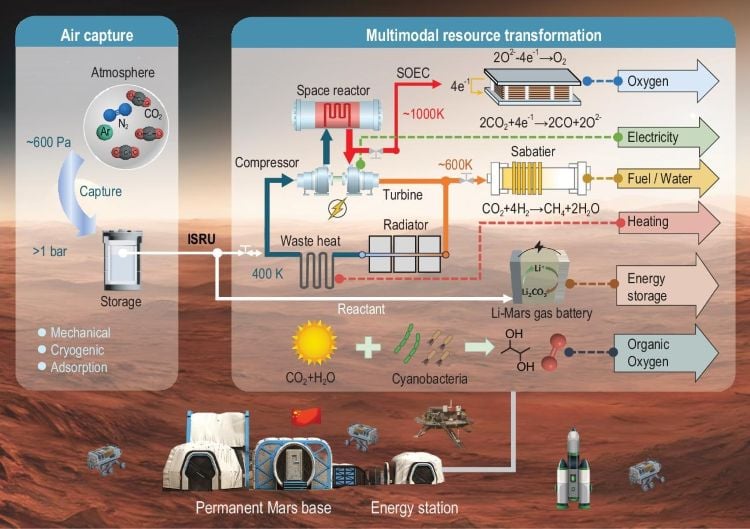
You’re in the lab analyzing Martian regolith samples within your cozy Mars habitat serving on fifth human mission to Mars. The power within the habitat has been flowing flawlessly thanks to the MARS-MES (Mars Atmospheric Resource & Multimodal Energy System), including the general habitat lighting, science lab, sleeping quarters, exercise equipment, the virtual reality headsets the crew use for rest & relaxation, oxygen and fuel generation, and water. All this from converting the Martian atmosphere into workable electricity.
While this scenario might be decades away, scientists on Earth are working hard to make this concept a reality today. This includes a team of scientists from China who propose using a novel concept for converting the thin Martian atmosphere into heat and electricity. Their findings were recently published in National Science Review and could help revolutionize how electricity is produced on Mars through a process called in situ resource utilization (ISRU) without the need for power or power supplies being shipped from Earth.
For the study, the researchers propose several concepts for producing power and electricity on a future human Mars mission, including Martian air capture, in situ power generation and storage, and life support resources transformation. The team notes all these methods carry their own benefits and challenges while emphasizing the importance of using ISRU for powering future human Mars missions.
For the atmospheric air capture, the researchers propose a multimodal concept using the Martian atmosphere, which only has approximately 1 percent of the atmospheric pressure of Earth, more than 95 percent carbon dioxide, and peak temperatures of 20 degrees Celsius (Earth is 57 degrees Celsius). Despite these stark contrasts, the researchers propose capturing the Martian atmosphere and compressing it to make it thicker using a myriad of methods, including mechanical compression, cryogenic trapping, and temperature adsorption. The researchers note that mechanical compression has yet to demonstrate long-term demonstrations, cryogenic trapping is still in the testing phase, and temperature adsorption continues to encounter limited rates and low heat production.
For in situ power generation and storage, the researchers propose using a micro-nuclear reactor to use captured Martian air for power generation and storing the power in lithium-Martian gas batteries, thus providing long-term and stable electricity. For the life support resources transformation, the researchers propose using a Sabatier reactor to convert the pressurized atmosphere and nuclear waste for producing heat, electricity, and methane fuel. For context, a Sabatier reactor serves as the cornerstone of the Environmental Control and Life Support System (ECLSS) onboard the International Space Station (ISS), with the proposed Sabatier reactor in this study being a larger and upgraded version.
The study notes, “The Martian atmosphere, as a central medium for power generation, can integrate independent chemical conversions to realize a power-to-X function. This perspective synthesizes the common characteristic of independent Mars CO2 ISRU, and outlines a vision for the future pathway. The first crewed Mars mission is expected to materialize in the coming decades. However, related ISRU technologies are still in the conceptual experimentation and analysis phase.”
The researchers outline next steps for developing and advancing ISRU technologies and emphasize the importance of using ISRU for future human Mars missions. As noted, ISRU uses local and available resources while significantly reducing the logistical and financial costs of shipping resources from Earth, including water, fuel, food, or electricity. A prime example of ISRU on Mars potentially includes using subsurface water ice for drinking, bathing, fuel, and electrolyzing (using electricity to separate the oxygen and hydrogen) for oxygen. Another example includes using Martian regolith for construction purposes, either through 3D printing or covering the habitat to shield it from harsh solar radiation.
How will in situ power stations help power future human Mars missions in the coming years and decades? Only time will tell, and this is why we science!
As always, keep doing science & keep looking up!