
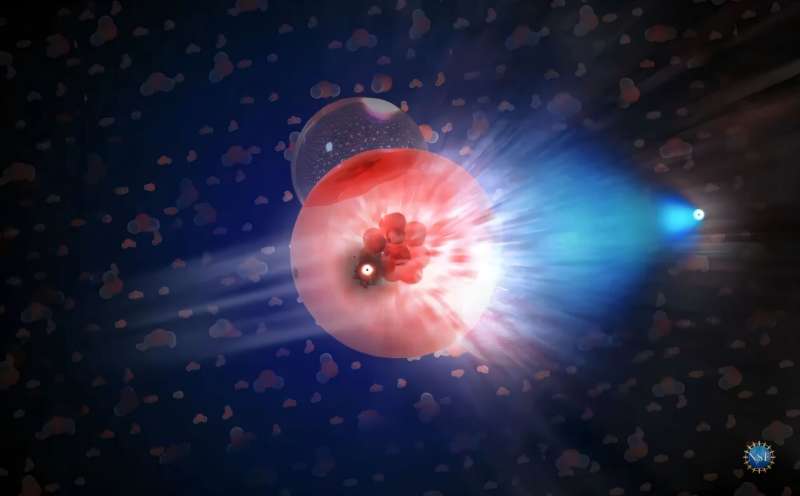
In the exotic world of particle physics, neutrinos are perhaps the most mysterious particles of all. They interact almost never with other matter, have virtually no mass, and carry no electric charge. These characteristics make them very difficult to study. Even detecting them requires special equipment located in deep caves, beneath the thick Antarctic ice, or on the ocean floor.
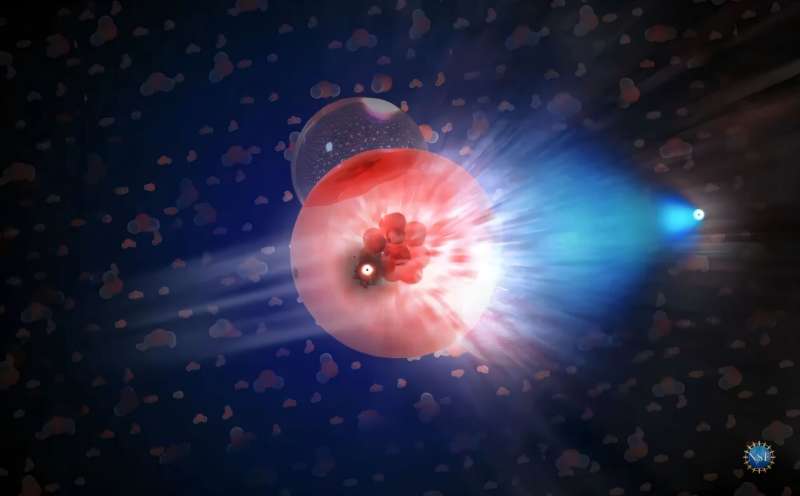 High-energy neutrino. Source: phys.org
Detection of an energetic neutrino
One of the most powerful neutrino detectors is called KM3NeT, which stands for “Cubic Kilometer Neutrino Telescope.” It is located at the bottom of the Mediterranean Sea, and in February 2023, it detected the highest-energy neutrino ever observed. It was designated KM3-230213A, and its energy was estimated to be 220 PeV (220×10¹⁵ electronvolts, or 220 million billion electronvolts). That’s an incredible amount of energy, and ever since it was discovered, physicists have been trying to determine its source.
Neutrinos originate from the high-energy universe. This is a world of catastrophic supernovae, gamma-ray bursts, kilonovae, and other extremely energetic events. Only these events are capable of imparting such high energy to particles. However, tracing the origin of KM3-230213A to one of these events was a complex scientific challenge, let alone determining its source.
Neutrino detectors do not actually detect neutrinos themselves. They detect secondary particles or Cherenkov radiation, which occurs in rare cases when a neutrino interacts with other matter. In the case of KM3-230213A, a muon was detected.
Searching for the source of radiation
After a thorough investigation of this high-energy phenomenon, scientists involved in the KM3NeT project published their findings in the journal Nature. The study is titled “Observation of an ultra-high-energy cosmic neutrino with KM3NeT.” The KM3NeT collaboration is listed as the author.
“The detection of cosmic neutrinos with energies above a teraelectronvolt (TeV) offers a unique exploration into astrophysical phenomena,” the authors write. “Electrically neutral and interacting only by means of the weak interaction, neutrinos are not deflected by magnetic fields and are rarely absorbed by interstellar matter: their direction indicates that their cosmic origin might be from the farthest reaches of the universe.”
High-energy neutrinos have specific sources. They are produced when ultra-relativistic protons or cosmic-ray nuclei interact with matter or photons. According to scientists, by observing neutrinos, they are, in a sense, examining the “signature” of the process itself. Researchers were able to trace the path of a high-energy neutrino back to its source, though not with millimeter-level precision. Their work identified four types of potential sources: galactic, local, transient, and extragalactic.
In their article, the authors point out that the energy in KM3-230213A was much higher than in any other detection to date. There are only a few possible reasons why it might have been so energetic. Either it originated from a different cosmic source than the other, less energetic neutrinos, or it is an example of a cosmogenic neutrino.
Is this a cosmogenic neutrino?
At present, cosmogenic neutrinos remain largely a hypothetical phenomenon, as they have not yet been definitively detected.They are formed when ultra-high-energy cosmic rays—protons or heavier nuclei traveling at speeds close to the speed of light—collide with photons of the cosmic microwave background, the relic radiation left over from the Big Bang. The collision creates a decay chain and a cascade of other particles, including ultra-high-energy neutrinos such as KM3-230213A.
Cosmogenic neutrinos are of interest for several reasons. They can directly point to their sources—active galactic nuclei, gamma-ray bursts, or even galaxy mergers. Since these particles have been forming throughout the history of the universe, they can serve as a kind of probe into its early stages. Moreover, their energies far exceed anything we are capable of producing in particle accelerators, so studying them opens the door to physics beyond the Standard Model. In other words, this is a true scientific breakthrough.
In their article, the scientists explain that this event may have been caused by a cosmogenic neutrino, and this explanation is a viable alternative hypothesis.
No clear conclusion
It all comes down to the extremely high energy of neutrinos. “This suggests that the neutrino may have originated in a different cosmic accelerator than the lower-energy neutrinos, or this may be the first detection of a cosmogenic neutrino, resulting from the interactions of ultra-high-energy cosmic rays with background photons in the universe,” they write.
Our understanding of these high-energy neutrinos will depend on both existing and future neutrino observatories. The KM3NeT project is expanding through the installation of additional detectors. This will not only make it possible to detect neutrinos more effectively, but also to pinpoint their sources in space with greater precision.
According to phys.org