
The gas giants of our Solar System—Jupiter, Saturn, Uranus, and Neptune—have always been a source of inspiration and wonder for scientists. Their colossal size, complex atmospheric storms, and hidden internal dynamics are gradually being revealed to us through images captured by spacecraft. However, beyond our “home,” there are exoplanets that are forcing astronomers to rethink the fundamental principles of planetary science. What can their atmospheres tell us about the birth and evolution of worlds? And do our theoretical models match the reality of conditions deep within the Galaxy?
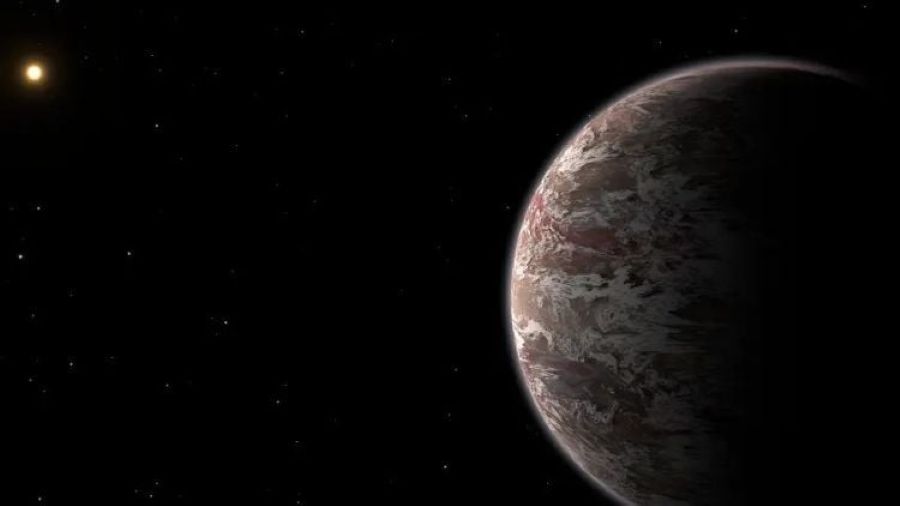
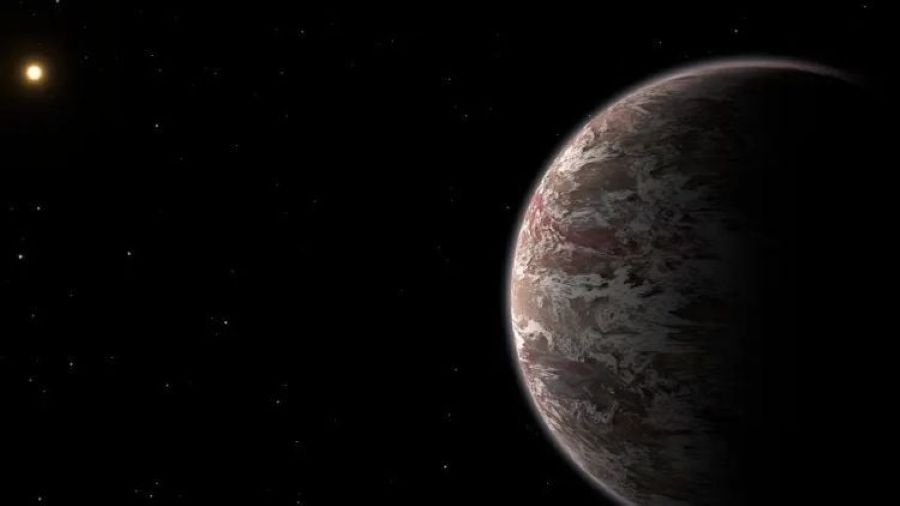 An artist’s impression of the super-Jupiter Eps Ind Ab. Credit: E. K. Matthews, MPIA / T. Müller, HdA
An international team of researchers, using the capabilities of the James Webb Space Telescope (JWST), has made significant progress in filling these gaps. Their focus was on the exoplanet Eps Ind Ab, which belongs to the super-Jupiter class. The findings, published in The Astrophysical Journal Letters, not only surprised the scientific community but also called into question a decade’s worth of work in planetary atmospheric modeling.
A giant neighbor in the early stages
The Epsilon Indi system is relatively close—just 12 light-years from Earth. At its center lies a K-type star (an orange dwarf)—Epsilon Indi A. Orbiting around it, at a distance of about 30 astronomical units (which is comparable to Neptune’s orbit in our solar system), is the massive planet Eps Ind Ab.
It is a true titan: according to new estimates, its mass is 7.6 times that of Jupiter. Although the planet is called “cold,” its temperature is approximately +2°C. This is significantly warmer than Jupiter, where the temperature reaches only -133°C. This difference indicates that Eps Ind Ab is still in the early stages of its formation and is releasing internal heat, which will gradually diminish as it evolves.
Surprises in the infrared spectrum: where is the ammonia?
Previous observations in 2024 had already detected traces of ammonia in the atmosphere of this giant. However, a new study using the JWST at longer infrared wavelengths has revealed a strange anomaly: the planet turned out to be significantly brighter than calculations had predicted, while the amount of ammonia was unexpectedly low.
By comparison, Jupiter is literally saturated with ammonia gas, which forms its characteristic clouds in the upper layers of the atmosphere. So why does its “big brother” in the Epsilon Indi system exhibit a different chemical profile? Scientists have concluded that the excessive brightness is caused not by the composition of the gas, but by the physical structure of the atmosphere—clouds of water ice.
When simplification becomes an obstacle
The detection of water ice in the atmosphere of Eps Ind Ab has posed a serious challenge for theorists. The problem is that older computer models used to simulate exoplanet atmospheres often ignored the presence of clouds. This was done to keep the calculations simple and conserve supercomputer resources.
“It’s a great problem to have, and it speaks to the immense progress we’re making thanks to JWST,” notes James Mang, a co-author of the study from the University of Texas at Austin. Something that was previously considered impossible to capture is now the subject of detailed analysis. This discovery is prompting scientists to rethink the structure of atmospheric models, adding new levels of complexity—such as cloud layers—that critically influence heat exchange and the planet’s apparent brightness.
Astrometry and orbital oddities
In addition to its chemical composition, scientists have determined the physical properties of Eps Ind Ab. In addition to the direct image, in which the star’s light is blocked by the coronagraph, the researchers used astrometry. This method is based on ultra-precise measurements of the slight shifts in a star’s position caused by a planet’s gravitational pull.
This has made it possible to determine that the super-Jupiter’s orbit is quite elongated. Its eccentricity is 0.24 (where 0 represents a perfect circle). By comparison, the orbits of Earth and Jupiter are nearly circular (0.01 and 0.04, respectively). Such a high eccentricity may indicate a turbulent past for the system, in which gravitational interactions with other objects—such as the nearby brown dwarfs Epsilon Indi Ba and Bb—may have altered the planet’s orbit.
The Eps Ind Ab study opens the door to a new era in the study of cold exoplanets. Scientists now need to determine whether the low ammonia levels are a unique feature of this world or a common characteristic of planets of this type.
We previously reported on how astronomers discovered a rare super-Jupiter.
According to universetoday.com