
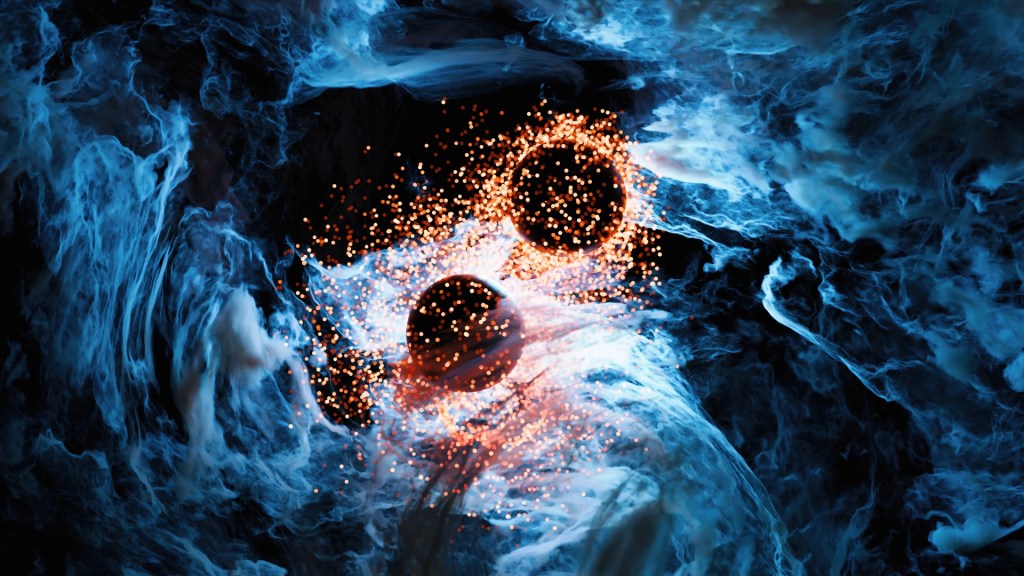
Physicists have successfully simulated false vacuum decay, a quantum process theorized to be capable of ending the universe as we know it. The simulation, conducted by researchers studying quantum field behavior, offers the first experimental analog of a phenomenon that has existed largely in the realm of theoretical cosmology.
What the experiment involved
False vacuum decay describes a scenario rooted in quantum field theory. The vacuum — the lowest-energy state of a quantum field — may not be the true ground state of the universe. If the universe exists in a metastable “false” vacuum, a quantum tunneling event could nucleate a bubble of lower-energy “true” vacuum. That bubble would then expand outward at the speed of light, altering the fundamental constants of physics in its wake. To simulate this process in a controlled setting, researchers engineered an analog system — typically an ultracold atomic gas or a coupled quantum circuit — tuned to reproduce the relevant field dynamics. The geometry of bubble nucleation and subsequent expansion mirrors the mathematical structure predicted by quantum field theory, even if the physical substrate differs from a cosmological vacuum. Quantum tunneling — the mechanism at the heart of this process — allows a system to transition through an energy barrier it would be classically forbidden from crossing. In this context, a localized region of the field spontaneously shifts to a lower energy configuration, seeding the expanding bubble.
Why the simulation matters
Cosmological false vacuum decay is, by definition, impossible to observe directly. No experiment can reproduce the energy scales of the early universe or wait out the timescales over which spontaneous nucleation might occur. Analog simulations allow researchers to test the mathematical predictions of quantum field theory against real physical behavior, providing empirical grounding for models that would otherwise remain purely abstract. The simulation probes questions about vacuum stability that have direct bearing on the Standard Model of particle physics. The measured mass of the Higgs boson — approximately 125 gigaelectronvolts — places the electroweak vacuum in a region of parameter space that some calculations suggest is metastable rather than absolutely stable. Whether that translates to genuine cosmic risk depends on parameters that remain poorly constrained. Analog quantum simulations have become an established tool for probing otherwise inaccessible physics, much as accelerator experiments probe high-energy particle interactions by proxy. The value lies not in recreating cosmological conditions but in testing whether the theoretical framework predicts observable behavior in a controlled analog.
Technical constraints and open questions
The simulation reproduces the field-theoretic structure of vacuum decay but cannot capture the full complexity of a realistic cosmological vacuum. Factors including gravitational backreaction, the precise shape of the Higgs potential at high energies, and quantum corrections beyond leading order all remain outside the scope of current analog platforms. Critically, the probability of spontaneous false vacuum decay in the observable universe — if the vacuum is indeed metastable — is estimated to be extraordinarily small on any human timescale. The simulation does not change that estimate; it tests the mechanics of how such a process would unfold once initiated. Research into quantum field behavior at extreme conditions shares methodological ground with other precision quantum engineering efforts. Work on silicon photonics platforms for advanced chip design reflects the broader push to manipulate quantum systems with greater precision, a capability that increasingly feeds back into fundamental physics experiments.
What comes next
Researchers are working toward analog systems with greater fidelity — larger qubit arrays, lower decoherence, and more tunable interaction geometries — that could probe bubble nucleation rates and expansion dynamics with higher precision. Matching those results to theoretical predictions would tighten constraints on vacuum stability parameters derived from collider data. The deeper question of whether the electroweak vacuum is stable, metastable, or sitting precisely on the boundary between the two remains unresolved, and answering it may require measurements of the Higgs self-coupling at energy scales beyond the current reach of the Large Hadron Collider.